
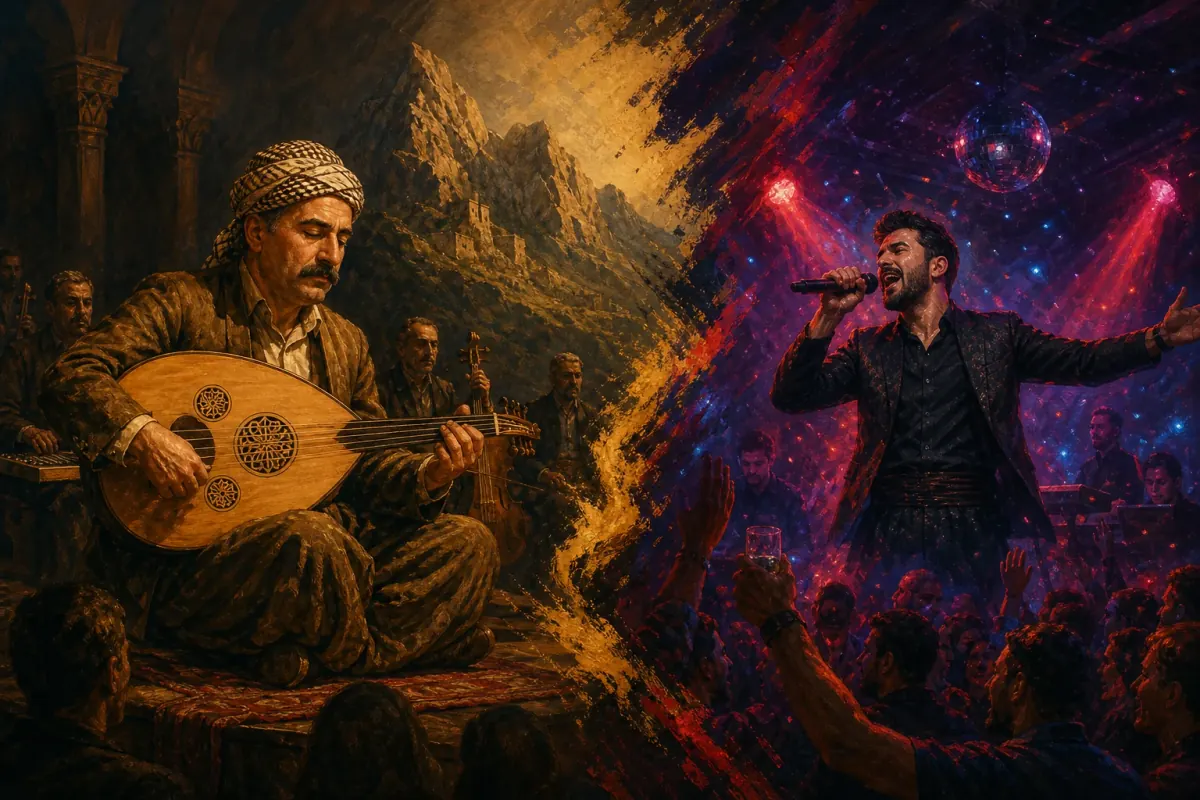
When the word "artist" comes up in the field of music and song, we immediately picture someone holding a musical instrument or a microphone. In one sense this holds true, because in the end art and artistry are attributed to someone who has an artistic talent that others lack, or have to a lesser degree. When you can sing better than anyone among your friends, it means you possess an artistic talent your friends do not. Of course, everyone is knowledgeable in one field and talented in another, and those talents may not be as close to one another as friendships are. What I want to shed light on here, in general terms, is the artistic and cultural dimension of these abilities — especially among musicians and vocalists…
Art is a necessity of life for human beings, just like all our other material and spiritual needs. Whether we want it or not, every day we have dozens of encounters — even more — with every field of art, from our mobile ringtones, which are music, to all the sounds, movements, colors, performances and scenes we come across daily. So when art is, willingly or not, part of the life of every individual in society, it falls to that individual to choose which art to enjoy. In the end everyone enjoys art — but which kind of art has a positive effect on the individual's intellectual and cultural side, and which a negative one?!
When a person is hungry, it is they who decide whether to eat in a clean and healthy place, or in a place with no regard for hygiene at all! In truth, they can be filled in either place — but in which of them is their health better protected?
So we cannot say that what anyone does artistically today is not art. But we can say that there is no proper classification to distinguish works by type, level and purpose — so that when an artistic title is attached to someone's name, that title would immediately tell us what artistic level they are at, rather than gathering every level and ability and every kind of musical work under a single title.
Until the end of the last century, the word "singer" was used only for those who sang a new or folk melody with a band, with one musician or several — whether recorded or performed at celebrations, occasions, and on radio and television programs. The word "singer" was not applied to the talented people who led wedding celebrations and similar occasions (at homes, in neighborhoods, in the countryside, at picnic spots, and so on) by singing bend — verses — and rhythmic songs. They often used no sound system at all, singing their verses in the middle of the reşbelek and helperkê circle dances, and they were called çawîş or şayer. Usually there were two vocalists who took the verses from one another (that is, the second verse-singer began from the last line of the first, and they carried on this way). Most often they were accompanied by two players of folk instruments — tepł and baleban, or dehoł and zurna — who, between the verses, played the main melody of the verses or any suitable tune.
So when we talk about the history of Kurdish music, this form occupies a broad historical space within the art of Kurdish song and music and is an important and large part of it. This style of singing continues to this day, but it has changed with technological progress: electronic instruments have replaced folk instruments, advanced sound systems are used, and celebrations are mostly held in halls dedicated to such occasions. Classifying and distinguishing in this way means that when we talk about one aspect of the art of music, we do not cross into the territory of the others, and we give each its due. Working in this direction, we can tell good, high-quality work apart from poor, low-level work, academic from non-academic work, and so on.
We must understand very clearly that high art is art that not everyone can handle. Before it is art, art is a lofty cultural phenomenon of human life that influences every other sphere of life. When it is said, "There are and will be hundreds of princes, but there is only one Beethoven," it does not mean that no one else made art in the era Beethoven lived in. It means that whoever created lofty, elevated art — it is their name and their works that travel with the course of life and endure. Undoubtedly this is true of the other arts as well…
So it is normal that today everyone who sings or plays music is referred to as an artist — but what kind of artist?! What is not normal is that we marginalize good artistic work, pay it no attention, and raise a generation that listens to everything without distinguishing good work from bad. Our young people are ready to spend hours listening to a voice that, at a single gathering, mixes every kind of word into its songs, yet they are not willing to spend a few minutes listening to a song or a piece of music with a great cultural and intellectual background behind it.
Young people today are fans of a kind of art called danîştin ("sitting"), in which a large group gathers around a vocalist and, without any public occasion, listens to song after song. Often the lyrics express nothing, and the words used show no regard whatsoever for social values. In my view, one of the main reasons our youth have become addicted to this kind of song is the retreat of academic art and the absence of good new work. When good work retreats, poor work undoubtedly takes its place. That is why, amid this retreat, we have not managed to produce nearly as many hunermend as the hunerbend we have turned out…
Translator's note: the Kurdish title, "Hunermend ya Hunerbend", plays on two words. Hunermend (هونەرمەند) is the ordinary Kurdish word for "artist". Hunerbend (هونەربەند) is a play on it built on bend — the sung verses of the wedding singers described above.
Translated from Kurdish. Read the original article in Kurdish.