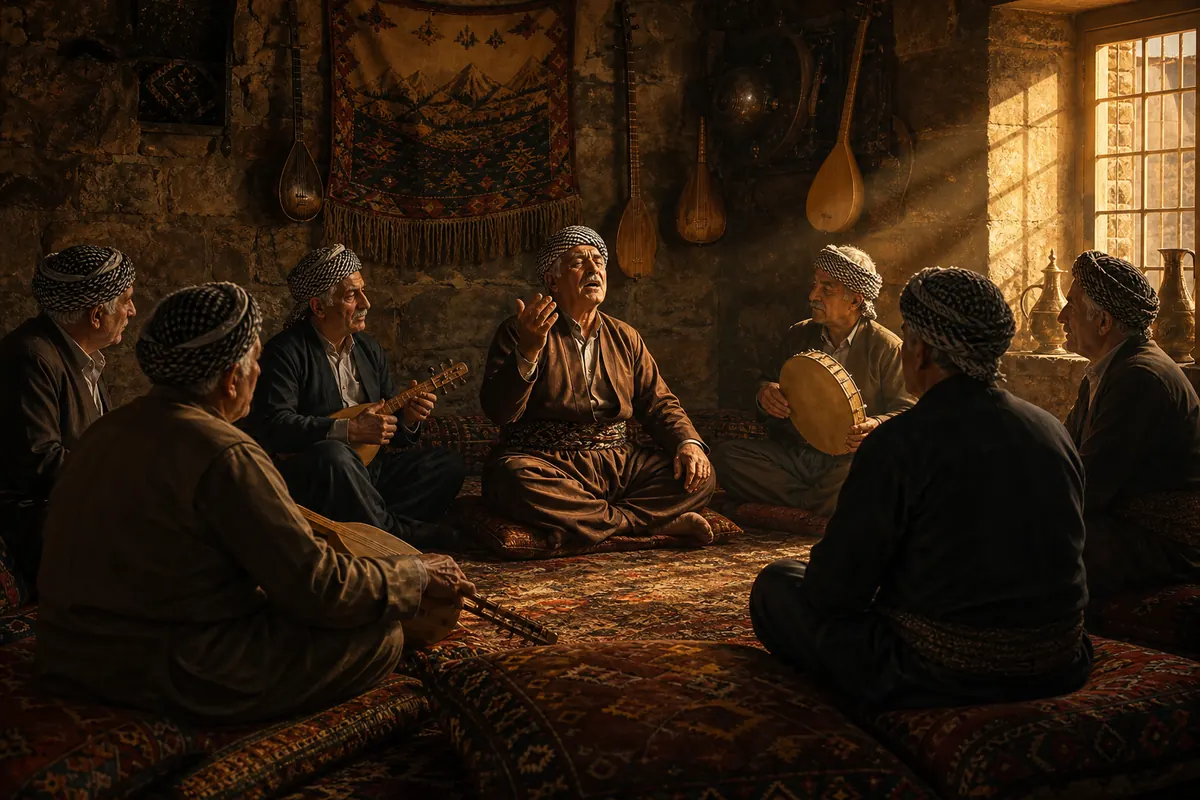
If you want to hear what dengbêj music actually sounds like in 2026, there's a place to go: a renovated traditional Kurdish house in the historic Sur district of Diyarbakır, called Mala Dengbêjan — the House of Dengbêj.
For 19 years, this institution has provided a daily venue for active dengbêj to perform. It's part cultural preservation, part working venue, part tourist attraction, part heart-breaking effort to hold a 1,000-year tradition together as its practitioners age out.
This is a piece about that place, the people in it, and what they're up against.
The history
For background on dengbêj generally, see our main piece on the tradition. The short version: dengbêj are professional Kurdish storyteller-singers who memorize and perform long oral epics in Kurmanji Kurdish. The tradition is centuries old. It nearly died in the 20th century.
The Mala Dengbêjan opened in 2007 as a response to that near-death.
The political context matters: Turkish state restrictions on Kurdish-language music had eased through the 1990s and early 2000s. Diyarbakır had a Kurdish municipal government willing to invest in Kurdish cultural institutions. International cultural-heritage attention was beginning to recognize dengbêj as endangered intangible heritage.
Diyarbakır Metropolitan Municipality bought a historic Kurdish house in the Sur walled city, renovated it sensitively, and dedicated it as a permanent dengbêj venue.
What happens at the Mala Dengbêjan
A typical day:
Morning preparation
Active dengbêj — usually 4-8 men, ranging in age from 50s to 80s — arrive in the late morning. They drink tea, talk, and prepare. There's no formal schedule, no announced setlist.
Daytime performances
Through the afternoon and into evening, dengbêj take turns performing. One sings while others listen, drink tea, and offer occasional vocal responses. Performances range from short songs to extended epic narratives lasting 30+ minutes.
Audiences
Visitors include:
- Local Diyarbakır Kurds (often older men, some women)
- Turkish tourists from other regions
- International tourists (Kurdish music has become a documented tourism interest)
- Researchers and ethnomusicologists
- Diaspora Kurds visiting from Europe
The atmosphere is intimate — people sit on traditional cushioned floor seating, drink tea, and listen quietly. It's not concert-hall formality and it's not chaos.
Recordings
The Municipality has supported systematic recording of Mala Dengbêjan performances since 2007. Many recordings are now public — published as albums, available in archives, increasingly accessible online.
The active dengbêj
The community of active dengbêj at Mala Dengbêjan has shifted over the years as elders pass away and (rarely) new participants emerge. Some figures who have been associated with the institution:
Names worth knowing
- Mehmet Sait Sait (Reso) — one of the most respected post-2000 dengbêj, active until the 2010s
- Şakiro (1936-1996) — predates the Mala Dengbêjan but his recordings are foundational reference for the tradition the institution preserves
- Various Diyarbakır-region dengbêj whose names matter locally; international fame is rare for the genre
The institutional model — naming individuals — is somewhat against the spirit of the tradition, where dengbêj historically worked within communal memory rather than personal celebrity. Mala Dengbêjan navigates this carefully.
What's being preserved
The Mala Dengbêjan has helped preserve:
Performance practice
The actual experience of dengbêj — the social context, the call-and-response between performers, the audience attention pattern, the tea-and-cushions atmosphere. This can't be preserved in audio recordings alone.
Repertoire
Specific songs and epic narratives are being recorded and transcribed. Some material that exists only in the memory of one or two living dengbêj is now archived.
Transmission attempts
The Mala Dengbêjan has hosted workshops trying to introduce younger Kurds to the tradition. Results have been mixed — the social conditions that supported traditional dengbêj training don't return easily.
Community for practitioners
Before the Mala Dengbêjan, individual dengbêj often had no venue and few peers. The institution gives the few remaining practitioners somewhere to belong.
What's being lost despite the effort
Honest assessment: the Mala Dengbêjan is a partial success, not a complete preservation.
Practitioners are aging
The youngest active Mala Dengbêjan dengbêj are in their late 50s. Most are 70+. Each year, more pass away. Without successors, the tradition will end with this generation.
Few new entrants
Becoming a dengbêj historically required:
- Growing up in a Kurdish-speaking village environment
- Memorizing repertoire over decades through repeated exposure
- Apprenticing with a living master
- Finding social context and economic support for ongoing practice
None of these conditions reliably exist for younger Kurds today, even those who care about the tradition.
Repertoire fragmentation
Each dengbêj has slightly different versions of the same songs. As elders die, specific variants are lost. Even with recording, future revival would have to choose specific variants — which means losing others.
Performance context shift
The traditional dengbêj context — village coffeehouse, traveling performer, communal evening — is gone. The institutional context (formal venue, paid audience, scheduled performances) preserves repertoire but not the social fabric that produced it.
Beyond Diyarbakır
Mala Dengbêjan is the most visible institution, but dengbêj-tradition preservation is happening elsewhere:
Other Turkish Kurdish municipalities
Several southeastern Turkish Kurdish-majority cities have developed similar smaller venues — Mardin, Batman, others. Quality and longevity vary.
Yerevan academic archive
Soviet-era recordings at Yerevan Radio and the Armenian Academy of Sciences include extensive Kurdish dengbêj material from the 1940s-80s. Digitization efforts are ongoing. Karapetê Xaço is the most documented historical figure from this archive.
European academic institutions
SOAS (London), Inalco (Paris), Berlin's Institut für Iranistik, various Swedish universities have field-recording archives and ongoing research. Most material isn't fully publicly accessible but academic arrangements exist.
Diaspora cultural centers
Kurdish cultural organizations in Stockholm, Berlin, Frankfurt, and other diaspora cities sometimes host visiting dengbêj. The audiences are mostly diaspora Kurds keeping connection with the tradition.
YouTube and online preservation
Younger Kurdish people have begun systematic YouTube documentation — recording older relatives, finding archival material, creating playlists. This bottom-up preservation is significant even if not centrally coordinated.
What you can do
If you care about dengbêj preservation:
Visit
If you're traveling to Turkey and care about Kurdish culture, visit Mala Dengbêjan. Quiet respectful attendance supports the institution's continued operation. Bring cash for tea/donations.
Listen widely
Listen to recordings not just of the famous figures (Şakiro, Karapetê Xaço) but of less well-known regional dengbêj. The full repertoire matters.
Record your elders
If you have Kurdish-speaking relatives in your family who know songs — even fragments, even half-remembered melodies — record them. Don't wait for institutional preservation; do it yourself.
Support institutions
Mala Dengbêjan and similar venues benefit from continued political and financial support. If you're in a position to support Kurdish cultural institutions financially or politically, do so.
Don't romanticize
The dengbêj tradition is real and beautiful. It's also genuinely dying. Realistic assessment ("we're trying to preserve as much as we can before the practitioners die") is more useful than romantic narratives ("the tradition will live forever in our hearts").
Continue exploring
- What is Dengbêj? — the broader tradition
- Sorani vs Kurmanji Music Traditions — dengbêj's Kurmanji home
- Karapetê Xaço biography — the most important dengbêj preserver historically
- Browse Kurmanji notation — pieces from the broader Kurmanji tradition
If you've visited Mala Dengbêjan or have personal connection with current dengbêj, we'd love to hear from you.