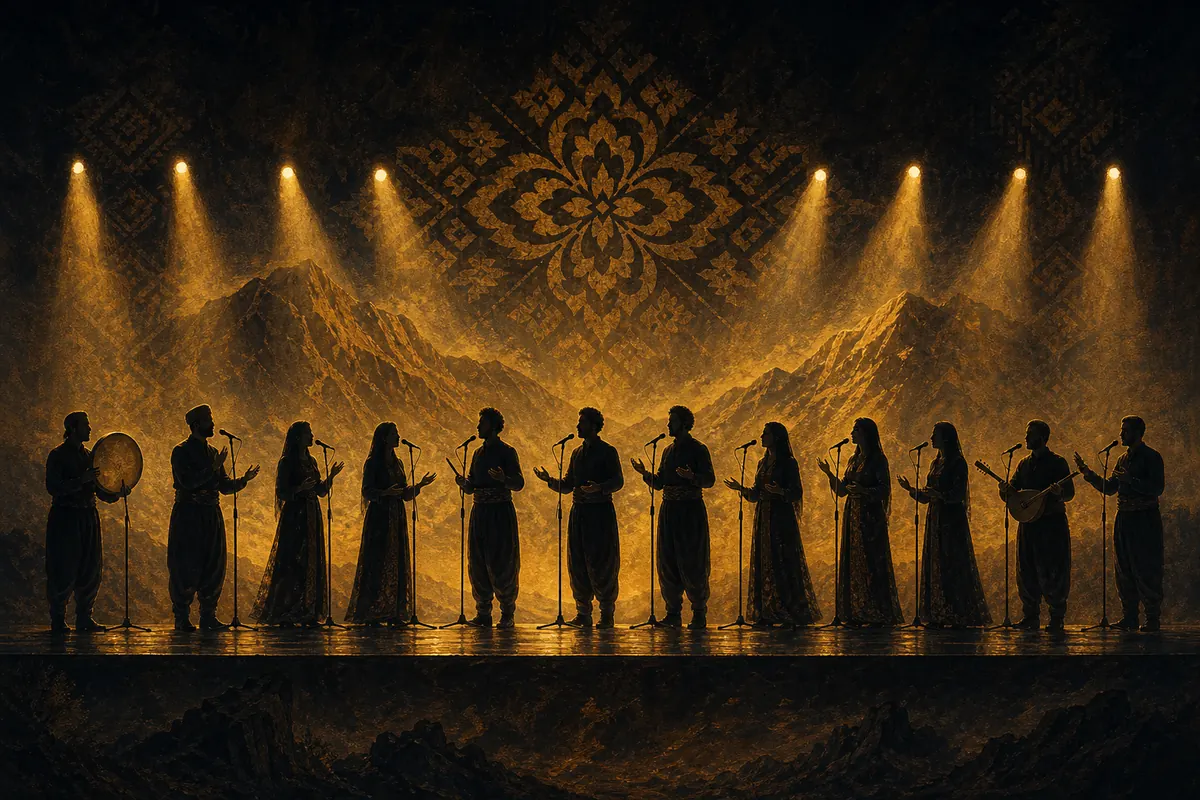
If Kurdish music has survived 100 years of borders, exile, and outright bans, it's because of the singers. Twelve voices in particular shaped what we know today as the Kurdish musical canon — preserving songs that might otherwise have vanished, defying censorship, and carrying their tradition into living rooms from Mahabad to Berlin.
This is a guide to those twelve. Each has a dedicated biography page on KurdNote with notation links to their songs.
The Sorani legacy: voices from Mahabad and Sulaymaniyah
1. Hassan Zirek (1921–1972) — the voice of Sorani folklore
If you only listen to one Sorani singer, make it Hassan Zirek. Born in Mahabad in 1921, he produced over 1,000 recordings — an unmatched body of work that defines the Sorani folk repertoire. His voice carried both the romantic longing of mountain love songs and the political weight of Kurdish nationalism. Most of the Sorani notation in our library traces directly to recordings he made between 1955 and 1970.
→ Read the full Hassan Zirek biography and find his notation
2. Mazhar Khaleqi (1938–2023) — the radif master
Born in Sanandaj, Iranian Kurdistan, Mazhar Khaleqi trained in Iranian classical (radif) tradition and brought that sophistication to Kurdish folk. His refined voice and modal precision made him a reference for everyone who came after. He performed and recorded into his 80s and passed away in 2023.
→ Read the full Mazhar Khaleqi biography
3. Mihemed Mamle (1925–1999) — the political folk voice
Born in Mawat, Iraqi Kurdistan, Mihemed Mamle's recordings voiced Kurdish national aspiration through the second half of the 20th century. He recorded extensively for Iraqi Kurdish radio, and his songs became anthems of the Kurdish liberation movement.
→ Read the full Mihemed Mamle biography
4. Naser Razazi (1948–) — the living legend
One of the most powerful voices still performing today. Razazi's career spans more than five decades, with deep contributions to both folk preservation and contemporary Kurdish pop. His instantly recognizable voice carries the Sorani tradition into the 21st century.
→ Read the full Naser Razazi biography
5. Ali Mardan (1904–1981) — the pioneer
A pioneering Sorani folk vocalist active from the 1930s through the 1970s. His recordings, made on early radio and primitive studio equipment, are some of the oldest surviving documentation of Sorani repertoire.
→ Read the full Ali Mardan biography
6. Tahir Tofiq (1922–1987) — the Sulaymaniyah master
A master of the Sulaymaniyah school of Sorani song. His command of the Iraqi maqam tradition and Kurdish folk modes made him a central figure of Iraqi Kurdish radio in the 1950s and 1960s.
→ Read the full Tahir Tofiq biography
The Kurmanji tradition: dengbêj and modern Northern voices
7. Mihemed Şêxo (1948–1989) — the foundational Kurmanji voice
Born in Qamişlo (Syrian Kurdistan), Şêxo combined the dengbêj oral tradition with contemporary instrumentation. He recorded extensively in Damascus and later in Sweden. His work bridges Northern Kurdish folk and the political music movement that emerged in the 1970s and 80s.
→ Read the full Mihemed Şêxo biography
8. Şivan Perwer (1955–) — the international voice
The most internationally recognized Kurdish singer. Born in Urfa in 1955, Perwer fled Turkey after the 1980 coup and has lived in exile in Germany since. His albums became anthems of Kurdish identity and resistance, and his voice introduced Kurmanji folk to global audiences. He has performed at major venues including the United Nations and European festivals.
→ Read the full Şivan Perwer biography
9. Ayşe Şan (1938–1996) — the foundational female voice
One of the great female voices of Kurmanji folk music. Born in Diyarbakır in 1938, she recorded across Turkey and the Kurdish diaspora until her death in 1996. Her work preserved the women's repertoire of lament and lullaby — songs that might otherwise have been lost as the dengbêj tradition declined. She is celebrated as a foundational figure for Kurdish women in music.
→ Read the full Ayşe Şan biography
10. Aynur Doğan (1975–) — the contemporary global voice
Born in Tunceli in 1975, Aynur draws from the Alevi religious tradition and Kurmanji folk repertoire. Her recordings have been performed at major world music festivals, and her voice introduced a new generation to Kurmanji song. She is arguably the most internationally recognized Kurdish woman singer alive today.
→ Read the full Aynur Doğan biography
11. Karapetê Xaço (1908–2005) — the Armenian-Kurdish preserver
An Armenian-Kurdish singer who became one of the most important preservers of Kurmanji oral tradition. He spent most of his career in Soviet Armenia, where his recordings on Yerevan Radio preserved hundreds of Kurmanji folk songs that would otherwise have been lost. He died in 2005 at age 96.
→ Read the full Karapetê Xaço biography
12. Tara Jaff (1958–) — the boundary-crosser
Tara Jaff is a contemporary Kurdish musician known internationally for blending Kurdish folk with jazz, classical harp, and world music. Born in Sulaymaniyah and based in London since the 1990s, she is a leading interpreter of Kurdish music for global audiences and a pioneer in introducing the harp to the Kurdish musical canon.
→ Read the full Tara Jaff biography
What unites them
These twelve artists span three generations and four countries. What they share:
- Custodianship. Each preserved a body of song that might otherwise have vanished. Hassan Zirek's recordings are now the primary source for Sorani notation; Karapetê Xaço's Yerevan Radio archive holds Kurmanji songs unrecorded anywhere else.
- Risk. Several recorded under threat. Şivan Perwer was forced into exile after Turkey's 1980 coup. Ayşe Şan recorded Kurdish-language music when doing so could end your career. Mihemed Şêxo died in exile.
- Transmission. They taught the next generation. Naser Razazi learned from the recordings of Hassan Zirek; Aynur Doğan listened to Ayşe Şan; today's Kurdish singers in Berlin and Stockholm trace their craft directly to these names.
The artists we don't yet have on KurdNote
The canon is bigger than twelve. Voices we want to add (if you can help, please reach out):
- Mihemed Arif Cizrawî — Kurmanji master from Cizre
- Hozan Dilgeş — political folk voice from Turkey
- Diyar Dersim — Dersim Alevi tradition
- Kemal Atilla — Sorani classical-folk
- Sileman Markesi — Kurmanji classical
- Mahmud Faqiyê Tayran — historical (17th-century) Kurdish poet whose work is sung today
- The dozens of dengbêj — most never recorded, their names lost
Where to start listening
If this list overwhelms you, start here:
- Hassan Zirek — "Arami Giyanim". A gentle ballad, perfect entry point. Notation here.
- Şivan Perwer — "Bana Bana". Energetic, instantly memorable. Notation here.
- Ayşe Şan — search YouTube for "Ayşe Şan Diyarbakır". Listen without trying to understand; let the voice work.
- Aynur Doğan — her album Keçe Kurdan (2004) is the modern starting point.
- Mihemed Şêxo — "Akh li Guli", a classic dengbêj-style lament. Notation here.
Continue exploring
- Browse all Kurdish notation (45 pieces) — sheet music PDFs, MP3 audio
- Kurdish music history pillar — how the tradition survived
- Sorani vs Kurmanji music traditions — the two great rivers explained
- Kurdish music theory: maqamat explained — the modal scales these singers use
KurdNote preserves the work of these artists for the next generation. If you have recordings, biographical material, or transcriptions that should be in the archive, get in touch.