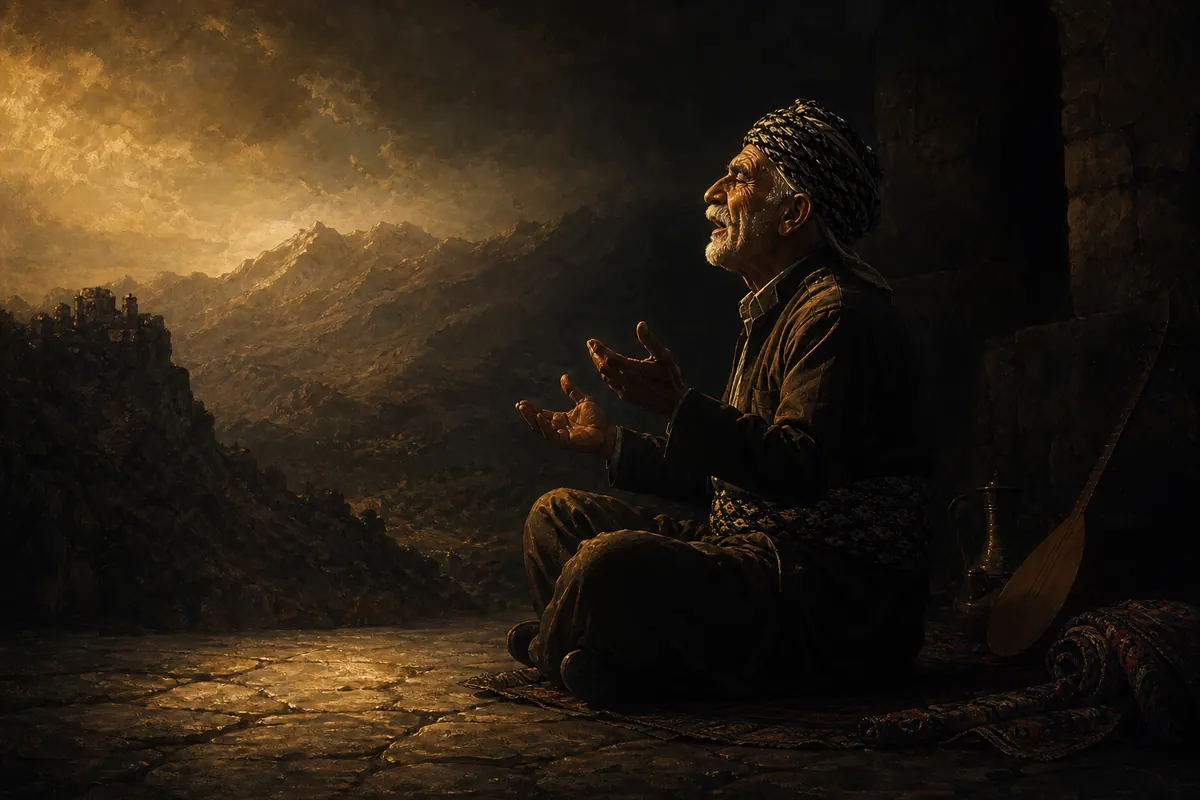
In a Kurdish village a hundred years ago, there was no internet, no books for most people, no recorded music. But there was the dengbêj.
A dengbêj was a singer who had memorized hundreds of songs — long narrative epics, sometimes thousands of lines, performed without instruments, often in a single sitting that could last hours. Through the dengbêj, the village heard about historical battles fought by their ancestors, the genealogies of important families, the love stories that became regional legends, and the dialects of mountain ranges they would never visit.
This is the story of that tradition: what it was, why it nearly disappeared, and what it still is.
What "dengbêj" means
In Kurmanji Kurdish, the word breaks into two parts:
- deng — voice
- bêj — one who says, one who speaks (from the verb "gotin," to say)
So "dengbêj" literally means "voice-keeper" or "one who carries voice." The word reveals the role: a dengbêj isn't primarily a singer in the modern entertainment sense. They are a keeper — someone whose voice carries cultural memory.
The female parallel term is stranbêj (literally "song-keeper"), though dengbêj is sometimes used inclusively.
What does dengbêj music sound like?
If you've heard contemporary Kurdish folk, you'll recognize echoes of dengbêj — but the original form is more austere than what most listeners encounter.
Three defining features:
1. Voice alone (or nearly so)
Classical dengbêj is performed unaccompanied. Sometimes a saz might support, but the voice is the entire instrument. The singer's expressive range — vibrato, ornament, slide, breath — IS the music.
2. Free rhythm
There is often no fixed meter. The singer breathes through the line, lengthening or compressing phrases according to emotional weight. Western listeners sometimes find this hard at first, then suddenly understand.
3. Modal scales (maqamat)
Dengbêj melodies sit in specific Kurdish modes — most often maqam Bayati and maqam Kurd. These give dengbêj its characteristic plaintive, longing quality.
What dengbêj songs are about
Five major themes recur:
Epic narrative (destan)
Long historical or legendary narratives. Some are about specific battles, regional power struggles, or famous love stories like Mem û Zîn (the most famous Kurdish romance). A skilled dengbêj could perform a destan for hours.
Lament (lawik / şîn)
Songs of grief — for the dead, for exile, for lost loves, for an entire homeland. The lament tradition is the emotional core of dengbêj.
Praise and elegy (medih)
Songs honoring an individual — a tribal leader, a brave warrior, a beloved who has died.
Wedding songs (şahî, dîlok)
Less mournful, more celebratory pieces performed at weddings.
Religious / spiritual
In Yarsan and Alevi communities, dengbêj-influenced singing carries religious devotion.
Where dengbêj came from
The tradition is centuries old. It draws from:
- Pre-Islamic Iranian oral epic traditions (the Persian Shahnameh has parallels)
- Mountain culture — isolated communities with strong oral memory practices
- Coffee-house culture in cities like Diyarbakır, where dengbêj performed for paying audiences from the 18th century onwards
- Religious orders — Sufi and Alevi dervishes used singing as devotional practice, influencing secular dengbêj
By the 19th century, dengbêj had become a recognized profession. A famous dengbêj might travel between regions, supported by patrons, performing at weddings, funerals, and gatherings.
How dengbêj almost disappeared
The 20th century was nearly fatal for the tradition. Three pressures:
1. The Turkish Republic's Kurdish policy
After 1923, Kurdish-language public expression was severely restricted in Turkey. Speaking Kurdish in public could result in fines or imprisonment. Performing in Kurdish was effectively impossible. By the 1980 coup, public Kurdish music was banned outright. The dengbêj coffeehouses of Diyarbakır went silent.
2. Anfal and Iraqi Kurdish displacement
The Anfal campaign (1986-89) destroyed thousands of Kurdish villages. With them died oral-tradition holders — elderly singers whose repertoire existed nowhere else.
3. Modernization
TV, radio, recorded music, and migration to cities ended the village social structures that had supported dengbêj for centuries. A young Kurd in 2026 has access to thousands of songs on Spotify; the dengbêj's monopoly on entertainment is over.
By 1990, many people thought dengbêj was dead.
How dengbêj survived
It didn't die — it adapted and migrated.
Yerevan Radio (1940s-1980s)
Soviet Armenia's Yerevan Radio ran a Kurdish-language program that recorded dengbêj systematically. The most important figure: Karapetê Xaço, an Armenian-Kurdish singer who preserved hundreds of Kurmanji songs in those recordings. Without Yerevan Radio, the documentary record would be far smaller.
Diaspora preservation
Kurdish exiles in Sweden, Germany, and Armenia recorded dengbêj-style singers from the 1970s onwards. Mihemed Şêxo, Şivan Perwer, and others continued the tradition in modified forms — often adding instrumentation but keeping the vocal style.
The Diyarbakır Dengbêj House (Mala Dengbêjan)
In 2007, Diyarbakır officials opened a dedicated venue where active dengbêj could perform daily. It's both a tourist attraction and a serious preservation effort. Several recordings have come out of this institution.
Academic interest
Ethnomusicologists at SOAS, Inalco (Paris), and various Turkish universities have begun systematic study of dengbêj only in the last 25 years. Field recordings are now being archived properly.
Famous dengbêj you should know
These names matter. If you're going to listen to one piece of dengbêj, hear something by:
- Şakiro (1936-1996) — perhaps the most respected post-war dengbêj
- Karapetê Xaço (1908-2005) — the Armenian-Kurdish bridge; preserved hundreds of songs. Read his biography
- Reso (Mehmet Sahin) — Diyarbakır master, active until the 2010s
- Salihê Qubînî — Kurmanji classical dengbêj
- Mihemed Arifê Cizrawî — Cizre tradition, hugely influential
Beyond these, there are hundreds whose names are remembered locally but never recorded.
How dengbêj is different from modern Kurdish music
Modern Kurdish folk often uses dengbêj-style elements — long melismas, modal scales, lament themes — but is different in important ways:
| Dengbêj (classical) | Modern Kurdish folk |
|---|---|
| Voice alone | Voice + instruments (saz, oud, etc.) |
| Free rhythm | Fixed meter |
| Long narratives | Verse-chorus structure |
| 20+ minutes per piece | 3-5 minutes per piece |
| Memorized repertoire | Composed pieces |
| Solo performer | Often with band |
Şivan Perwer and Mihemed Şêxo are dengbêj-influenced but not pure dengbêj. They use the vocabulary of the tradition while adapting it for radio and concert audiences.
How to start listening
- Start with Şakiro on YouTube — search "Şakiro dengbêj." You'll need patience; the pieces are long.
- Listen to Karapetê Xaço's Yerevan recordings — many are on YouTube. The audio quality is rough; the music is invaluable.
- Visit Diyarbakır's Dengbêj House if you ever travel to Turkey. Recordings of contemporary practitioners exist online too.
- Read the lyrics in translation if you don't speak Kurmanji. The poetic depth often surprises.
Why dengbêj matters today
Beyond its artistic value, dengbêj matters because of what it represents: a culture that survived without written form. Every Kurdish folk song that exists today is downstream of an oral tradition that, at one point, depended on a single elderly singer's memory.
When that singer died, songs disappeared.
The push to record, transcribe, and preserve isn't nostalgia — it's an emergency response to ongoing loss. KurdNote's notation library of 19 Kurmanji pieces is a small contribution to that work. Most of the dengbêj canon remains unwritten, with most surviving practitioners over 70 years old.
Continue exploring
- Sorani vs Kurmanji: Two Great Traditions — how dengbêj fits in the broader Kurdish musical landscape
- The History of Kurdish Music Notation — preservation history
- Browse Kurmanji notation — 19 free PDF transcriptions
- Karapetê Xaço biography — the most important dengbêj preserver
If you have field recordings of dengbêj, contacts with active practitioners, or transcriptions we should publish, please get in touch. This is preservation work, and it benefits from every contribution.