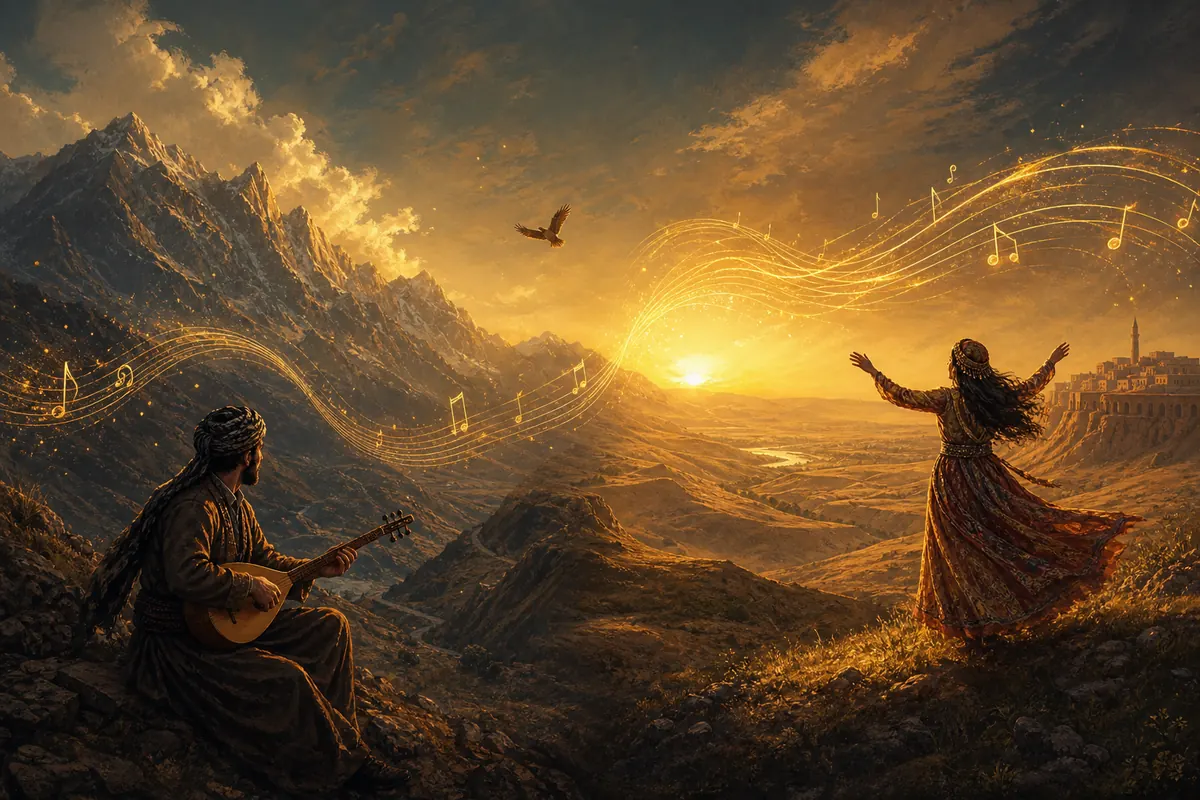
Kurdish music isn't one tradition — it's two great rivers that share a source. The Sorani (Central Kurdish) tradition flows through Iraqi Kurdistan and parts of Iran. The Kurmanji (Northern Kurdish) tradition is the music of Turkish Kurdistan, Syrian Kurdistan, and Armenian Kurdistan. They share a heart but speak with different voices.
If you've ever wondered why a song from Sulaymaniyah sounds different from a song from Diyarbakır, this guide is for you.
The dialects, in 30 seconds
Sorani and Kurmanji are two dialects of Kurdish, separated by political borders, mountain ranges, and centuries of independent evolution. They share roughly 60–70% vocabulary but differ in grammar, pronunciation, and writing system:
- Sorani uses a modified Arabic script (with extra letters: ڕ ڵ ۆ ێ).
- Kurmanji uses the Latin alphabet (Hawar) since the early 20th century, though it was historically also written in Arabic script.
Music follows these linguistic and geographical fault lines.
The Kurmanji tradition: the dengbêj heritage
Northern Kurdish music is dominated by the dengbêj — storyteller-singers who carry epic narratives in their memory and voice. The dengbêj sings unaccompanied or with minimal instrumental support, often improvising over a fixed melody.
Characteristic features:
- Vocal-led, often a cappella or with one supporting instrument
- Long melismatic phrases — many notes per syllable
- Free rhythm in many pieces; the singer drives the timing
- Heavy use of maqam Bayati and maqam Kurd
- Themes of exile, lost love, mountain life, and historical battles
Major Kurmanji artists to know:
- Şivan Perwer (the political voice of Kurdish folk in the diaspora)
- Mihemed Şêxo (master of the dengbêj tradition)
- Ayşe Şan (one of the great female voices)
- Karapetê Xaço (Armenian-Kurdish, a bridge tradition)
You'll find their songs and others in our Kurmanji notation collection.
The Sorani tradition: maqam, instruments, and urban sophistication
Sorani Kurdish music developed in the urban centers of Sulaymaniyah, Erbil, Sanandaj, and Mahabad. It absorbed influences from Iranian classical music (the radif tradition), Iraqi maqam, and Ottoman court music.
Characteristic features:
- Instrumentally rich — oud, kamancheh, tanbur, santur, daf, and qanun
- Modal sophistication — frequent maqam modulations within a single piece
- Fixed rhythmic cycles — 6/8 and complex meters like 7/8, 10/8
- Heavy use of maqam Hijaz, maqam Saba, and maqam Hicaz Kar
- Themes of love, nature, philosophical reflection, and patriotic celebration
Major Sorani artists to know:
- Hassan Zirek (the voice of Sorani folk — unmatched repertoire)
- Mazhar Khaleqi (refined classical-folk fusion)
- Mihemed Mamle (politically charged Iraqi-Kurdish folk)
- Tahir Tofiq (master of the maqam tradition)
- Naser Razazi (Iranian-Kurdish powerhouse)
Their works dominate our Sorani notation collection.
What they share
Both traditions share:
- Quarter tones — both use microtonal inflections, especially in modal music
- Modal scales — though specific maqamat favored differ, the modal framework is identical
- Vocal centrality — even instrumental pieces emulate vocal lines
- Heroic and tragic themes — songs about Kurdish national identity, lost lovers, the mountains
- Wedding (govend/dawat) and lament traditions
- A modal flexibility Western ears need time to learn
Where the borders blur
Modern Kurdish music erases these borders. A Sorani singer covers a Kurmanji classic. A Kurmanji band uses Sorani instrumentation. Diaspora artists in Berlin, Stockholm, and Toronto blend both with rock, jazz, and electronic music.
This is healthy — Kurdish music is alive, not a museum piece. But for the historical record, KurdNote separates the traditions when transcribing so listeners and researchers can hear them clearly.
Which tradition should you start with?
If you have a Western harmonic background, start with Sorani. The maqam modulations and instrumental textures are richer and more familiar to ears that grew up on jazz or classical music.
If you're drawn to vocal music and lyrical storytelling, start with Kurmanji. The dengbêj tradition is one of the great oral epics of world music, comparable to Albanian iso-polyphony or Tuvan throat singing in cultural depth.
Or do what most Kurds do: don't choose. Listen to both. Play both. They're cousins, not rivals.
A starter playlist (with notation)
If you want to dive in, here are six pieces — three Sorani, three Kurmanji — that introduce the breadth of the tradition:
Sorani:
- "Arami Giyanim" — gentle, ballad-style, maqam Bayati. → Notation
- "Baran Barana" — celebratory, dance-driven. → Notation
- "Ashna" — a deep-throated love song. → Notation
Kurmanji:
- "Akh li Guli" — a classic dengbêj lament. → Notation
- "Bana Bana" — bright, melodic, often heard at weddings. → Notation
- "Akhawo" — an oral-tradition piece passed through Kurmanji singers for generations. → Notation
Further reading
- How to Read Kurdish Music Notation — A Complete Guide
- Browse all Sorani notation (26 pieces)
- Browse all Kurmanji notation (19 pieces)
- Browse our Kurdish music books library
KurdNote preserves both traditions equally. If you have transcriptions from regions we don't cover yet — Faili, Hawrami, Zazaki — please get in touch.