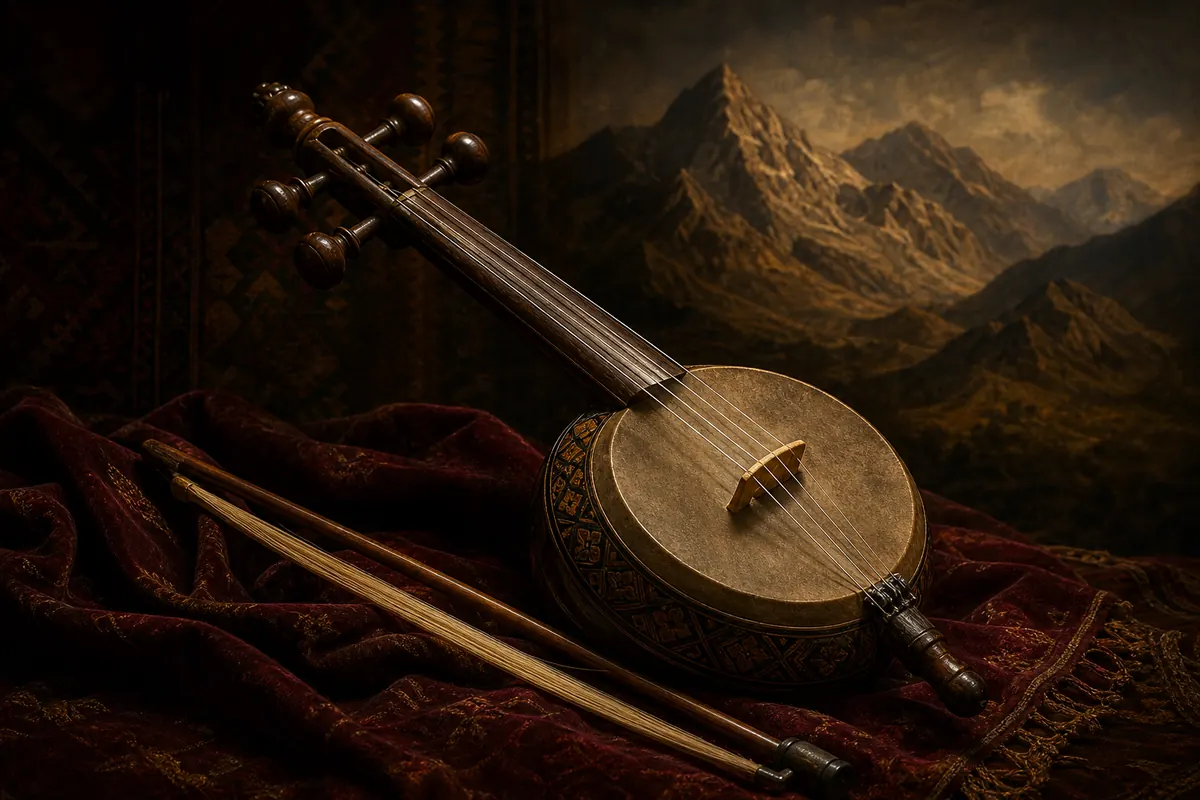
If Kurdish music has a single instrument that captures its emotional range — the loneliness of mountain nights, the swell of a love song, the cry of a lament — it's the kamancheh.
A small spiked fiddle, played upright on the knee, four strings, no frets. The instrument looks impossibly modest for the sound it produces. Skilled kamancheh players make it cry, sing, and whisper — sometimes all in the same phrase.
This is a guide to the kamancheh in Kurdish music — what it is, how it works, who plays it, and how to start learning.
What is a kamancheh?
A kamancheh is a bowed string instrument with these defining features:
- A small spherical body — typically wooden, sometimes carved from a single block of mulberry or walnut
- A long thin neck with no frets
- Four strings (sometimes three on older instruments) tuned in fifths
- A spike at the bottom that rests on the player's knee or thigh
- A bow strung with horsehair, similar to but smaller than a violin bow
The body is usually covered with a thin membrane (lambskin or fish skin traditionally) that vibrates with the strings — giving the kamancheh its characteristic warm, slightly nasal tone.
It's classified as a spiked fiddle in organology — a category that includes related instruments across Central Asia (the gijak in Uzbekistan, the kamancha in Azerbaijan, etc.).
How it sounds
Three characteristics define the kamancheh sound:
1. Vocal qualities
The kamancheh's tone is closer to the human voice than to a violin. The skin-covered body and the small resonance chamber produce a sound that sustains, breathes, and bends the way a singer does. In Kurdish folk music, the kamancheh often takes the role of "second voice" alongside the singer.
2. Microtonal capability
With no frets, the player can produce ANY pitch between standard chromatic notes. This is essential for the quarter-tone inflections of Kurdish maqam music — the half-flats and half-sharps that give Bayati, Saba, and Hijaz their characteristic flavors.
3. Expressive vibrato
Kamancheh players can produce extremely fast, narrow vibrato or slow, wide vibrato — and shift between them within a single phrase. The vibrato vocabulary is part of what distinguishes a beginner from a master player.
Where the kamancheh fits in Kurdish music
The kamancheh has central roles in:
Sorani classical-folk ensembles
The classic Sorani urban-folk ensemble — common in Mahabad, Sanandaj, and Sulaymaniyah — features kamancheh alongside oud, santur, tonbak, and voice. The kamancheh provides the lyrical vocal-like line.
Solo classical performance
Kamancheh is a primary instrument for solo classical Kurdish music — extended improvisations (taqasim) exploring a single maqam. The instrument can sustain a 10-minute solo improvisation that holds the listener entirely.
Lament accompaniment
For slower, mournful pieces, the kamancheh is uniquely suited. Its vocal qualities let it shadow the singer's grief without overwhelming it.
Cross-genre use
Modern Kurdish musicians use kamancheh in fusion contexts — with jazz, world music, classical Western chamber ensembles. The instrument adapts well to non-traditional contexts.
Famous Kurdish kamancheh players
The Kurdish kamancheh tradition has notable figures:
- Iranian Kurdish kamancheh school — Sanandaj produces some of the finest players, working in both Kurdish folk and Iranian classical
- Iraqi Kurdish players — Kurdistan Institute of Fine Arts (Sulaymaniyah) trains kamancheh players within Sorani folk tradition
- Diaspora performers — Several Kurdish-Iranian kamancheh players based in Europe and North America perform internationally
The kamancheh is also central to Iranian classical music broadly, so much of the technique transmission happens within the wider Persian-Kurdish kamancheh world.
Famous (non-Kurdish) kamancheh players worth knowing
For context, the broader kamancheh world includes:
- Kayhan Kalhor (Iranian) — probably the most internationally known kamancheh player; collaborates with Yo-Yo Ma, plays at major world music festivals
- Habil Aliyev (Azerbaijani) — kamancha (Azerbaijani spelling) master
- Ali Akbar Shekarchi (Iranian) — classical kamancheh master
If you want to understand the instrument's expressive potential, listen to Kayhan Kalhor's solo work.
How it's played
Playing position
Kamancheh is played seated with the spike resting on the player's left knee. The instrument is held upright (perpendicular to the floor), and the player rotates the instrument to reach different strings rather than moving the bow across them as a violinist does.
This rotation-based playing style is one of the harder elements for beginners coming from violin — the right arm position is fundamentally different.
Bowing
The bow is held in a relaxed grip (less stiff than classical violin bow holds). Bow speed and pressure produce the dynamic range. Skilled players can sustain a single bow stroke for surprisingly long phrases.
Left-hand technique
With no frets, intonation depends entirely on muscle memory and ear. Kurdish modal music requires the player to know exactly where the half-flats and half-sharps fall — different in different maqamat. This is a 6-month-to-1-year skill development.
Ornamentation
Kamancheh ornaments include:
- Trills between adjacent notes
- Slides (glissando) between distant notes
- Vibrato of varying speeds
- Mordents (rapid alternation around a central note)
- Drone bowing on a sympathetic open string while melody is on another
How to start learning
Realistic learning path:
Year 1
- Find a teacher (in person or online)
- Learn proper hold, bow grip, basic intonation
- Master the major Kurdish maqamat (Bayati, Hijaz, Kurd) at slow tempo
- Practice 30+ minutes daily
Year 2
- Begin ornaments — trills, slides, vibrato
- Learn 5-10 traditional Kurdish folk pieces
- Begin improvisation in single maqam
- Recommend joining a small ensemble
Year 3-5
- Develop personal style
- Learn the more complex maqamat (Saba, Hicaz Kar)
- Develop sustained taqasim (solo improvisation)
- Start performing publicly
Realistic for intelligent committed adult: ~2 years to be enjoyable to listen to, ~5 years to be a competent ensemble member.
Resources for learning
KurdNote has Learning Kamancheh (فێربوونی کەمانچە) — a Kurdish-language tutorial book in our library. It's one of the few comprehensive Kurdish-language kamancheh resources.
Other resources:
- Iranian classical kamancheh schools online — many offer remote lessons in Persian or English
- YouTube tutorials — quality varies but Kayhan Kalhor and others have shared technique demonstrations
- Sanandaj-based teachers — for those who can travel to Iranian Kurdistan, the strongest pedagogical tradition
Where to buy a kamancheh
Quality matters. A bad kamancheh is unplayable; a good one will last decades.
Beginner instruments ($300-700): Available from Persian music specialty retailers online. Look for hand-built instruments, not factory mass-produced.
Intermediate ($800-2,000): Custom from luthiers in Tehran, Sanandaj, or Iraqi Kurdistan.
Professional ($2,000+): Made-to-order from established luthiers. Wait time can be months to a year.
If you're starting out, get a beginner instrument from a reputable specialty retailer rather than gambling on Amazon or eBay. The cheaper end of online listings is often unplayable.
Why kamancheh matters for Kurdish music preservation
The kamancheh is an instrument that takes serious commitment to learn. As Kurdish musical education has been disrupted by displacement, urbanization, and political pressure, the number of skilled kamancheh players has declined.
Some context:
- Iranian Kurdish kamancheh tradition is currently the strongest, with active conservatories
- Iraqi Kurdish tradition is rebuilding after the Anfal disruption
- Turkish Kurdish kamancheh is rare due to a different regional musical tradition (saz-dominated)
- Diaspora kamancheh depends on individual teachers and is not institutionally supported
If you're a young Kurdish person considering an instrument: kamancheh is a high-value choice. Skilled players are in demand, the repertoire is deep, and you'd be contributing to keeping the tradition alive.
Continue exploring
- Kurdish Musical Instruments Guide — full instrument family overview
- Kurdish Music Theory — Maqamat — the modal system you'll be playing
- Learning Kamancheh book — Kurdish-language tutorial
- Browse Kurdish notation — pieces to play once you can
If you're a kamancheh player, teacher, or luthier we should know about, get in touch.