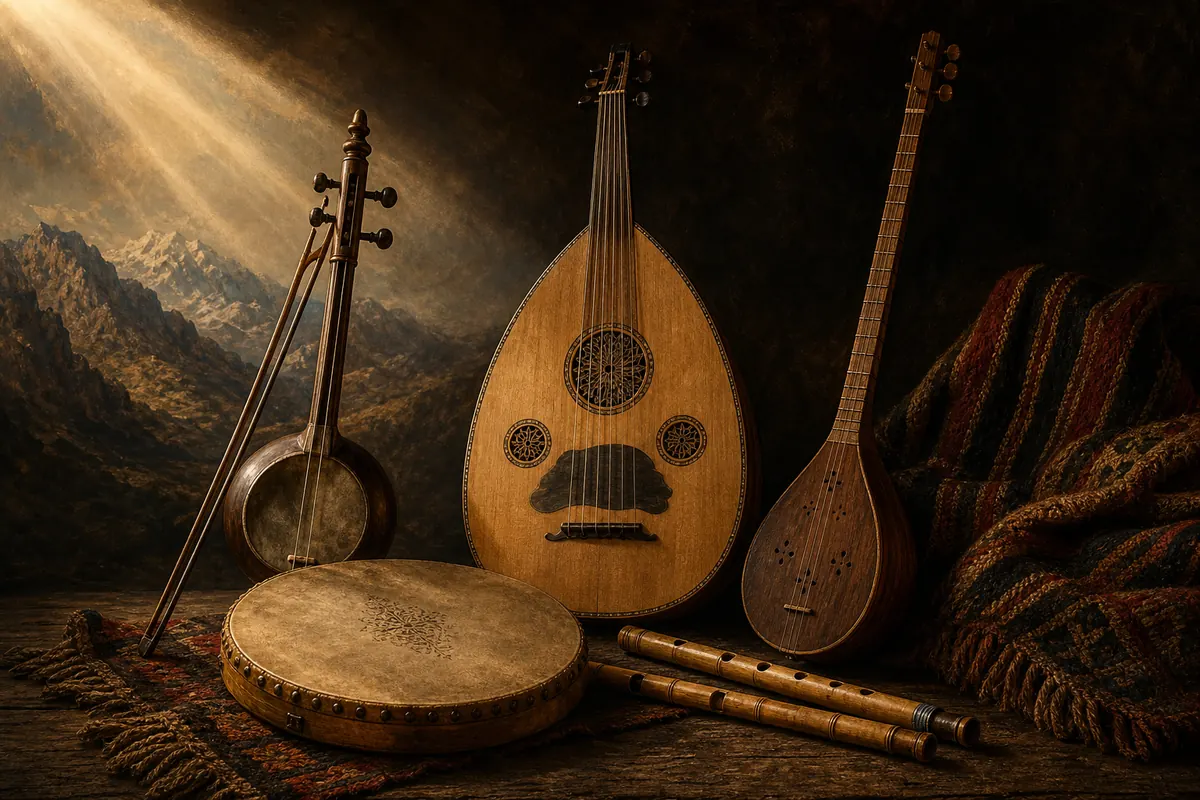
Kurdish music is unimaginable without its instruments. The kamancheh that cries in the high mountain laments. The oud that improvises through long maqam preludes. The daf whose rhythm drives every wedding. The tanbur that carries Yarsan religious devotion.
This is a complete guide to the instruments that built Kurdish music — what they are, how they sound, and where to start listening or playing.
The string instruments
Oud (عوود / ud)
The oud is the king of the Kurdish string instruments. A short-necked, fretless lute with 11 strings (5 doubled courses + 1 single bass), it produces a deep, resonant sound that anchors classical-folk ensembles.
Where it shines: Sorani classical-folk repertoire (especially from Sulaymaniyah and Mahabad), love songs, instrumental preludes (taqasim), and the long modulating maqam improvisations that open many Kurdish concerts.
Famous Kurdish oud players: the Iraqi Kurdish player Hama Jaza, and many of the singers in our artist library accompany themselves on oud or work closely with oud players.
Want to learn? KurdNote has two Kurdish-language oud tutorial books: Fundamentals of Oud Learning Level 1 and Level 2. There's also a deeper history book, The Oud in the History of the East.
Kamancheh (کەمانچە)
A bowed string instrument with a small spherical body, played upright on the player's knee. It looks impossibly small for the sound it produces — piercing, vocal, capable of mimicking the human voice in lament passages.
Where it shines: Kurdish classical music, mournful slow songs, the introductory free-rhythm sections (âvâz) that open many pieces.
Iranian influence: The kamancheh is shared with Iranian and Azerbaijani classical traditions; Kurdish kamancheh players draw from but distinguish their playing through Kurdish modal (maqam) preferences.
Want to learn? KurdNote has Learning Kamancheh — a comprehensive Kurdish-language tutorial book.
Tanbur (تەمبوور)
A long-necked lute with two or three strings, played mostly with fingerpicking. The Kurdish tanbur is a SACRED instrument in the Yarsan (Ahl-e Haqq) religious tradition — playing it is itself a form of worship in Yarsan ceremonies.
Where it shines: Yarsan religious music, devotional pieces, mountain folk repertoire from Kermanshah province.
Differs from Turkish tanbur: the Turkish tanbur is a much larger instrument used in classical Ottoman music. Different family, despite the shared name.
Saz / Bağlama (سازە / باغلامە)
A long-necked lute that lives at the intersection of Turkish, Kurdish, Armenian, and Iranian traditions. Bağlama is the formal Turkish name; "saz" is colloquial across the region.
Where it shines in Kurdish music: the Kurmanji singer-songwriter tradition, especially in Turkish Kurdistan. Şivan Perwer has played saz throughout his career.
Santur (سەنتوور)
A trapezoidal hammered dulcimer with 72 strings. Played by striking the strings with two small wooden mallets. The sound is bright, percussive, and sustains beautifully.
Where it shines: Sorani classical-folk ensembles, especially in Iranian Kurdish (Mahabad, Sanandaj) repertoire.
Iranian root: the santur is more central to Iranian classical music; Kurdish musicians adopted it especially in Iranian Kurdistan.
Qanun (قانوون)
A trapezoidal plucked zither with up to 78 strings, played with finger-picks. Less common in Kurdish music than in Arab classical, but appears in some Sorani urban-folk ensembles.
The wind instruments
Ney / Bilûr (نەی / بلوور)
An end-blown reed flute, breathy and expressive. The Kurdish ney is closely related to the Persian ney and the Turkish ney but has its own folk identity.
Bilûr is the Kurmanji word for the same family of flutes — often the simpler, shorter shepherd's flute version, particularly in Northern Kurdistan.
Where it shines: Slow, contemplative pieces; pastoral and shepherd songs; sufi-influenced music.
Zurna (زورنا)
A loud, double-reed shawm — think of it as the conical-bore relative of an oboe but considerably louder. Designed to be heard outdoors, often paired with the davul drum.
Where it shines: Wedding processions, govend and halay dances, outdoor celebrations. The zurna-davul pair is the soundtrack of Kurdish weddings across all dialects.
Duduk / Balaban / Mey (مەی / بالابان)
A double-reed pipe with a softer, more melancholy sound than the zurna. Closely related to the Armenian duduk. The Kurdish form is sometimes called mey (in Turkish Kurdistan) or balaban (in Iranian Kurdistan).
Where it shines: Sad ballads, slow folk pieces, lyrical preludes.
The percussion
Daf (دەف)
A large frame drum with metal rings inside the rim, producing both a deep drum sound and a metallic shimmer when shaken. The daf is sacred in Sufi and Yarsan traditions, but appears across all Kurdish music as a primary rhythm instrument.
Where it shines: Spiritual ceremonies, wedding music, almost any ensemble piece needing rhythm.
Davul / Dahol (دەهۆل / داڤول)
A large double-headed drum, played with two sticks of different sizes — one heavy stick on the deep bass head, one thin switch on the high snare side. Loud, outdoor instrument.
Where it shines: With the zurna, drives wedding and harvest celebrations.
Tonbak / Zarb (تنبک)
A goblet-shaped hand drum, fingertip-played, allows extremely complex rhythmic patterns. Iranian in origin but central to Sorani classical-folk ensembles.
Where it shines: Indoor classical-folk ensembles, especially with santur and kamancheh.
How they fit together: typical Kurdish ensembles
The classical Sorani ensemble (urban, indoor)
- Oud + kamancheh + santur + tonbak + voice
- Used in formal concerts, classical-folk recordings, recordings by Hassan Zirek, Mazhar Khaleqi, and Tahir Tofiq
The Kurmanji folk ensemble (rural, intimate)
- Saz OR voice alone (for dengbêj) OR voice + tanbur
- Often unaccompanied — the dengbêj tradition is voice-first
- See Şivan Perwer for the modern saz-led version
The wedding ensemble (outdoor, loud)
- Zurna + davul at minimum
- Sometimes augmented with daf and singer
- Drives the govend (Kurmanji) or halay (broader Anatolian) circle dances
The Yarsan religious ensemble (sacred)
- Tanbur + daf + voice
- Specifically the long-necked Kurdish tanbur (not the Turkish kind)
Where Kurdish instruments came from
The Kurdish instrument family didn't appear in isolation. It's part of a continuous instrumental tradition stretching across the broader region:
- From Mesopotamia: ancestor instruments of the oud (chartar) date to ancient Akkad and Sumeria, ~3000+ years old.
- From Persian classical: kamancheh, santur, tonbak — Kurdish musicians adopted and made their own.
- From Anatolia: saz, davul, zurna — the broader Turkic-Kurdish-Armenian musical zone.
- From the Arab world: the modern oud arrived through the Caliphate; Kurdish urban traditions absorbed it from Iraqi sources.
- Indigenous to Kurdish regions: the long-necked tanbur and certain folk flute (bilûr) variants have deep Kurdish-specific lineage.
The result is an instrumental palette that's cousin to Persian, Arab, and Turkish music but distinctly Kurdish in how it's used — which scales (maqamat), which ornaments, which rhythmic patterns, and which combinations.
Where to learn each instrument
| Instrument | Difficulty | Best resource |
|---|---|---|
| Daf | Beginner-friendly | YouTube tutorials abundant |
| Saz | Moderate | Saz schools in Istanbul, Berlin, Stockholm |
| Oud | Moderate-advanced | KurdNote's Oud Level 1 and Level 2 books |
| Kamancheh | Advanced (bowed) | KurdNote's Learning Kamancheh book |
| Tanbur | Spiritual + technical | Yarsan teachers in Kermanshah, online communities |
| Santur | Advanced | Iranian classical schools; YouTube |
| Ney | Difficult (breath control) | Sufi music traditions, online courses |
Where to find Kurdish instrumental music to study
- Notation: Browse Kurdish notation by piece — many include instrumental introductions you can isolate
- Books: Kurdish music books library — including dedicated tutorials for kamancheh and oud
- Theory: Kurdish music theory: maqamat — the modal scales these instruments operate within
Continue exploring
- 12 Famous Kurdish Singers — the voices these instruments accompany
- The History of Kurdish Music Notation — how this tradition was preserved
- How to Read Kurdish Music Notation — beginner's guide
Have a Kurdish instrument we missed, or want to contribute a tutorial book? Get in touch.