
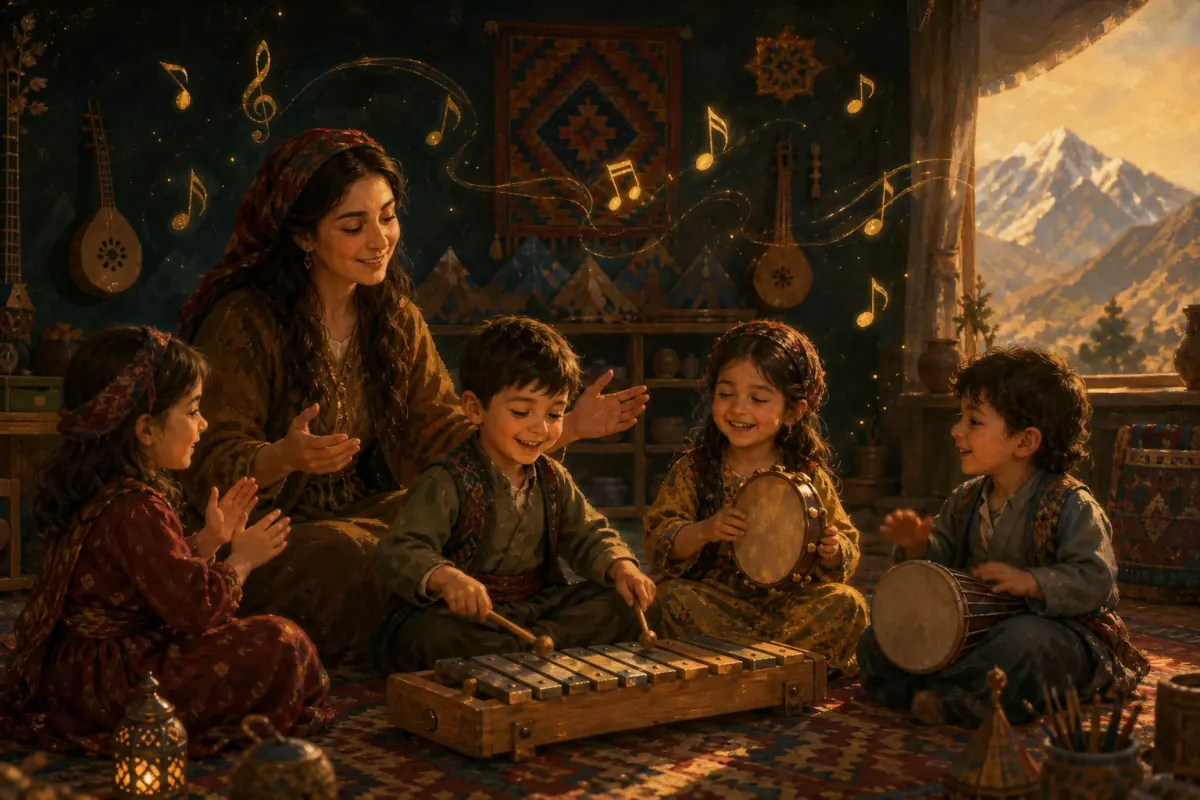
Through music, a kindergarten can create an environment that motivates children to learn, nurtures their thinking, and instills in them a love of music and of learning. Although the use of music in schools as a tool for learning has no precise date of origin, music has likely developed as one of the core subjects in schools alongside other lessons, and has found its place in the curriculum with a great impact on the process of education and teaching. The kindergarten — an important stage of early education — emerged in Europe in the eighteenth and nineteenth centuries. The German educator Friedrich Froebel is regarded as the creator of the first kindergarten program, in the mid-1800s. Because Froebel's philosophy emphasized the importance of play and creativity in kindergarten programs, music was likely also part of that program's lessons.
Kindergartens as institutions of education and teaching became widespread across Europe and North America in the late nineteenth and early twentieth centuries, and music was undoubtedly an integral part of their curricula. Although we cannot single out any one country as the pioneer in using music as a subject in schools and kindergartens, the countries with a strong tradition in music education — Germany among them — as well as those that placed great importance on child development, are the ones that put music at the forefront of the fields important for children's upbringing and learning.
Research shows that music as a school subject is not just a way for children to spend a pleasant, relaxed time; it is a means of developing the child's brain and has an effect on raising their intelligence. If we look at the kindergarten stage — an important stage in which children learn many things — there are many tools for learning, but there is one powerful and effective instrument that can develop a child's thinking: music. Music is like a full-body workout in the service of the brain. Listening to music strengthens the connections between different parts of the brain, providing sharper thinking, better attention and a faster ability to organize information — all important requirements for human learning, and for children in particular.
The melodies used for children in schools — especially those whose lyrics have repeated rhymes — help children understand the rhythm of language, learn to say words, and grasp the meanings of words easily. This is a way of making a child's ability to read and to repeat words and sentences faster and stronger.
The structure of music, whether in theory or in practice, familiarizes children's minds with mathematical concepts, because the length and shortness of sounds in music are based on counting beats: they are marked by a set of symbols called note values ("the times of music"). This is one of the foundations of every melody, and children count these musical time values by clapping or by playing rhythm instruments.
Beyond playing the notes, music is also directly connected to the ability and expression of the person playing the music or singing the melody. That is why playing various musical instruments, singing, or moving and dancing to music creates an atmosphere in which children sense the talent and creativity within their abilities, and try to find other ways to show those abilities to those around them — their family, friends, classmates and teachers. Music also strengthens a child's ability to retain the information they learn in daily life, which is an important and necessary part of schooling. Learning melodies and songs (verses), memorizing melodies easily and singing them again at different moments, is a kind of training for the "muscles" of the brain, helping children learn new subjects very quickly and easily and not forget them.
Although listening to music on its own may not have much direct effect on a child's mind, a child's participation in musical activities — singing alone or in a group (choir), playing instruments alone or with a group of young musicians (a children's orchestra), or taking part in movement and dance — has a more noticeable effect on the development of the child's thinking and of their intellectual and cultural side. That is why music creates a joyful, activity-rich environment for children, which likewise helps secure a positive environment for learning other subjects and wins the child's love of school and learning.
Teachers of other subjects can therefore also use music to get their messages across to the children in their classes. As is well known, melodies and pieces of music differ: each has its own rhythm, style, tempo and scale. So the music chosen must suit the atmosphere of the lesson and the learning activities, because it will affect the learning process.
It is also important that music teachers, especially at the kindergarten stage, explain to parents the benefits of music education that research has shown — for developing children's cultural and intellectual side, their social relationships, creativity and success. Building a strong connection between kindergarten and home through songs and music is also essential: parents should be made familiar with the songs and music sung at kindergarten, so that a child's connection to music and song is not broken at home and a musical environment is created for them there too.
On the other hand, it is the duty of education authorities to provide training opportunities for kindergarten teachers through a series of workshops, so that music can be integrated effectively into subjects such as mathematics, reading and writing, and science. Music should be used for specific teaching goals and woven into classroom activities through movement and song. This, of course, requires supplying kindergartens with musical instruments — especially instruments that are suitable for children to play and carry.
If we consider movement activities with music — dancing, walking to a rhythm, playing games to a beat and so on — bringing them into lessons draws children's attention to the lesson, makes learning easier through physical activity, and strengthens their thinking. Music can also develop a child's self-confidence. It is therefore important that kindergarten music teachers let children take part in choosing songs and musical activities; this makes music more enjoyable and more beloved, and builds the child's sense of self-belief. That is why it is important and necessary for music specialists — in consultation with experts in child education and researchers in child psychology — to design a dedicated music curriculum for kindergartens covering the whole school year: one that keeps pace with today's advances and benefits from the progress kindergartens in developed countries have achieved.
Translated from Kurdish. Read the original article in Kurdish.