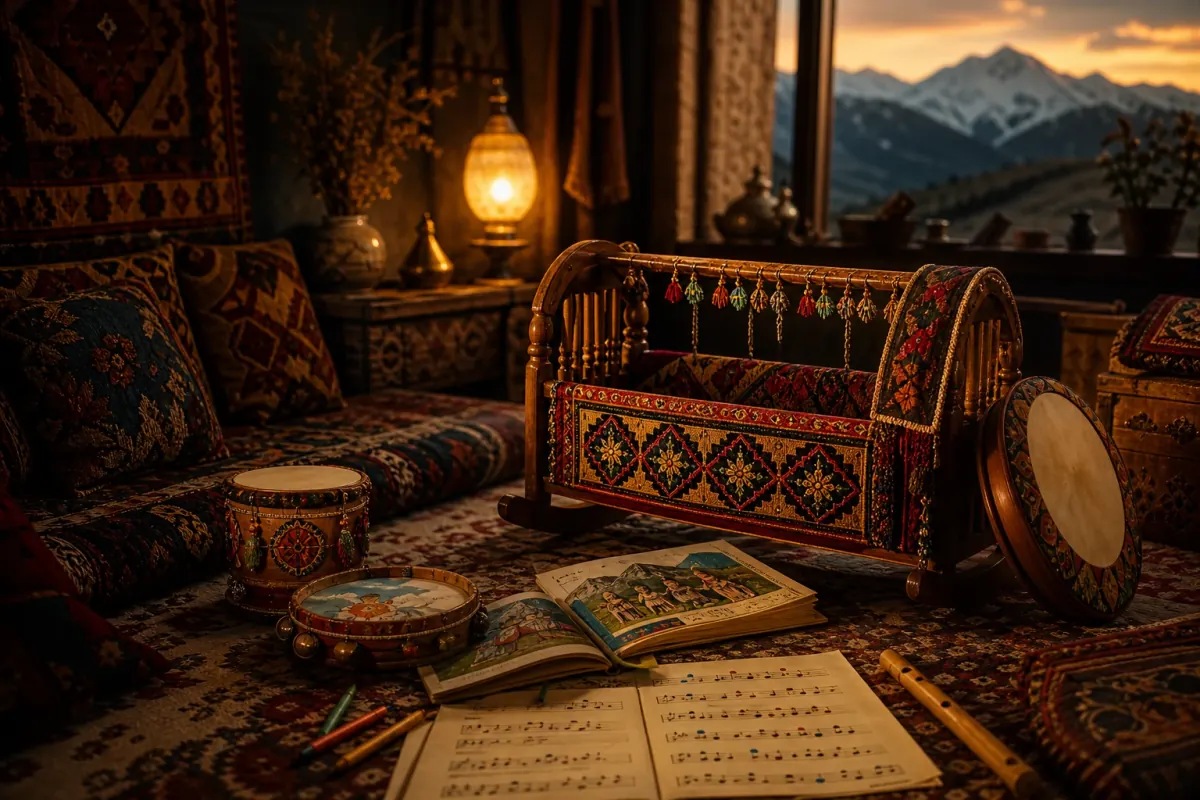
Before a Kurdish child can speak, they have usually heard hundreds of songs. A mother rocking a cradle. A grandmother bouncing a toddler on her knee and counting. Older sisters singing at the door during a rain procession. These songs are the first Kurdish lessons a child ever receives, and most of them were never written down.
This guide is for parents, teachers and kindergartens who want to bring traditional Kurdish children's songs back into daily life. We explain what kinds of songs exist, share short traditional lines with transliteration and translation, and give simple ways to sing and play them at home or in class.
What counts as a Kurdish children's song?
Kurdish children's songs are not one genre but a family of related forms:
- Lullabies, called lorî in Kurmanji and laye laye or lay lay in Sorani, sung to calm or put a child to sleep.
- Sound rhymes and tongue-twisters (zûgotinok in Kurmanji), where the fun is in the sound, not the meaning.
- Number and name rhymes, which play with counting or with a child's name.
- Custom songs, sung by children themselves during seasonal rituals such as the rain procession.
- Written children's songs and school anthems, a newer tradition that began in the twentieth century.
Very little of this has been collected. A 2023 article by the folklorist Mustafa Öztürk ends by calling for much more research on Kurdish lullabies and related forms. Most of what survives is still in the memory of women.
Lullabies: lorî and laye laye
Lullabies are the heart of Kurdish children's song, and they deserve an article of their own. We wrote one: our guide to Kurdish lullabies, lawk and heyran covers their history, themes and the women who kept them alive. Here we only look at what parents need in order to start singing.
The refrain does the work. Kurdish lullabies are built around soothing syllables: lorî lorî in Kurmanji, lay lay or laye laye in Sorani and in the Kermanshah region, and lo lo when the singer addresses a boy as lawo. These syllables have no dictionary meaning. They carry the rocking rhythm of the cradle.
The lines between are love. In 1962 the researchers Dieter and Nerthus Christensen recorded a young woman, Batul Ziyayi, singing what she called an "old lullaby" in the village of Bawale near Sonqor, in Iranian Kurdistan. Their published translation gives the shape of almost every Kurdish lullaby:
Dear suckling, sleep, sleep, lay lay lay. Child darling, lay lay lay.
Their notes explain that Kurdish lullabies are very similar to each other. They are made of flattering names for the child and gentle calls to sleep. The notes add that girls were sometimes addressed as if they were boys.
Here is a Kurmanji example, collected by Öztürk from a woman in Qoser, in Mardin province:
Lorî lorî berxêm lorî Xewê xweş be çavê morî Lullaby, lullaby, my lamb, lullaby, Sweet sleep to you, my bead-eyed one.
Berx (lamb) is one of the most common pet names for a child in Kurdish lullabies, along with kurrê min (my son), delal (darling) and xweşik (beautiful one).
Sorani families will know the lullaby Lay Lay Nemamî Jiyanim recorded by Mazhar Khaleqi, by far his most-viewed song on the lyrics site GoraniKurdi. Rhythm Passport describes a Laye Laye associated with him as widely known across Iranian and Iraqi Kurdistan. For older Kurmanji recordings, Ayşe Şan is the classic voice of women's song.
Rhymes that play with sound
Some Kurdish children's verses mean almost nothing, and that is exactly the point. Öztürk describes lullabies built in the style of tongue-twisters, made of rhyming sounds that hold a child's attention and calm them. One of his examples:
Lorikê lorikê lorî Dorikê dorikê dorî Mozikê mozikê mozî
There is no story here: lorik, dorik and mozik are chosen because they rhyme and roll off the tongue. For a small child this is ideal. It is pure rhythm and repetition, the same pleasure as "hickory dickory dock" in English. It is also a good first song for a toddler to join in, because every line follows the same pattern.
Counting and number rhymes
Kurdish folk rhyme also plays with numbers. Another verse in Öztürk's collection counts its way through a village:
Silêman yeke gund gelek e Silêman sê ye gundî lê ye Silêman çar e gundî hezar e Silêman is one, the village is big, Silêman is three, there are villagers there, Silêman is four, the villagers are a thousand.
The verse ends with Silêman getting up and the village scattering, which makes a perfect place for a game. Teachers can use it to practise numbers. Children can stand up and sit down, or "scatter" around the room on the last line. Swap Silêman for a child's name and every child gets a turn.
Bûka Baranê: the rain bride song
Not every children's song was sung to children. Some were sung by them. The best-known example is Bûka Baranê (Kurmanji) or Bûke Barane (Sorani), the "rain bride".
In times of drought, children dress a wooden doll, often a simple cross of sticks, as a bride in Kurdish clothes. They carry it from house to house, singing a chant that asks God for rain for the poor and needy. At each door the household splashes water on the doll and gives the children treats such as eggs, raisins, walnuts, sweets or coins, which they share at the end. Jin News reports the custom across Eastern Kurdistan, Northern Kurdistan, Rojava and the Kurdistan Region of Iraq. Kurdistan24 describes it resurfacing amid recent drought fears.
According to the same Jin News report, the doll is usually dressed by one of the mothers or grandmothers of the neighbourhood, and in the past the oldest woman of each household would sprinkle water, flour or white clay along its path. The children end by carrying the doll to a sacred place, or in some areas to a spring, and the ritual closes with a collective prayer. The custom had faded in recent decades, especially in the Mukriyan region, but in 2025 it was revived in Mahabad, Bukan, Naqadeh and Sardasht.
It is also being revived on purpose. In 2021 a local organisation in Sulaymaniyah's Şexan neighbourhood held a "Carnival of Buka Baranê" so that neighbourhood children would learn the custom. For a kindergarten, this is a wonderful project: make a doll, learn a short rain chant from a grandparent, and walk it around the school. It connects singing with the seasons, with sharing and with water.
Rain runs through Kurdish song for adults too. After the procession, you might play the folk song Baran Barane ("It is raining") from our free notation, and talk about the rain in both songs.
Written children's songs and modern TV
Alongside the oral tradition, a written tradition of Kurdish children's poetry and school songs began in the early twentieth century. A 2020 study in The Journal of Mesopotamian Studies says Kurdish children's literature in Iraqi Kurdistan began at that time with children's poems and songs (sirûd). Sorani poets such as Zêwer, Goran and Latif Halmat are the best-known names of this written tradition.
Several singers also made songs especially for children. Merziye Feriqi, for example, recorded children's songs and lullabies alongside her love songs; read more in our Merziye Feriqi biography.
Today most families find modern Kurdish children's songs on television and online. Afarin Kids TV, based in Sulaymaniyah, and Zarok TV, launched in Diyarbakır in March 2015, publish songs and cartoons in Kurdish, much of it on YouTube and streaming apps. These are valuable, especially for children growing up in the diaspora. They are also modern, copyrighted works, so we do not reproduce their lyrics here. We see them as a complement to the old songs, not a replacement.
Why singing with children matters
Children do not need a reason to love songs, but parents and teachers often want one. In our article on music in kindergarten and the child's brain, Kurdo Sardar explains how music strengthens the connections between parts of a child's brain. He shows how rhyming songs help children hear the rhythm of language and learn new words.
Folklore research says the same about Kurdish lullabies in particular. Öztürk notes that lullabies use the plainest everyday words of the mother tongue, with very few foreign words. He argues they help lay the foundations of listening, speaking and understanding. For Kurdish families this matters doubly. In the diaspora, or wherever school happens in another language, a lullaby may be the child's richest daily contact with Kurdish.
There is an emotional side too. A 2025 study of 40 Kurmanji lullabies from Shirvan County in Iran found themes of history, nature, family relations and love. Many of these themes are not childish at all. When a mother sings, she passes on her world, not just a tune. Our article on music and emotional regulation explores how songs help children, and adults, calm down.
How to sing and play them simply
You do not need to be a musician. Here is a simple approach that works at home and in a kindergarten.
- Start with the refrain. Sing lorî lorî or lay lay lay on two or three notes, slowly, while rocking or swaying. Children join the refrain long before they know the words.
- Add names. Traditional lullabies are built from loving names for the child, so add your own: the child's name, berxê min (my lamb) or gula min (my flower). That is how these songs have always grown new verses.
- Keep the beat on a daf or with hands. For rhymes like Lorikê lorikê lorî, clap or tap a steady beat on a frame drum. Our daf page and our guide to daf rhythms show simple patterns. A slow, even pulse is all a young child needs.
- Use movement. Rock for lullabies, stand and sit for the Silêman rhyme, and walk in a line for the rain bride chant.
- Try a piano or keyboard. Kurdish folk melodies are written as a single line, so a parent can play them with one hand. Our guide to Kurdish songs on piano recommends three-note tunes for absolute beginners. These include Asê, Ba Wabê and Baran Barane. They are not children's songs, but they are short enough for an older child to learn.
- Repeat, repeat, repeat. Sing the same few songs every day for weeks. Familiarity is what children enjoy most.
For a gentle next step, the Beginner's Sorani Folk playlist collects easy traditional melodies to listen to together. Teachers who read Sorani can go deeper with the free book Songs and music in teaching at primary schools in Erbil. It is a study of how songs are used in the classroom. You can also try the methods book Methods of teaching music.
Keep the songs alive
The most important archive of Kurdish children's songs is not a library. It is the grandmother down the street. Ask her what she sang. Record it on your phone, write down the words, and sing it back to her grandchildren. If you collect a lullaby or a rhyme your family has always sung, KurdNote would love to hear it. Every variant is part of the heritage.
Ready to make music with your children? Start with the short, free notation for Baran Barane and explore more easy melodies in our Sorani notes.
Sources
- Mustafa Öztürk, "Pênase û Çend Taybetmendîyên Lorîyan", Mukaddime 14(2), 2023
- Kurdish Folk Music from Western Iran, liner notes by Dieter Christensen, Smithsonian Folkways (FE 4103)
- Vahdanifar and Imani, "Content Analysis of Kurmanji Lullabies: A Case Study of 40 Lullabies", Culture and Folk Literature, 2025
- "Bride of the Rain": A Kurdish Tradition Reviving Collective Memory, Jin News
- Children of Sulaymaniyah carry on Buka Baranê tradition against drought, Jin News
- Traditional Kurdish "Rain Bride" Ritual Resurfaces Amid Regional Drought Concerns, Kurdistan24
- Zeyad Rashad, "Letîf Helmet û Şi'îrê Mindalan", The Journal of Mesopotamian Studies, 2020
- Children's poetry in Sorani: Zêwer, Goran, Letîf Helmet and Emîn Mihemed (thesis), YÖK Açık Bilim
- Daily Discovery: Eléonore Fourniau, Laye Laye, Rhythm Passport
- Mazhar Khaleqi song list, GoraniKurdi
- Zarok TV, Wikipedia
- Turkey's first Kurdish children's TV station ready to air, Hürriyet Daily News
- Afarin TV, App Store