
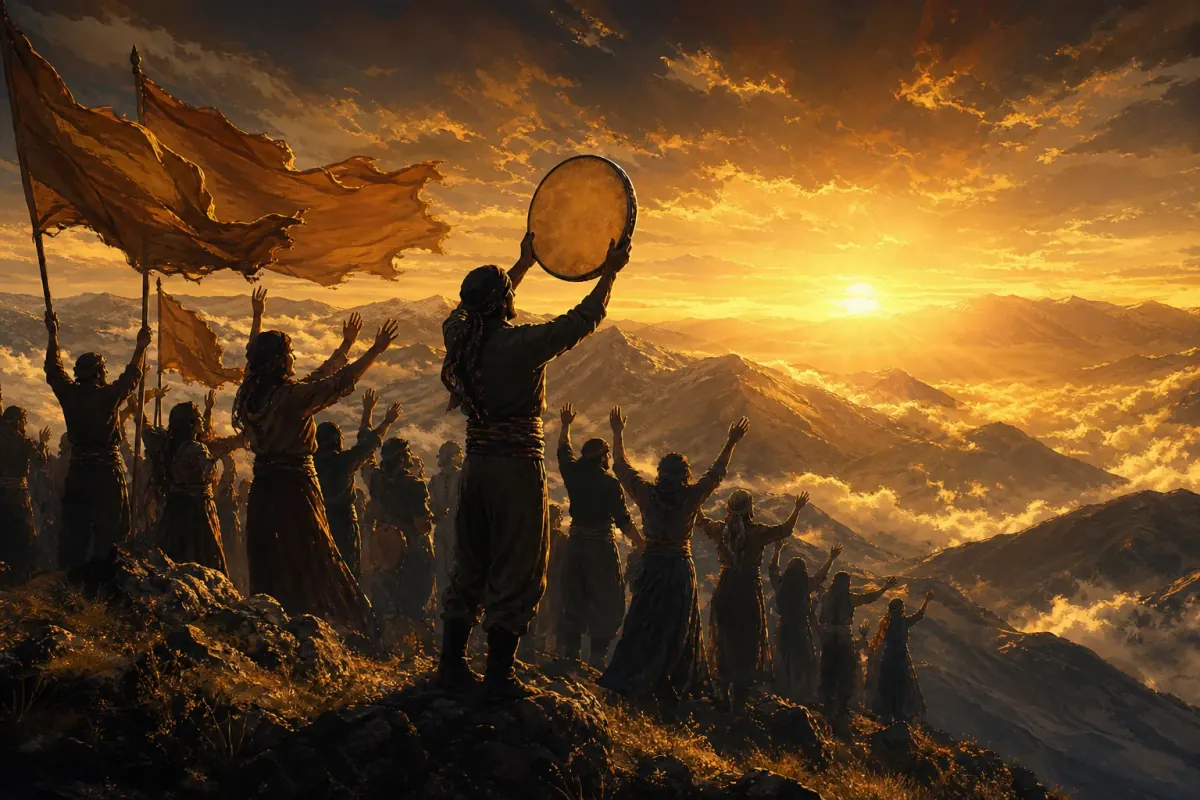
In national struggles, the role of music has been as important as the revolutionary movements themselves, and throughout history music has been a powerful force in shaping and expanding those movements. From chanting slogans over simple rhythms and melodies — which helped rallies and protests grow — to revolutionary melodies and songs that eventually became part of nations' cultural identity, music plays a many-sided role in uniting and empowering the members of societies who strive for change among their people and in their homeland.
Revolutions often grow by bringing together all the sides and opposing individuals within a society. Music therefore works as a universal language that can become a bridge, drawing together the social and cultural divisions that, under the umbrella of revolution and of civil and armed struggle, strive toward a single goal. Songs and anthems have a shared effect: they foster a sense of resistance, independence, freedom, patriotism, steadfastness and more among the members of a society. For example, during the American civil rights movement, songs such as "We Shall Overcome" became a symbol of hope and resilience, uniting diverse groups in their efforts to achieve justice. It was sung at countless protests, marches and rallies, and its message of unity, perseverance and ultimate victory over injustice resonated deeply.
This is why we can say that music carries a message with a deep effect on people. Often the stirring content of a piece of music, a song or a revolutionary anthem can express a movement's values, goals and grievances in a way that speeches, statements or media headlines sometimes cannot.
For example, Bob Dylan's song "The Times They Are A-Changin'" influenced activists caught up in the social turmoil of the 1960s around the world. At a sensitive moment of significant social and political change in America, the song became a powerful political anthem and resonated among young people.
In many revolutions, music acts as a guardian of cultural identity, preserving the cultural, social and traditional customs that oppressive regimes try to erase. In the national struggle of the Kurdish people, patriotic melodies and lyrics have played an effective role in preserving a sense of identity and resistance; these songs and this music were used against the oppression of the Kurdish people. At times these anthems and songs carried revolutionary messages indirectly, serving as guidance and signposts for the national movement and struggle — while being broadcast and circulated under names, titles and lyrics that the authorities did not recognize as revolutionary songs.
Throughout the successive Kurdish revolutions, music and song have always been present and have played a prominent role in uprisings and demonstrations and in rallying the public. Alongside the outbreak of each revolution, music ensembles, anthems and patriotic songs also emerged — such as the founding of the Revolution Music Ensemble in the mid-1970s. Through their musical performances at commemorations and occasions, and through recording anthems and patriotic songs that were broadcast on the radio, this ensemble was a strong and effective force in raising national spirit among Kurdish people and among the Peshmerga forces of Kurdistan.
From the uprisings of the Kurdish people up to the spring uprising of 1991 — which ultimately led to the creation of a Kurdish entity in Southern Kurdistan — songs, music and patriotic anthems were an integral part of the political plan drawn up for the uprising and the liberation of Kurdistan's regions. That is why, whenever an area was liberated from the rule of the former regime, music and songs were broadcast in moments of victory to stir enthusiasm, while for losses and the martyrdom of leaders, mournful music was broadcast that moved the emotions of Kurdish people and planted a spirit of retribution deep within them. Sometimes these pieces were not known by their own names but were named after the purpose and occasion for which they were broadcast — such as the music of Karwanî Nemran (the Caravan of the Immortals) or Karwanî Şehîdan (the Caravan of Martyrs).
In 2003, at the time of the fall of the former regime across all of Iraq — when some of the Kurdish areas still under its rule were also liberated — musicians and singers played an effective role with numerous patriotic songs and pieces of music. This ultimately gave rise to dozens of outstanding musical works, some of which still keep their role and influence today. Indeed, across all parts of Kurdistan, at national occasions, demonstrations and protests, they are played alongside the national anthem "Ey Reqîb" — for example, the song "Kurdistan" by the artist Zakaria Abdulla and the patriotic anthem "Her Kurdîn û Her Kurd Ebîn" (We Are Kurds and Will Always Be Kurds).
Translated from Kurdish. Read the original article in Kurdish.