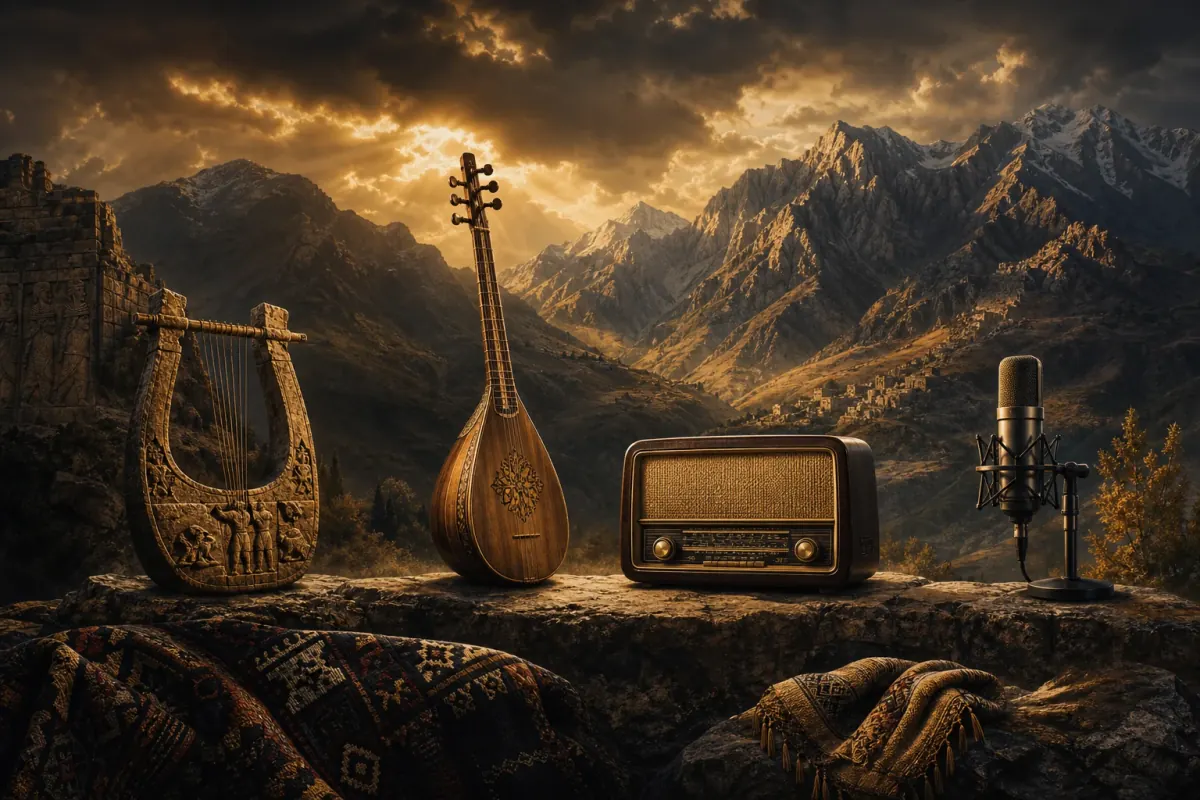
Kurdish music has no single birthplace and, for most of its life, no written score. It lived in memory: in the voice of a village storyteller, a mother's lullaby, a wedding drummer's rhythm, a dervish's lute. Then, within a single century, it passed through notation, shellac records, radio, cassettes, satellite TV and the internet.
This is a short history of Kurdish music, told in broad chapters. It is not the full story. Two parts are covered in depth elsewhere on KurdNote, so we only touch on them here: how the music was written down in notation, and how it was banned and suppressed in the 20th century.
A quick timeline
- Before 1900: oral epics, songs, dance music and sacred music, passed on by memory
- 1692: Ehmedê Xanî completes Mem û Zîn, the best-known Kurdish literary epic, drawing on an older oral tale
- 1903: Komitas publishes the first collection of Kurdish melodies in notation
- Late 1920s: record companies in Baghdad begin recording Kurdish singers
- 1939: the Kurdish section of Baghdad Radio opens; Ali Mardan becomes its first Kurdish singer
- 1946: the Republic of Kurdistan in Mahabad adopts Ey Reqîb as its anthem
- 1955: Radio Yerevan launches its Kurdish broadcasts
- Late 1950s to 1960s: Kurdish radio in Tehran and Kermanshah; the golden age of radio song
- 1970s to 1990s: cassettes, protest song and exile
- 1991 onwards: Kurdish self-rule in Iraq, Kurdish TV, festivals and a new pop scene
- 2000s to today: digital recording, YouTube, streaming and online archives
The deep roots: an oral music
For centuries Kurdish music was held not in books but in people. Kurdish folklore is often described through three kinds of performers:
- Çîrokbêj, the storytellers, who told long tales mixing speech and song.
- Dengbêj, the bards of the Kurmanji-speaking north, who sang epics, laments and histories in long, unaccompanied recitative. Masters such as Reso and Şakiro carried the art into the age of recording. We explore it in what is dengbêj.
- Stranbêj, the popular singers of songs for everyday life, celebration and dance.
Alongside them were the women who kept the repertoire of lullabies and laments (see Kurdish lullabies, lawk and heyran), a repertoire that singers like Ayşe Şan later carried onto record, and the wedding musicians with their daf, dahol and zurna, who kept the dance going (see Kurdish wedding music).
Epics and love stories
Some of the great Kurdish stories survived as sung epics before and after they were written down. The most famous is Mem û Zîn, the tragic love of two young people from rival houses. The poet Ehmedê Xanî completed his literary version in 1692, probably drawing on the older oral epic Memê Alan. Other tales, like Xec û Siyamend, were sung and retold across generations. Our library holds a book on it: Khej u Siamend.
Sacred music
Two religious communities preserved some of the oldest continuous musical practices among Kurds:
- The Yarsan (Ahl-e Haqq), for whom the tanbur is a sacred instrument, used to accompany religious hymns (kalam). Masters such as Ali Akbar Moradi and Sayyid Khalil Alinejad have recorded its repertoire. See the tanbur, sacred Kurdish lute.
- The Yazidis, whose hereditary musicians, the qewal, perform hymns with the daf and the shebab flute. A study by the scholar Isya Joseph in 1909 already described the qewals and their instruments. See Yazidi religious music.
Sufi orders across Kurdistan added their own tradition of zikr with frame drums, which is one reason the daf is so central to Kurdish music today.
Kurds and the maqam world
Kurdish music has always lived beside Arabic, Persian, Turkish and Armenian music, and the exchange ran in every direction. Kurdish singers use the shared maqam system, with modes like Bayati, Hijaz, Rast, Saba, and one named after the Kurds themselves, maqam Kurd. We explain how this works in what is a maqam?.
Some famous figures of the wider tradition are claimed as Kurdish, but the evidence is often thin. The 9th-century musician Ziryab is the best-known case: Kurdish, Persian and African origins have all been proposed. We look at that debate in our article on Ziryab, the oud master.
The first documentation: notation and records (1903 to 1930s)
Until the 20th century almost nothing of Kurdish music was fixed on paper. The first published collection came from outside: in 1903 the Armenian priest and composer Komitas published a small collection of Kurdish melodies he had transcribed during fieldwork, mostly epic songs. It is generally counted as the first publication of Kurdish music.
The next step was the gramophone. In the late 1920s, record companies in Baghdad began recording Kurdish singers. For the first time a Kurdish voice could be heard far from where it was sung. Among the very first Kurdish singers whose voices were recorded was Sayed Ali Asghar Kurdistani, from a village near Sanandaj, who died in the mid-1930s and was admired for the range and agility of his voice.
The full story of how Kurdish songs were transcribed, from Komitas to today's digital archives, is in our history of Kurdish music notation.
The radio age (1939 to 1970s)
If one invention defined 20th-century Kurdish music, it was radio. Radio made stars, created ensembles, and carried songs across borders that people themselves could not cross.
Baghdad, 1939
In 1939 a Kurdish section opened at Baghdad Radio. Its first Kurdish singer was Ali Mardan (1904–1981) from Kirkuk, who became known as a master of Kurdish maqam singing. Over the following decades Baghdad's Kurdish radio became a meeting place for a generation: Tahir Tofiq, Mihemed Arif Cizrawî, Hassan Zirek from 1953, the Badini singer Tahsin Taha from 1958, and many more.
Mahabad, 1946
The short-lived Republic of Kurdistan in Mahabad (1946) had its own radio and adopted Dildar's poem Ey Reqîb as its national anthem. The Republic lasted less than a year, but the anthem outlived it. Read its story in Ey Reqîb, the Kurdish national anthem.
Yerevan, 1955
One of the most surprising chapters took place in Soviet Armenia. Earlier Kurdish programmes on Radio Yerevan had been shut down in the Stalin era, but on 1 January 1955 its Kurdish broadcasts began again under Casimê Celîl. At first they aired only three times a week, for fifteen minutes. Casimê Celîl left more than 700 original recordings when he stepped down in 1964, and his daughter Cemîla Celîl carried the work on for decades. By the early 1960s the broadcasts reached across the border into Turkey, where Kurdish was not allowed. Singers like Karapetê Xaço became household voices through it, and the Armenian oud player Aram Tigran worked with its Kurdish service for about eighteen years after moving to Yerevan in 1966.
Tehran and Kermanshah
In the late 1950s Kurdish radio opened in Tehran, and in the 1960s Kermanshah became a centre. These stations had real radio orchestras, with instruments like the kamancheh, santur and tar alongside the singer. In Tehran, Mazhar Khaleqi brought the refinement of classical training to Kurdish song, and Mahabad's Mihemed Mamle recorded for the Kurdish services of Mahabad, Kermanshah and Tehran radio. Hassan Zirek's Kermanshah recordings, made with an orchestra in which the young violinist Mojtaba Mirzadeh played and arranged, are often called his finest. His story, and his songs, are in Hassan Zirek's greatest songs.
What radio changed:
- Ensembles replaced the lone voice. Songs that had been sung unaccompanied or with one instrument were now arranged for small orchestras.
- Stars were born. A singer could become famous across all parts of Kurdistan at once.
- Songs got fixed versions. A radio recording became "the" version that others copied.
- The dialects met. Sorani, Kurmanji and Southern Kurdish listeners heard each other's music. See Sorani vs Kurmanji music traditions.
Songs of the nation: 1960s to 1980s
As Kurdish political movements grew, so did patriotic and protest song. Singers recorded songs of the homeland, of the mountains and of loss, often at personal risk. In Syria, Mihemed Şêxo combined the dengbêj heritage with the new political song. In Turkey, Şivan Perwer became the voice of a generation. His recordings spread on cassettes, copied from hand to hand, after he left Turkey in 1976. In Iraqi Kurdistan, Hama Jaza sang for the Peshmerga in the mountains, and in Zakho Erdewan Zaxoyî released cassettes of political song in the late 1970s, when such recordings were banned.
The cassette was the perfect technology for a music under pressure: cheap, easy to copy, easy to hide. For the laws, bans and destruction of this period in each country, see how Kurdish music was banned. For the songs of struggle themselves, see music and revolutionary movements.
Exile and the diaspora
From the 1970s onwards, many Kurdish musicians worked from Sweden, Germany, France and the UK: Ciwan Haco and the singing couple Naser Razazi and Merziye Feriqi in Sweden, Nizamettin Ariç in Germany, and many others. Exile turned out to be a strange kind of protection. Studios, festivals and Kurdish associations in Europe let musicians record what they could not record at home. At the same time, a new sound emerged, mixing Kurdish folk with European instruments and production. That story is told in Kurdish diaspora music.
After 1991: a new public stage
The uprising of 1991 and Kurdish self-rule in Iraq opened a new chapter. Kurdish-language TV and radio stations multiplied, music institutes grew, and concerts could be held openly in Erbil, Sulaymaniyah and Duhok. In Turkey, restrictions were gradually eased from the 1990s, and in the 2000s artists like Aynur Doğan reached international world-music stages.
On the concert stage, ensembles like the Kamkar family from Sanandaj brought Kurdish music to major international venues, blending Kurdish melodies with the refinement of Persian classical training. Two musicians from Kermanshah, the kamancheh master Kayhan Kalhor and the singer Shahram Nazeri, took Kurdish and Persian classical music into the world's great concert halls. We tell their story in the Kamkars, and our library has a book on them and their contemporaries: The Kamkars, Khaleqi, Qaradaghi and Kurdish music.
At the same time, a Kurdish pop industry grew, with music videos, satellite channels and wedding bands, from the albums Zakaria Abdulla recorded in Sweden to the videos of Dashni Morad. Its best songs now sit next to the old radio classics in every Kurdish playlist.
The digital age
Since the 2000s, affordable recording, YouTube and streaming have changed Kurdish music again. Archives of old radio recordings have been digitised, and young listeners discover singers who died decades before they were born. New challenges have arrived too: songs uploaded without names or sources, and since 2023, AI-generated songs presented in the voices of dead singers. How technology can help rather than harm is the subject of how AI can help preserve Kurdish music.
What this history teaches
Looking back over a century, three patterns stand out:
- Every new medium was a lifeline. Records, radio, cassettes and the internet each helped Kurdish music survive where the state tried to silence it.
- Crossing borders kept it alive. Baghdad radio for Iranian Kurds, Yerevan radio for Turkey's Kurds, Europe for the exiles: the music often survived by being broadcast from somewhere else.
- Memory is still the foundation. Behind every recording was a singer who had learned the song by ear. That is why preserving the old recordings, and writing them down, matters so much.
Where to go next
- For the whole story in Sorani, read the book Mizhuy Mosiqay Kurdi (History of Kurdish Music) in our free library.
- Hear the tradition for yourself with our Kurmanji classics playlist and our Sorani folk for beginners playlist.
- Meet the voices in 12 famous Kurdish singers.
Sources
- Kurdish music, Wikipedia
- Kurdish melodies (Komitas, 1903), Wikipedia
- Mem and Zin, Wikipedia
- Yêrêvan Xeberdide: How a Soviet Armenian radio station preserved Kurdish culture, Ajam Media Collective
- The Kurdish Voice of Radio Yerevan, EVN Report
- Ceremony commemorating Baghdad Radio's Kurdish department, Shafaq News
- Kurdish broadcasting in Iraq, MERIP
Every chapter of this history is still audible. Start with the free Sorani notation library and Kurmanji notation library, and play the songs these singers kept alive.