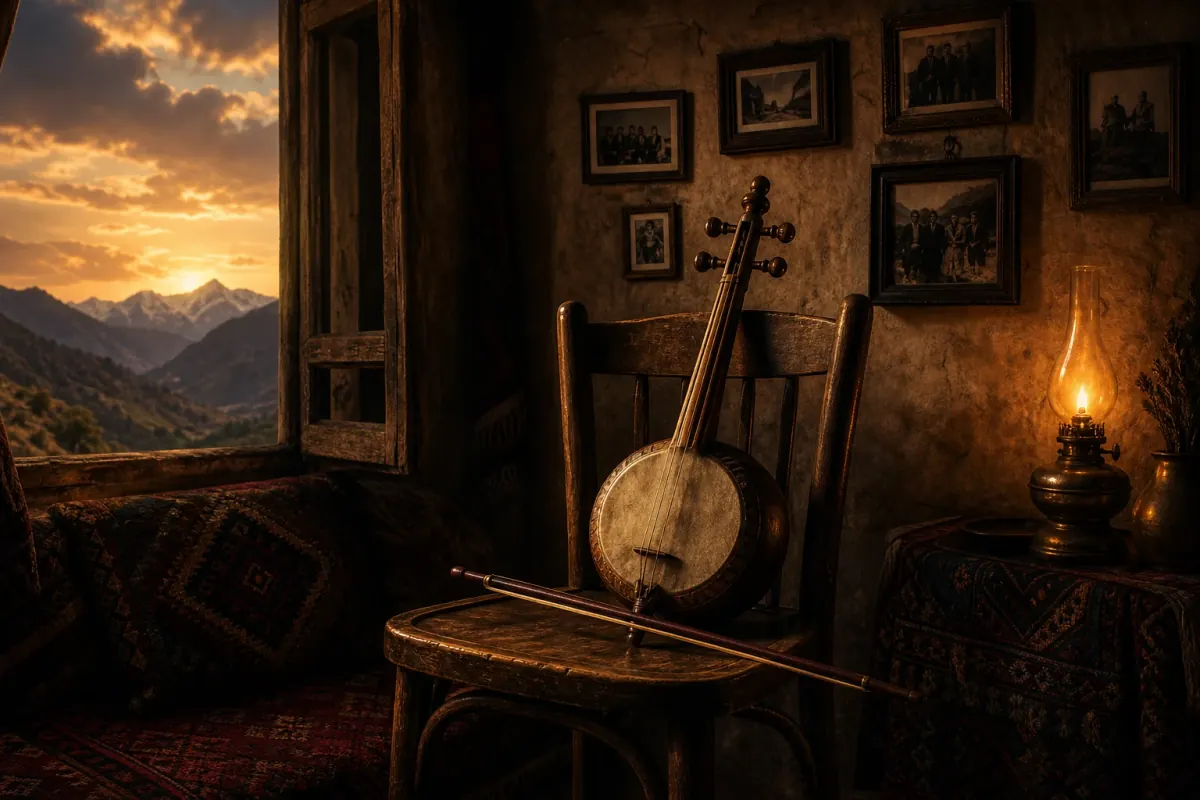
In the Goyje neighbourhood of Sulaymaniyah, a family of mullahs, poets and maqam singers produced two of the most important names in twentieth-century Sorani culture. One brother, Muhamad Salih Dilan, became a poet whose verses changed modern Kurdish poetry. The other, Qadir Dilan, became a violinist and composer who is often called the first Kurdish musician to blend Western styles with Kurdish song.
Together they are linked to one of the most sung Kurdish melodies of all: the Newroz song built on Piramerd's poem. This Qadir Dilan biography tells the story of the composer, his brother, and the family behind them.
Quick facts
- Name: Qadir Dilan (قادر دیلان)
- Born: Sulaymaniyah, in 1930 according to English Wikipedia, in 1928 according to Sorani Wikipedia
- Died: 18 March 1999, Prague, Czech Republic
- Origin: Sulaymaniyah, Kurdistan Region of Iraq
- Genre: Kurdish song, folk, and Western-influenced arrangements
- Instruments: violin, flute and other instruments
- Known for: Frishta, Jwani Benaw, the Newroz melody, bringing Western techniques into Kurdish music
- Family: son of Mullah Ahmad Dilan; brother of the poet and maqam singer Muhamad Salih Dilan
Early life: a family of poets and maqam singers
Qadir grew up in a household where poetry and melody were part of daily life. Both English Wikipedia and the Kurdish culture site Kurdshop name his father as Mullah Ahmad Dilan, from a well-known religious family of Sulaymaniyah.
English Wikipedia describes the father as a lover of poetry and a maqam specialist who knew Kurdish, Persian and Arabic. That matters for the story of both sons. The Sulaymaniyah maqam tradition, with its long, ornamented vocal lines, was the first music they heard. If you're new to the term, our beginner's guide what is a maqam? explains how these modal systems work.
The two sources disagree on Qadir's year of birth. English Wikipedia gives 24 March 1930, while Sorani Wikipedia gives 1928. We give both, as we could not settle it.
Career in Sulaymaniyah
According to both English and Sorani Wikipedia, Qadir Dilan founded a music group in 1948, while still a young man. In the 1950s that circle became the basis of the Mawlawi music group, which he led in Sulaymaniyah. These were the years when Kurdish radio was growing and when a generation of musicians was trying to find a modern voice for Kurdish song.
Qadir's answer was the violin and the harmonic ideas of Western music. Wikipedia describes him as the first Kurdish singer to mix Western styles with Kurdish music. In practice, this meant arrangements that treated Kurdish melodies with a new kind of instrumental colour, while keeping the phrasing of Sorani song.
The Newroz song of 1948
The most famous story about the brothers comes from the same year. According to English Wikipedia's article on Muhamad Salih Dilan, in 1948 the two brothers met the elderly poet Piramerd in Sulaymaniyah. Piramerd wrote his Newroz poem on a cigarette packet and asked if they could give it a melody. Qadir composed the tune, and Muhamad Salih sang it for the first time on 21 March 1948.
The poem opens with the line Em roj-e sal-î taze-ye, Newroz-e hatewe ("This is the day of the new year, Newroz has returned"). It became one of the defining songs of the Kurdish New Year and was later recorded by many singers, including Hassan Zirek.
We should add a caution. Not every source credits the melody the same way. Wikipedia's separate article on the song names a different composer. The attribution to Qadir Dilan is strong in Sulaymaniyah memory and in the sources on the Dilan family, but it is not undisputed. Read more about the song's place in the festival in our article on Newroz music.
Prague: study, marriage and exile
In 1962 Qadir Dilan left Iraq for Prague, then the capital of Czechoslovakia. Both English and Sorani Wikipedia say he studied music there for four years.
He never returned to live in Kurdistan. He married in Prague and raised a family there. For more than three decades he was a Kurdish composer living in Central Europe, far from the city whose music had formed him. His story belongs to the wider history of Kurdish musicians abroad that we explore in Kurdish diaspora music.
Qadir Dilan died in Prague on 18 March 1999, a few days before Newroz. English Wikipedia says the cause was stomach cancer diagnosed in 1998, while Sorani Wikipedia mentions a lung illness. He was first buried in Prague. His remains were later brought back to Sulaymaniyah and reburied there. The sources disagree on the year of the reburial (2007 in some accounts, 2011 in others), so we leave the date open.
Muhamad Salih Dilan: poet, maqam singer, brother
Any Qadir Dilan biography has to give space to his older brother.
Muhamad Salih Dilan was born in Sulaymaniyah in 1927 and died there on 28 October 1990. He was a Kurdish poet and maqam singer. Some online databases, including Wikidata, describe him as a "Turkish poet", which is simply wrong. English Wikipedia, Kurdshop and the family's own history all place him firmly in Sulaymaniyah, in Iraqi Kurdistan, writing in Sorani Kurdish. He lived and died in the city where he was born.
According to both English Wikipedia and Kurdshop, he began writing poetry around 1948, when he was about twenty. He went on to become one of the poets who modernised Sorani poetry in the twentieth century.
He also had one of the most admired voices in Sulaymaniyah's maqam tradition. Kurdshop notes that he performed maqams and songs but considered himself first of all a poet, and disliked being called a singer.
Like many Kurdish writers of his generation, Muhamad Salih Dilan was imprisoned for his political activity and his opposition to the regimes ruling Kurdistan. Both Wikipedia and Kurdshop record this, although accounts of how long he spent in prison vary.
Signature works
- Frishta (فریشتە, "Angel"), words by Abdulla Goran
- Jwani Benaw (جوانی بێناو, "Nameless Beauty"), words by Abdulla Goran
- The Newroz melody for Piramerd's poem, first sung by Muhamad Salih Dilan in 1948
- Key Tom Diwe (کەی تۆم دیوە) and Klpey Derûn (کڵپەی دەروون), listed among his songs on Sorani Wikipedia
Abdulla Goran is the father of modern Sorani poetry, so the pairing is significant. A composer who wanted a modern sound for Kurdish music chose the poet who had modernised the Kurdish poem.
Best songs
If you're searching for Qadir Dilan songs, start with these:
- Frishta (Firîşte). His signature love song, with Goran's lyrics.
- Jwani Benaw (Cwanî Bênaw). The second of his two most famous Goran settings.
- Newroz (Em roj-e sal-î taze-ye). The melody associated with the brothers since 1948.
- Key Tom Diwe. A lesser-known song, worth finding for its lyrical melody.
- Klpey Derûn. Another song from his Sulaymaniyah repertoire.
For Muhamad Salih Dilan, look for his recordings of Sulaymaniyah maqams, which show why his voice was so admired.
Legacy
Qadir Dilan's legacy has two sides. At home, he showed a generation that Kurdish music could take in Western instruments and ideas without losing its identity. Many later Sorani composers and arrangers worked in the space he opened.
Abroad, the Dilan name travelled in an unexpected direction. In 2003, the kamancheh player and composer Shahriyar Jamshidi founded the Dilan Ensemble in Iranian Kurdistan and named it in memory of Qadir and Muhamad Salih Dilan. The ensemble performs classical Kurdish music, songs and maqam from Eastern Kurdistan, and has since performed in Canada, the United States and Europe. That a Kurdish group in Iran chose the name of two brothers from Sulaymaniyah shows how far their reputation had spread across the border.
The Dilan legacy in Kurdish music today
The Dilan brothers are not an outside influence on Kurdish music. They are part of its core. The Newroz song is sung every March. The Sulaymaniyah maqam tradition that Muhamad Salih represented is still taught. And the Dilan Ensemble has carried their name onto international stages through the kamancheh, the bowed instrument at the heart of Eastern Kurdish classical music.
If Qadir's violin makes you want to learn a bowed instrument yourself, our guide kamancheh or violin: what should a Kurdish beginner learn? compares the two. The Sorani method book Learning the Kamancheh by Salah Rauf is a free place to start.
Where to start listening
- First song: Frishta, to hear Qadir's lyrical style.
- For the history: the Newroz song, ideally in more than one version, so you can hear how different singers shaped the melody.
- For Muhamad Salih Dilan: any of his maqam recordings from Sulaymaniyah.
- For the living legacy: the Dilan Ensemble's album Call of the Mountains (2008).
For more context on the era, read our short history of Kurdish music and the Sorani book A History of Kurdish Music in our library.
Visit Qadir Dilan's artist page, explore more Sulaymaniyah repertoire in our Sorani notation library, or download the kamancheh method book and start playing the music the Dilan name still stands for.