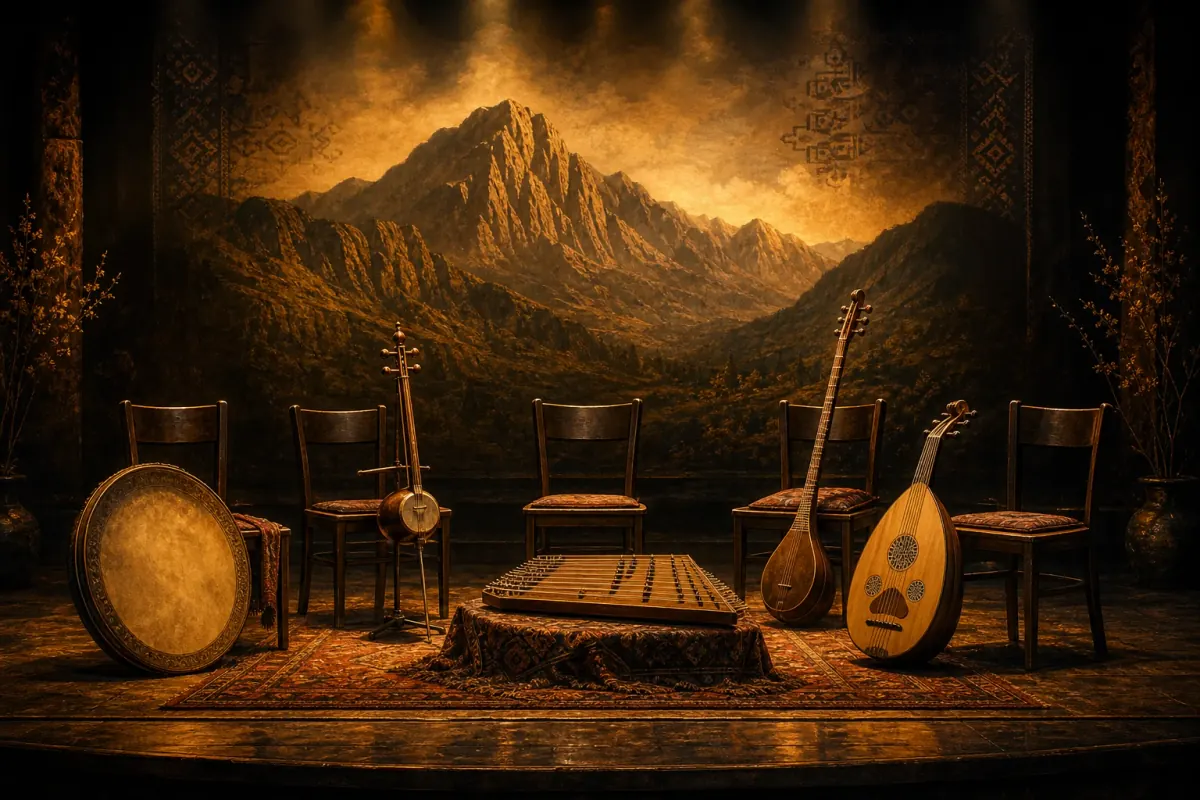
Few families have done as much for Kurdish music as the Kamkars. From a house in Sanandaj, a violin teacher and his children built an ensemble that took Kurdish songs to WOMAD, European concert halls and the Nobel Peace Prize ceremony in Oslo. For many listeners outside Kurdistan, the Kamkars were the first Kurdish music they ever heard.
This article tells the story of the family: who plays what, how the group grew, their best recordings, and why they matter so much to Kurdish music today.
Quick facts
- Name: The Kamkars (Kamkaran, کامکاران)
- Origin: Sanandaj, Kurdistan Province, Iran
- Founded: in the 1960s as a family band led by Hassan Kamkar; most sources give 1965, the Tehran Times gives 1961
- Members: seven brothers and a sister, plus guest singers and players
- Genre: Kurdish music and Persian classical music, often with orchestral strings and winds
- Core instruments: santur, kamancheh, oud and barbat, setar, tar, violin, tombak, daf
- Known for: Kurdish ensemble albums, the 2003 Nobel Peace Prize ceremony, the Kamkars music institute in Tehran
The Kamkars' beginnings in Sanandaj
The story starts with the father, Hassan Kamkar, a violinist and music teacher in Sanandaj. According to Wikipedia and the World Music Network's profile, he formed the group as a family band and trained his children himself. They practised at home and played locally before becoming known across Iran.
Sanandaj was a good place for this to happen. The city has long been one of the capitals of Eastern Kurdish music, home to singers, maqam specialists and instrument makers. Its singing tradition reaches back to Sayed Ali Asghar Kurdistani, one of the first Kurdish singers ever recorded, around 1930. It's the same city that shaped Mazhar Khaleqi, the master vocalist whose refined style set a standard for Kurdish singing in Iran, and the singer and poet Abbas Kamandi, who would become one of the Kamkars' most important partners (and who later wrote a book about Kurdistani's life).
The family and their instruments
Every sibling specialised, and the result was a complete ensemble inside one family. Wikipedia lists the members this way:
- Hooshang Kamkar, director and composer. He started on accordion.
- Bijan Kamkar, lead singer, who also plays tar, rubab, tombak, dohol and daf.
- Pashang Kamkar, santur.
- Ghashang Kamkar, the sister, on setar, violin and vocals.
- Arzhang Kamkar, tombak.
- Arsalan Kamkar, barbat, oud and violin.
- Ardeshir Kamkar, kamancheh and ghaychak.
- Ardavan Kamkar, santur.
The World Music Network's profile and the Tehran Times list the same siblings, with some differences in which instruments they name. That's normal for a family where most members play several instruments.
The next generation joined too. Omid Lotfi, Ghashang's son with the tar master Mohammad Reza Lotfi, became a member as a tar player.
Why the instrument mix matters
Listen to a Kamkars record and you hear a whole Eastern Kurdish soundscape. The hammered santur gives shimmer and speed. The kamancheh sings the long lines. The daf and tombak drive the rhythm. Ardavan and Pashang Kamkar are both known as santur players, and Ardeshir is one of the leading kamancheh players of his generation. If you want to hear what each of these instruments does in Kurdish music, our instrument pages for the santur, kamancheh and daf are a good companion to the albums.
From family band to world stages
The Kamkars grew from a local family group into one of the best-known ensembles in Iran. The World Music Network describes collaborations with some of the biggest names in Persian classical music, including Mohammad Reza Lotfi, Hossein Alizadeh and Parviz Meshkatian, and with the singers Mohammad Reza Shajarian and Shahram Nazeri, the Kurdish vocalist from Kermanshah.
Abroad, they played at WOMAD and many European halls. The same profile describes a 2001 visit to Turkey, with Kurdish concerts in Istanbul and Diyarbakır, as a turning point for Kurdish music in the region.
The Nobel Peace Prize, 2003
The best-known moment came on 10 December 2003. When the Iranian lawyer Shirin Ebadi received the Nobel Peace Prize in Oslo, the Kamkars performed at the award ceremony. The Nobel Prize's own record of the ceremony lists the "Iranian-Kurd folk music group The Kamkars" among the performers. For many viewers around the world, this was their introduction to Kurdish music.
Teaching the next generation
In 1997 the family founded a music institute in Tehran to train young musicians. It turned the family's methods into a school, and many younger Kurdish and Iranian players have passed through it.
A return to the stage
After a six-year break, the Kamkars returned to the stage in Tehran with a concert titled Living Fire at Espinas Hall. The Tehran Times described a programme that mixed Kurdish music and classical Iranian pieces, with a string and wind orchestra. It showed the family still pushing their sound into new forms.
How to listen to a Kamkars record
If you're new to this kind of ensemble music, it helps to know what to listen for. A typical Kamkars piece is built in layers, and each sibling has a clear job.
Listen for the santur first. The hammered dulcimer is often the first sound you hear. It plays the melody, then breaks it into fast repeated notes and tremolos that fill the space behind the singer. With two santur players in the family, you'll sometimes hear the instrument doubled, which gives the sound a bright, ringing texture.
Then follow the kamancheh. The bowed kamancheh usually carries the long, singing lines, answering the voice between verses. It's the instrument closest to the human voice, so it often takes the most emotional moments. Our profile of Kayhan Kalhor, the Kurdish kamancheh master from Kermanshah, explores what the kamancheh can do in the hands of a virtuoso, and his artist page introduces his life and work.
Feel the frame drum underneath. The daf and tombak rarely play loudly all the time. They shift from soft support in slow sections to full, driving rhythm in dance songs. In pieces based on Kurdish dance tunes, the daf takes over and the whole ensemble lifts.
Notice the singer's space. Kurdish song is built around the voice, and the ensemble leaves room for it. When Bijan Kamkar or a guest singer like Abbas Kamandi comes in, the instruments step back and shadow the melody.
Listen for the orchestra in later works. On their bigger concert projects, the family added Western strings and winds. The Kurdish instruments still lead, but the harmony and colour are wider. That mix of Kurdish modal melody and orchestral writing is one of the things that makes the Kamkars sound different from a village wedding band, even when they play the same tunes.
The Kamkars' signature albums
The Kamkars have recorded a great deal, both Kurdish and Persian. These albums are among the most important for Kurdish listeners:
- Hawraman (Uraman, 1981). The first album with Abbas Kamandi, named after the Hawraman region. Read more in our Abbas Kamandi biography.
- Gelawêj (Gelavizh). Also with Kamandi, and the source of several of his best-loved songs.
- Nightingale with a Broken Wing (1997).
- Chant of Drums (1999). A showcase for the family's rhythm section.
- Music From Kurdistan (1999).
- Kani Sepi, Shilereh, Golnishan and In Memory of Saba, all listed in the World Music Network's discography.
- Emşew (Imsho, 2006), recorded in Tehran with the Iraqi Kurdish singer Adnan Karim. We cover it in our Adnan Karim biography.
Best songs and recordings
If you search for Kamkars songs, you'll mostly find tracks from their collaborations with singers. Start with these:
- Meylî Jiyayî with Abbas Kamandi, from Gelawêj.
- Gelawêj, the title song of the same album.
- Dilî Min with Adnan Karim, from Emşew.
- Chant of Drums, the album's rhythmic pieces, to hear the daf and tombak at full power.
- Nightingale with a Broken Wing, for the family's instrumental writing.
Legacy
The Kamkars proved that Kurdish music could be performed at the highest concert level without losing its identity. Before them, Kurdish music in Iran was often treated as a regional folk style. The Kamkars played it with the same care and training that musicians gave to Persian classical music, and audiences responded.
They also connected Kurdish regions. Their albums with Adnan Karim linked the music of Sanandaj and Iraqi Kurdistan, and their Turkish concerts brought them to Kurdish audiences in the north. In 2017, Bijan Kamkar sat on the judging panel of Kurd Idol, the Kurdish singing competition launched in Sulaymaniyah.
For a wider picture of this period, see our short history of Kurdish music, and for the modes they use, our guide what is a maqam?.
The KurdNote book on the Kamkars
Our library has a Sorani book devoted to this world: **The Kamkars, Khaleqi, Qaradaghi and Kurdish Music** (کامکارەکان، خالقی، قەرەداخی و مۆسیقای کوردی) by Brayim Farshi. It places the Kamkars next to other key figures of Eastern Kurdish music, including Mazhar Khaleqi, and it's free to download.
Where to start listening
- First album: Gelawêj with Abbas Kamandi, for the Kurdish songs.
- For instruments: Chant of Drums, to hear daf and tombak.
- For the ensemble at its most orchestral: Nightingale with a Broken Wing.
- For a bridge between Kurdish regions: Emşew with Adnan Karim.
- On KurdNote: our kamancheh spotlight playlist, to hear the bowed instrument at the centre of their sound.
If you'd like to play along on a frame drum, our guide to learning the daf is a practical start.
Download The Kamkars, Khaleqi, Qaradaghi and Kurdish Music from our library, visit the artist pages of their partners Abbas Kamandi and Adnan Karim, and browse our Sorani notation for songs from the same tradition.