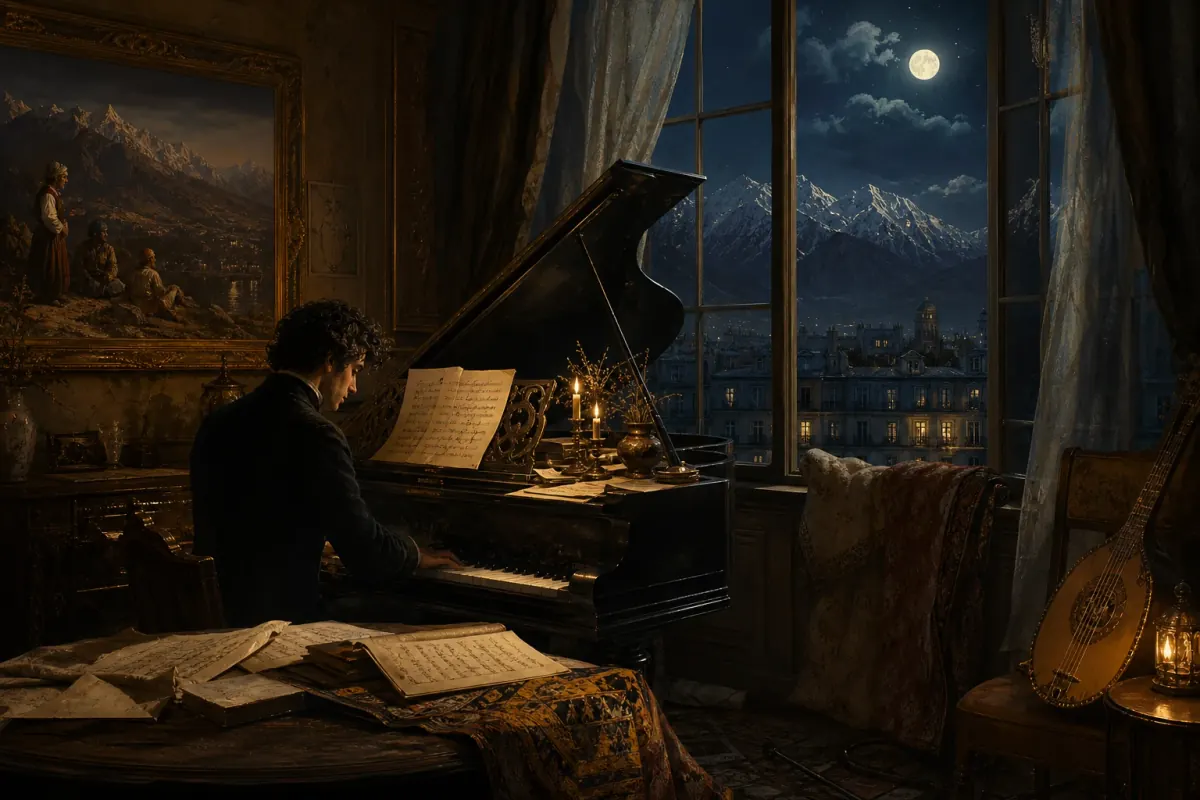
If one composer belongs to the piano more than any other, it is Frédéric Chopin. Almost everything he wrote was for the instrument, and he found in it a singing, intimate voice that nobody had heard before. This Chopin biography follows him from Warsaw to exile in Paris, explains the forms he made his own, lists the pieces worth hearing first, and looks at what Kurdish listeners and pianists can take from a composer who built art music out of his homeland's folk dances.
Quick facts
- Full name: Fryderyk Franciszek Chopin (in French, Frédéric François Chopin)
- Born: 1 March 1810 (baptismal record: 22 February), Żelazowa Wola, Duchy of Warsaw
- Died: 17 October 1849, Paris, aged 39
- Parents: Nicolas Chopin, a Frenchman from Lorraine who taught French in Warsaw, and Justyna Krzyżanowska, who was Polish
- Genre: Romantic classical music
- Instrument: piano
- Known for: nocturnes, mazurkas, polonaises, études, preludes, ballades, waltzes and two piano concertos
- Resting place: Père Lachaise Cemetery, Paris; his heart is in the Holy Cross Church, Warsaw
Early life in Warsaw
Chopin grew up in Warsaw, where his father taught French at the Warsaw Lyceum. The house was full of music, and the boy showed his gift early, both as a pianist and as a composer. He published his first small pieces as a child and played in the salons of the Warsaw aristocracy.
After the Lyceum he studied from 1826 to 1829 with Józef Elsner at the Warsaw Conservatory, working on theory, figured bass and composition. Elsner's final report praised his "exceptional talent" and "musical genius." In these years Chopin also spent summers in the Polish countryside, where he heard village music and dances. Those rhythms would stay with him for the rest of his life.
Before he left Poland he had already written his two piano concertos, No. 1 in E minor and No. 2 in F minor, and he had begun to play abroad, including concerts in Vienna in 1829.
Exile: from Warsaw to Paris
On 2 November 1830 Chopin left Warsaw for what was meant to be a study trip. Less than a month later the November Uprising against Russian rule broke out. The uprising was crushed, and Chopin never went home again. He became part of the "Great Emigration," the wave of Polish artists and political exiles who settled in Western Europe.
He arrived in Paris on 5 October 1831 and gave his Paris debut in February 1832. Paris made him. Robert Schumann had already greeted him in print with the words "Hats off, gentlemen, a genius!", and Chopin quickly found a place among the city's artists and aristocrats. Unusually for a great pianist, he disliked large public concerts. In his 18 years in Paris he performed in public only about 30 times, mostly in salons. He made his living from publishing and from teaching piano to wealthy pupils.
Career and the years with George Sand
In 1836 Chopin met the French novelist Aurore Dupin, who wrote as George Sand. By the summer of 1838 they were a couple. They spent the winter of 1838–39 on the Spanish island of Mallorca, hoping the climate would help his health. It was a miserable winter, cold, damp and hostile, and he was seriously ill, yet he finished his 24 Preludes, Op. 28, there.
For most of the next decade Chopin spent his summers at Sand's country house at Nohant in central France, where much of his mature music was written: the later ballades, the Polonaise-Fantaisie, the Barcarolle and the Third Sonata. The relationship ended in 1847, after about nine years.
His health, weak for years, was now failing. He gave his last Paris concert in February 1848. Later that year he toured Britain and played for Queen Victoria, but the trip exhausted him. He returned to Paris and died on 17 October 1849. His death certificate named tuberculosis; some modern researchers suggest pericarditis as a complication. At his funeral at the Church of the Madeleine, Mozart's Requiem was sung, as he had asked. His body lies in Père Lachaise, and his sister carried his heart back to Warsaw.
Signature works
Chopin took small forms and made them deep. The main genres to know:
- Nocturnes. Night pieces with a singing melody over a flowing accompaniment. He wrote 21.
- Mazurkas. More than 50 pieces based on Polish folk dances in triple time, with shifting accents and modal touches borrowed from village music.
- Polonaises. Proud Polish dances, including the "Military" Polonaise and the "Heroic" Polonaise in A-flat major, Op. 53.
- Études. 27 studies that train a technical problem while also being real music, including the "Revolutionary" and "Winter Wind."
- Preludes, Op. 28. 24 short pieces, one in each major and minor key.
- Ballades and scherzos. Four of each, his largest single-movement works.
- Sonatas and concertos. Above all the Piano Sonata No. 2 in B-flat minor, Op. 35, with its famous funeral march.
Best Chopin pieces to know
These are the titles people search for most:
- Nocturne in E-flat major, Op. 9 No. 2. The one everyone knows.
- Fantaisie-Impromptu, Op. 66. Published after his death, and a favourite showpiece.
- Étude in C minor, Op. 10 No. 12, "Revolutionary." Traditionally linked to his anger at the fall of Warsaw in 1831.
- Waltz in D-flat major, Op. 64 No. 1, "Minute Waltz." "Minute" means small, not sixty seconds.
- Prelude in D-flat major, Op. 28 No. 15, "Raindrop." A repeated note falls through the whole piece like rain.
- Ballade No. 1 in G minor, Op. 23. Stormy and narrative.
- Funeral March from the Piano Sonata No. 2, Op. 35.
- Polonaise in A-flat major, Op. 53, "Heroic."
- Nocturne in C-sharp minor (published after his death). Made famous again by the film The Pianist (2002).
- Prelude in E minor, Op. 28 No. 4. Two minutes of quiet grief, and playable for a late beginner.
Legacy
Chopin changed what the piano could say. He used the sustain pedal to blend harmonies into a haze of sound, he wrote melodies that imitate the human voice, and he stretched harmony in ways that later composers such as Liszt, Debussy and Scriabin built on. Almost every serious pianist studies his études, and his music is a core part of piano teaching worldwide.
Poland treats him as a national hero. The International Chopin Piano Competition in Warsaw, founded in 1927 and devoted only to his music, is one of the most prestigious piano competitions in the world. The 2025 edition was won by the American pianist Eric Lu, the first American winner since Garrick Ohlsson in 1970.
The Kurdish connection
Chopin had no direct contact with Kurdish music, and we won't pretend otherwise. But three real threads connect his story to ours.
Folk dance turned into art music. Chopin's mazurkas and polonaises take the rhythms and modal colours of Polish village dances and turn them into concert music, without losing where they came from. Kurdish musicians face the same question: how do you bring a dance song or a lament into a new setting and keep its soul? If you know the circle dances in our guide to Kurdish wedding music, govend and halay, listen to a Chopin mazurka and you'll recognise the idea, even though the sound is different.
Exile. Chopin wrote his most Polish music far from Poland, after an uprising made going home impossible. Many Kurdish artists lived a version of that story, such as Şivan Perwer, who has lived in exile since leaving Turkey in 1976. We have a whole playlist of songs of longing and exile.
A Kurdish pianist who learned from Chopin. Hersh Anwer, a pianist from the Kurdistan Region of Iraq, came to Canada as a refugee in 2016. Local press in Victoria reported that he had practised for hours by imitating recordings of master pianists such as Vladimir Ashkenazy playing Chopin's nocturnes, and that his recital there combined Chopin, Liszt and Rachmaninoff with Kurdish compositions and works of his own.
The piano itself sets a limit worth knowing. It is tuned in twelve equal semitones, so it can't play the quarter tones of maqams like Bayati. Chopin never needed them; Kurdish music often does. Our beginner guide to Kurdish songs on piano explains how pianists work around that.
For Sorani readers who want to go further into the great composers, KurdNote's library has Nawdarani Muziki Jihan (Famous Figures of World Music) and Zhiyannamey Gewre Muzikzanan, biographies of great musicians.
Where to start listening
- Nocturne Op. 9 No. 2. The Chopin sound in four minutes.
- Prelude in E minor, Op. 28 No. 4, then the "Raindrop" Prelude. Small pieces, big feeling.
- A mazurka, for example Op. 17 No. 4 in A minor. Listen for the folk rhythm and the modal colour.
- Ballade No. 1. Chopin telling a story without words.
- The "Heroic" Polonaise. Poland's pride in music.
- Piano Concerto No. 1, second movement. The young composer's farewell to Warsaw.
If you want the wider picture, read how Chopin's world grew out of Mozart's and Beethoven's.
Sources
- Frédéric Chopin, Wikipedia
- Frédéric Chopin, Simple English Wikipedia
- What music did Chopin choose for his funeral?, Interlude
- Frédéric Chopin and his suffering, Tidsskrift for Den norske legeforening
- American Eric Lu wins the 2025 Chopin Piano Competition, Bachtrack
- Hersh Anwer performs his first piano concert in Canada, Oak Bay News
Ready to play? Try reading a Kurdish melody from our free Sorani sheet music, then open the composer biographies in our books library.