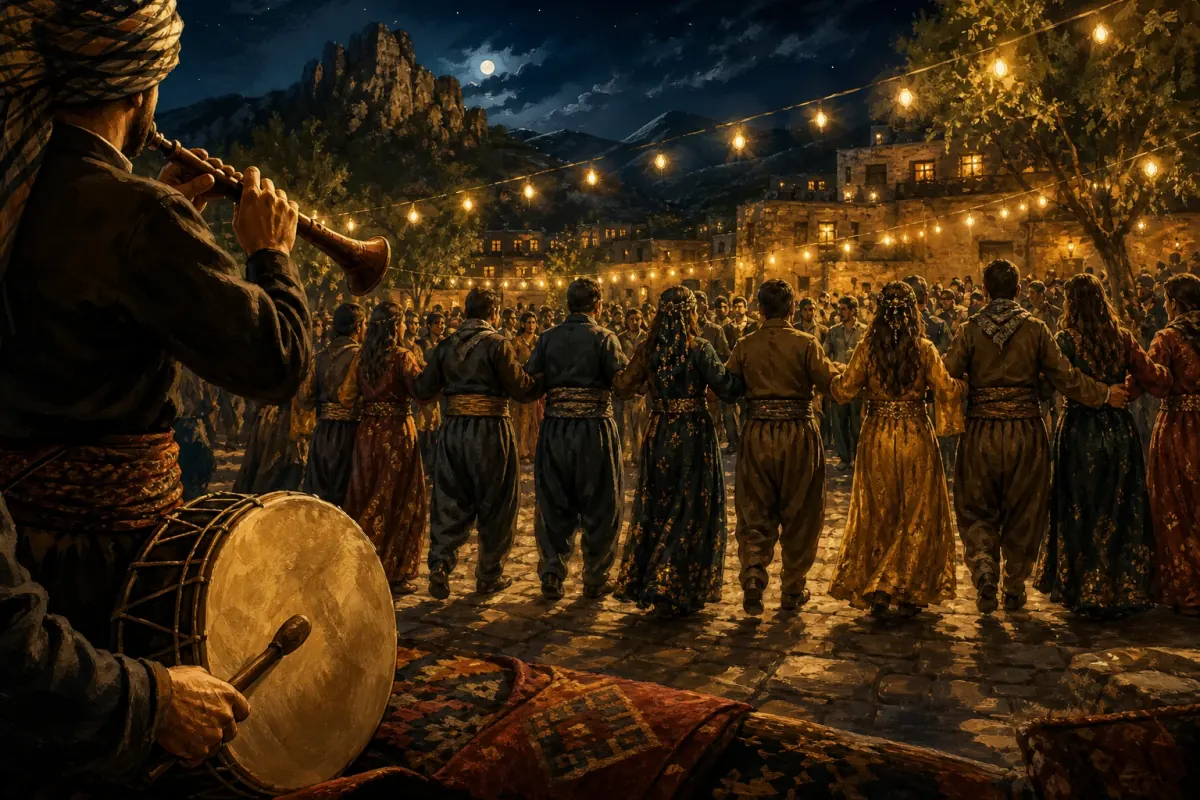
At a Kurdish wedding in Sulaymaniyah, Erbil or Kermanshah, there is a good chance that at some point the circle of dancers will be moving to a song by Aziz Waisi. He is not a concert-hall artist or a classical singer. He is something every Kurdish community needs just as much: a şayî singer, a master of fast, joyful dance songs built on folk melodies. When Kurds search for his name today, one of the most common words they add is kon, meaning "old". People want the songs they grew up dancing to.
This biography covers where he comes from, what kind of singer he is, his albums, his brush with the Iranian authorities in 2022, and the songs to start with.
Quick facts
- Name: Aziz Waisi (Sorani: عەزیز وەیسی; also written Aziz Weisi or Vaisi)
- Born: 21 February 1968, Salas-e Babajani county, Kermanshah province, Iranian Kurdistan
- Lives in: Javanrud, Kermanshah province
- Genre: Kurdish şayî (party and wedding song), folk-based pop
- Languages: Kurdish, with a few songs in Persian
- Albums: Seven, from Bemo (2006) to Newroz (2013), plus many singles
- Known for: Kura Kurd, Xirxal, Buk û Zava, Qaçaxçî, Melengê
Which Kurdish does he sing in?
It is worth being precise here, because Aziz Waisi comes from a region that is often misdescribed.
Salas-e Babajani and Javanrud lie in the north-west of Kermanshah province, close to the Iraqi border and to the Hawraman mountains. This is a borderland where several Kurdish varieties meet. Sorani Wikipedia lists Aziz Waisi among singers of Central Kurdish (the group that includes Sorani), and he performs mainly for Central Kurdish-speaking audiences in Iranian and Iraqi Kurdistan. That is why his Sorani fan base is so large.
His song titles often appear in Latin script on streaming platforms, as Xirxal or Buk û Zava, for example. That spelling can make them look like Kurmanji to some readers, but Latin-script titles are common for all Kurdish dialects on international platforms. We found no reliable source describing him as a Kurmanji singer, so we do not call him one. For more on how the Kurdish dialects shape their music, see our guide to Sorani and Kurmanji music traditions.
Early life
Aziz Waisi was born on 21 February 1968 in the county of Salas-e Babajani, part of Kermanshah province in Iranian (Eastern) Kurdistan. Sorani Wikipedia, English Wikipedia and the Sorani culture site Zaniary all agree on the year and place. He later settled in Javanrud, the nearby town that Rudaw and the human-rights group Hengaw both describe as his home.
Little has been published about his childhood or musical training, and we would rather leave that gap than fill it with guesswork. What is clear is the musical world he grew up in. Kermanshah's Kurdish villages and towns have a strong tradition of wedding music, where singers keep the dancers going for hours with long chains of folk songs over a driving beat.
Career
A şayî singer
Sorani Wikipedia calls Aziz Waisi a şayîxwên, literally "a singer of şayî". In Sorani, şayî means a celebration, especially a wedding, and a şayîxwên is the singer who leads it. As English Wikipedia summarises, citing the Kurdish news site AVA, most of his songs are based on Kurdish folklore and set to a fast rhythm.
This is demanding music. A wedding singer has to know a huge repertoire, read the room, and move smoothly from one dance rhythm to the next. The recordings that made Aziz Waisi famous carry that energy into the studio. Our article on Kurdish wedding music, govend and halay explains the dances these songs are made for.
The albums (2006–2013)
His recording career took off in the mid-2000s. Wikipedia and Zaniary list seven albums:
- Bemo (2006)
- Sehend (2007)
- Soma (2008)
- Dîlan (2009)
- Sema (2010)
- Herzane (2012)
- Newroz (2013)
These are the records behind the "old songs" people still search for. Since 2013 he has mostly released singles and music videos rather than full albums. Kurdish news sites regularly report his new clips, including three new videos for Newroz and Eid in 2024.
Across the border
Although he lives in Iran, much of his audience is in the Kurdistan Region of Iraq. Rudaw reported in 2014 that he travelled to Baghdad to perform in an election campaign, and Kurdish outlets record that he has sung at campaign events for several parties in the Kurdistan Region, including the KDP and the PUK.
He has also recorded duets with younger singers, among them Benazî with Aras Mohammad (2021) and Kura Kurd with the singer Sepideh.
Illness and arrest
In July 2020 he caught Covid-19, which was widely reported in the Kurdish press. He later recovered and spoke about it in a long interview with Rudaw in January 2021.
On 15 October 2022, during the protests that followed the death of Mahsa Amini, a young Kurdish woman, in Iranian police custody, Iranian security forces detained Aziz Waisi in Kermanshah. Rudaw and Hengaw both reported that he had posted a video on Instagram supporting the protests and had published a song dedicated to the people killed. His son Sahand confirmed the arrest. Rudaw reported the next day that he had been released on bail. We have not found reliable reporting on any later court outcome, so we say nothing more about it.
That moment put Aziz Waisi, a party singer, alongside the long line of Kurdish musicians whose work has collided with politics. Our article on music and revolutionary movements looks at that history more widely.
In his own words
The title of Rudaw's 2021 interview gives a good sense of how he sees his role. Translated, it reads: "I would like to sing only about the figure and grace of women." It is a light-hearted line, but it sums up the şayî tradition well. These are songs about love, beauty and celebration, made to be danced to.
Best songs
These are the titles fans search for most, along with a few recent favourites. Sorani spellings are in brackets.
- Kura Kurd (کوڕە کورد), "Kurdish Boy": a duet with Sepideh, one of his most streamed recent songs.
- Xirxal (خڕخاڵ), "Anklet": a dance song named after the traditional jangling anklet.
- Buk û Zava (بووک و زاوا), "Bride and Groom": an obvious wedding favourite.
- Qaçaxçî (قاچاخچی), "The Smuggler": a frequently searched title with his name.
- Melengê (مەلەنگێ): a 2020 release reported by the newspaper Xebat.
- Benazî (بەنازی): a 2021 duet with Aras Mohammad.
And for the "old songs": start with the albums Dîlan, Sema and Newroz, which contain much of the material fans remember from the late 2000s and early 2010s.
KurdNote does not yet have notation for Aziz Waisi's own songs. His repertoire, though, grows out of the same folk dance tradition as many pieces in our Kurdish wedding evening playlist and our Sorani folk notation.
Legacy
Aziz Waisi's importance lies less in innovation than in continuity. Wedding and party music is where most Kurds actually meet their musical tradition. It is where folk melodies are kept in daily use, and where young people learn the dances. Singers like him keep that living repertoire moving, adapting old tunes to modern sound systems and keyboards without losing the rhythms that make people stand up. Every Kurdish family has a wedding video with a soundtrack like his, and that is a kind of archive too. Many folk tunes survive today because singers like him keep playing them, night after night, for people who want to dance rather than to study.
He is also a reminder that Kurdish music does not stop at state borders. A singer from a small county in Kermanshah province became a household name in Erbil and Sulaymaniyah. That cross-border audience is part of what made the arrest of 2022 so widely reported.
The Kurdish connection on KurdNote
For another, very different singer from Iranian Kurdistan, meet Abbas Kamandi of Sanandaj in our full biography. For the instruments that drive Kurdish wedding music in the Kermanshah region, see our pages on the zurna and the daf. And if you want to understand why a new year album called Newroz matters so much, read our article on Newroz music.
Listening guide: where to start
- For the dance floor: Buk û Zava, then Xirxal.
- For the old songs: the albums Dîlan (2009) and Newroz (2013).
- For something newer: Kura Kurd with Sepideh, and Benazî with Aras Mohammad.
- To read more: our overview of famous Kurdish singers.
Ready to play the music behind the dance? Visit Aziz Waisi's artist page, then explore our wedding evening playlist and the free Sorani sheet music in the KurdNote library.
Sources
- Aziz Waisi, English Wikipedia
- عەزیز وەیسی, Sorani Wikipedia
- عەزیز وەیسی, Zaniary
- Popular Kurdish singer Aziz Waisi arrested in Iran for allegedly supporting protests, Rudaw English
- Aziz Vaisi, a famous singer from Javanrud, was detained, Hengaw
- عەزیز وەیسی: حەز دەکەم تەنیا بەسەر بەژن و باڵای ئافرەتاندا گۆرانی بڵێم, Rudaw Sorani (2021 interview)
- عەزیز وەیسی بۆ بانگەشە دەچێتە بەغدا, Rudaw Sorani (2014)
- عەزیز وەیسی سێ کلیپی نوێ بۆ نەورۆز و جەژن بڵاودەکاتەوە, AVA News (2024)