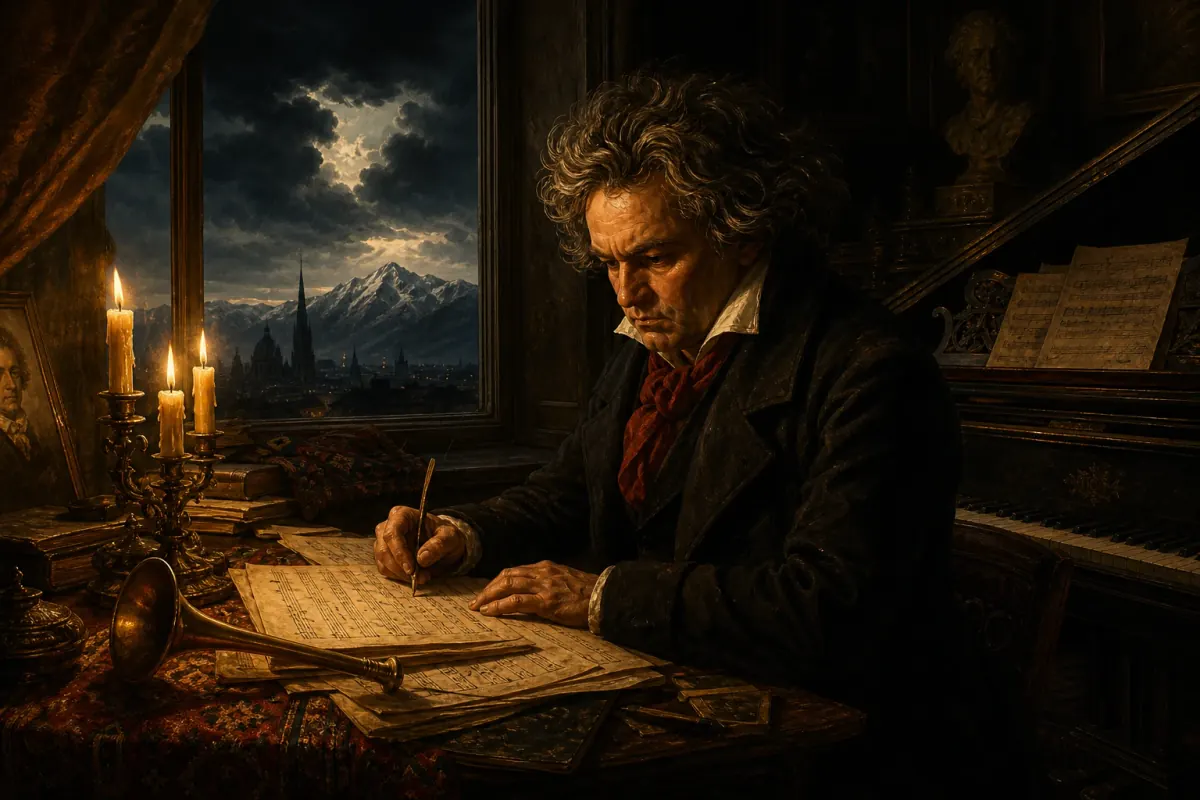
Ludwig van Beethoven is the composer who made music personal. He grew up in the Classical world of Haydn and Mozart, lost his hearing in his late twenties, and still wrote music that changed what a symphony, a sonata and a string quartet could be. Sorani readers already have good introductions to Beethoven, so this biography leans towards the practical. After the life story, you will find a listening plan for the nine symphonies, a guide to the 32 piano sonatas, and a realistic first repertoire for piano students.
Quick facts
- Full name: Ludwig van Beethoven
- Born: baptised 17 December 1770, Bonn (Electorate of Cologne, now Germany)
- Died: 26 March 1827, Vienna, aged 56
- Family: father Johann van Beethoven, a court singer; grandfather Ludwig, Kapellmeister at the Bonn court
- Genre: Western classical music, bridging the Classical and Romantic periods
- Instruments: piano, organ, viola
- Known for: 9 symphonies, 32 piano sonatas, 5 piano concertos, a violin concerto, 16 string quartets, the opera Fidelio and the Missa solemnis
- Also known for: composing through deafness
Early life in Bonn
Beethoven was born into a family of court musicians in Bonn. His grandfather and namesake led the court music; his father, Johann, sang in the court chapel and was the boy's first, often harsh, teacher. Johann's drinking weakened the family, and as a teenager Ludwig took on more and more responsibility for his mother and younger brothers.
His real mentor in Bonn was the court organist Christian Gottlob Neefe, who taught him Bach's Well-Tempered Clavier and helped him publish his first pieces. Beethoven played viola in the court orchestra and organ in the chapel, and he built a reputation as a brilliant improviser at the keyboard. His supporters included Count Ferdinand von Waldstein, who later received the dedication of the "Waldstein" Sonata.
Vienna and the three periods
In November 1792 Beethoven moved to Vienna to study composition with Joseph Haydn. Count Waldstein sent him off with a famous farewell note, telling him he would receive "the spirit of Mozart from the hands of Haydn." He never lived in Bonn again.
Historians often divide his work into three periods. It is a simplification, but a useful map.
Early period (to about 1802). Beethoven conquered Vienna first as a pianist. His early works, the first two symphonies, the first piano concertos, the Op. 18 string quartets and sonatas such as the Pathétique, speak the language of Haydn and Mozart with more force and surprise.
Middle, "heroic" period (about 1803–1814). His hearing had started to fail around 1798. In October 1802, staying in the village of Heiligenstadt, he wrote a letter to his brothers, never sent, now known as the Heiligenstadt Testament. In it he admits thoughts of suicide and decides to live on for the sake of his art. What followed was an explosion of large, dramatic works: the Eroica Symphony, which he had planned to title after Napoleon until he scratched out the name; Symphonies 4 to 8; the Waldstein and Appassionata sonatas; the Violin Concerto; the Fourth and Fifth ("Emperor") Piano Concertos; and his only opera, Fidelio.
Late period (about 1815–1827). By around 1818 he could no longer hold normal conversations and used conversation books in which visitors wrote their side. These were also years of family conflict, above all a long legal battle for custody of his nephew Karl. His output slowed but deepened: the Hammerklavier Sonata and the last three piano sonatas, the Missa solemnis, the late string quartets and the Ninth Symphony.
Deafness and the Ninth Symphony
The Ninth Symphony was premiered in Vienna on 7 May 1824. It was the first major symphony to bring in voices, setting Schiller's poem An die Freude (Ode to Joy) in the finale. Beethoven stood on stage beside the conductor. According to the famous account, when the music ended he was still facing the orchestra, and the contralto soloist Caroline Unger turned him around so that he could see the audience applauding.
It is worth being precise about his deafness. Research indicates that he never became completely deaf; he could still sense low tones and sudden loud sounds. But from his late thirties onward he could not hear music properly, and in his last decade he composed almost entirely from inner hearing. A 2023 genome study of his hair found no clear genetic cause for the hearing loss.
Death
Beethoven fell seriously ill in late 1826 and died in Vienna on 26 March 1827, aged 56. The autopsy found severe liver disease. The 2023 study, published in Current Biology, found hepatitis B in his hair and high-risk genes for liver disease. Combined with his drinking, these probably explain his final illness. The same study argued against the older theory of lead poisoning as the cause.
Signature works
- Symphonies: No. 3 Eroica, No. 5 in C minor, No. 6 Pastoral, No. 7 and No. 9 Choral
- Piano sonatas: Pathétique (Op. 13), Moonlight (Op. 27 No. 2), Waldstein (Op. 53), Appassionata (Op. 57), Hammerklavier (Op. 106) and the last three, Opp. 109–111
- Concertos: Piano Concerto No. 5 Emperor and the Violin Concerto in D major
- Chamber music: the late string quartets, including the Grosse Fuge, and the Kreutzer Violin Sonata
- Vocal music: Fidelio and the Missa solemnis
- Short pieces: Für Elise and the Bagatelles
Best Beethoven pieces to know
- Symphony No. 5 in C minor. The four-note opening is the most famous motif in classical music.
- Symphony No. 9, "Ode to Joy" finale. The melody is used as the anthem of Europe.
- Für Elise. A short piano piece, published decades after his death, that nearly every piano student meets.
- Moonlight Sonata, first movement. Slow, quiet and hypnotic.
- Pathétique Sonata, second movement. One of his most singable melodies.
- Symphony No. 7, second movement (Allegretto). A slow march that grows and grows.
- Symphony No. 6, "Pastoral." Countryside, birdsong and a storm.
- Piano Concerto No. 5, "Emperor."
- Appassionata Sonata. Fire from the first page to the last.
- Symphony No. 3, "Eroica." The work that opened his heroic period.
A listening plan for the nine symphonies
Don't start at No. 1 and go in order. Try this route:
- Symphony No. 5. Short, tight, and gripping from the first second. Listen for how the four-note motif appears in every movement, and how the dark C minor turns into a blazing C major finale.
- Symphony No. 7. Rhythm is everything here. If you like dance music, this is the one; Wagner famously called it "the apotheosis of the dance."
- Symphony No. 6, "Pastoral." Five movements that picture a day in the countryside. Calm, generous, and a good contrast after the Fifth.
- Symphony No. 3, "Eroica." Longer and more demanding. Give the first movement your full attention and then hear the funeral march.
- Symphony No. 9. Save it for when you're ready for an hour-long journey. Many people go straight to the finale, but the slow third movement is the key to the whole work.
- Then Nos. 1, 2, 4 and 8. Lighter and wittier, closer to Haydn, and easy to underrate.
A guide to the 32 piano sonatas
Thirty-two sonatas can feel like a wall. Here's a way in, first as a listener:
- Begin with the famous three: Pathétique (Op. 13), Moonlight (Op. 27 No. 2) and Appassionata (Op. 57).
- Then the middle-period giants: Waldstein (Op. 53) and Tempest (Op. 31 No. 2).
- Then the farewells: Les Adieux (Op. 81a), and after that the last three sonatas, Opp. 109, 110 and 111. These are some of the most profound music ever written for piano, but they reward patience.
- **Leave the Hammerklavier (Op. 106) for last.** It's the longest and hardest of them all.
If you play piano: a realistic first Beethoven repertoire
Beethoven isn't only for concert pianists. In rough order of difficulty:
- The Ode to Joy melody in simple arrangements. It moves mostly by step and stays within a small range, so it's ideal for the first weeks.
- Für Elise, the opening A section. The middle sections are harder; learn them later.
- Bagatelles from Op. 33, Op. 119 and Op. 126. Short character pieces, many of them manageable at an intermediate level.
- Moonlight Sonata, first movement. The notes are not hard; the challenge is keeping the triplets even and the melody singing on top.
- Pathétique, second movement. A lesson in singing tone and legato.
- The two easy sonatas, Op. 49 Nos. 1 and 2. Real Beethoven sonatas, written on a small scale.
Whatever you play, Beethoven's scores are full of dynamic markings, sforzandi and accents. Read them as carefully as the notes. If you're still learning to read the staff, start with our guide to how to read Kurdish music notation: the symbols are the same ones Beethoven used.
Legacy
Beethoven changed the image of the composer from a skilled servant of the court to an independent artist with something personal to say. His Ninth Symphony set the scale for Brahms, Bruckner and Mahler, and his late quartets still sound modern. The Ode to Joy melody was adopted as the anthem of the Council of Europe in 1972 and later as the anthem of the European Union. For many listeners around the world, the opening of the Fifth is simply what "classical music" sounds like.
The Kurdish connection
As with Mozart, we'll stick to connections we can check.
Kurdish orchestras. The Kurdistan Philharmonic Orchestra was founded in Sanandaj in 2005 and has over 50 musicians; its concertmaster is Arsalan Kamkar, of the Kamkar family we write about in our piece on the Kamkars. In 2018 Iran's Financial Tribune reported that the orchestra would perform Beethoven's Fifth Symphony in Sanandaj. In the Kurdistan Region of Iraq, the Kurdistan String Orchestra draws its players from the Institutes of Fine Arts in Sulaymaniyah, Erbil and Duhok, where Western classical repertoire is part of the training.
Shared notation. Beethoven's scores and KurdNote's Kurdish song transcriptions use the same five-line staff, clefs, key signatures and dynamic markings. The main addition in Kurdish scores is the quarter-tone accidental, which you need for maqams like Bayati and which the piano can't play. Our beginner guide to Kurdish songs on piano explains what to do about that.
An anthem tradition. The Ode to Joy shows how a melody can become a shared political symbol. Kurds know that story well, which is why we've written about Ey Reqîb, the Kurdish national anthem.
Beethoven in Sorani. KurdNote's library includes Sorani books on the great composers: Zhiyannamey Gewre Muzikzanan, biographies of great musicians, and Nawdarani Muziki Jihan (Famous Figures of World Music). For a broader history, see A Short History of World Music.
Where to start, in one line
Listen to the Fifth Symphony, play the Ode to Joy, and read the Heiligenstadt Testament. Together they tell you most of what you need to know about Beethoven. Then continue with Chopin, who took the piano in a direction Beethoven made possible.
Want to keep going? Open the composer biographies in our Sorani books library, or put your score-reading to work on our free Kurdish sheet music.
Sources
- Ludwig van Beethoven, Wikipedia
- Genomic analyses of hair from Ludwig van Beethoven, Current Biology (2023)00181-1)
- Beethoven's cause of death revealed from locks of hair, Nature
- DNA from Beethoven's hair reveals clues about his death, Smithsonian Magazine
- Kurdistan Philharmonic Orchestra, Wikipedia
- Kurdish Philharmonic Orchestra to perform in Sanandaj, Financial Tribune