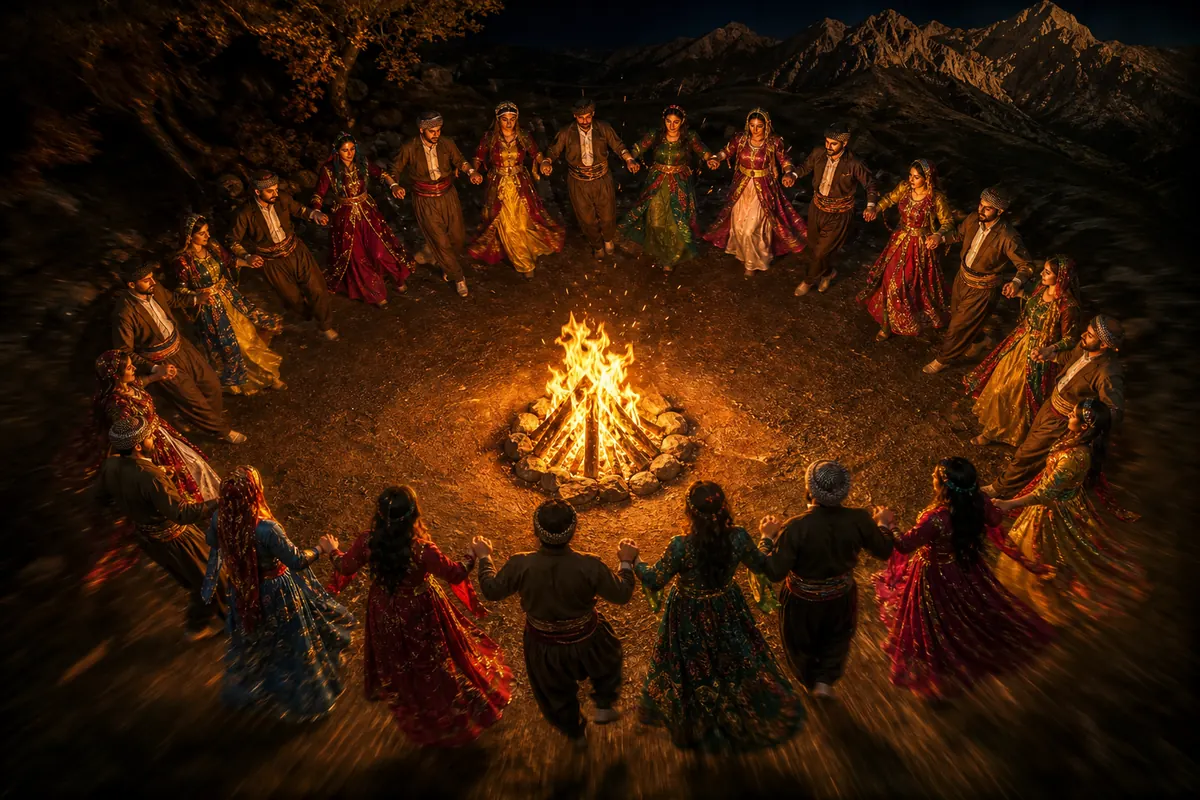
If you've never been to a Kurdish wedding, prepare yourself. There's a moment, often somewhere in the second hour, when the zurna player hits a particular phrase, the davul drummer answers, and a dance line forms that will keep growing for the next four hours.
This is govend. It's the heart of Kurdish wedding music, and it's something that has to be witnessed — preferably from inside the line, holding the hand of a stranger who somehow knows exactly when to step.
This is a guide for outsiders, diaspora Kurds reconnecting, and anyone who wants to understand how Kurdish weddings sound and why.
The dance: govend (and its cousins)
Govend is a circle (or line) dance. Participants stand shoulder-to-shoulder, often linking pinkies or holding handkerchiefs, and step in coordinated patterns that vary by region and tempo.
Key features:
- Open or closed circle. Sometimes the line forms a complete circle; sometimes it's a long curving line led by a head dancer.
- Head dancer (serçopî). The first person in the line — usually someone skilled who improvises step variations the others follow.
- Handkerchief. The head dancer often holds a handkerchief that they wave; symbolic and practical (signals the next move).
- Tempo shifts. A single govend session typically moves through several tempos — slow walking patterns, then medium 6/8, then faster 4/4 driving sections.
Regional names and variants:
| Name | Region | Characteristic |
|---|---|---|
| Govend | General Kurmanji | Most common term |
| Halay | Anatolia (broader Turkic-Kurdish) | Same dance family, slightly different step |
| Delilo | Eastern Anatolia | Specific tempo, named after the song "Delîla" |
| Dîlok | Kurmanji | Sometimes used as general term for celebration song-dance |
| Govenda Dîlanê | Northern Kurdistan | Wedding-specific govend variant |
Sorani Kurdish regions have their own variants — sometimes called helperke or referring to specific named dances tied to particular songs.
The instruments: zurna and davul
The classic Kurdish wedding ensemble is two instruments — and that's enough for a 12-hour wedding.
Zurna
A loud double-reed conical-bore shawm. Designed to be heard outdoors, across a village square, against a crowd of dancing celebrants. The zurna player carries the melody, often improvising elaborate ornamentation between fixed melodic phrases.
Read more about zurna and other Kurdish instruments.
Davul
A large double-headed drum, played with two sticks of different sizes. The heavy stick on the bass head produces deep punctuation; the thin switch on the snare head produces fast filling rhythms. The davul drummer drives the dance tempo and signals tempo changes.
Why these two?
The zurna-davul pair has been the wedding sound across the broader Anatolia/Mesopotamia region for centuries — across Kurdish, Turkish, Armenian, and Greek wedding traditions. They're loud (no amplification needed), portable (can be carried through processions), and rhythmically efficient (two musicians can play for hours).
Modern Kurdish weddings often add:
- Electric organ or keyboard (for indoor venues with PA systems)
- Saz or oud (for slower, more melodic moments)
- A vocalist with mic
- DJ for non-Kurdish portions of the night
But the zurna-davul moment — usually for the procession of the bride and groom, and for peak govend — remains essential.
What a Kurdish wedding sounds like (timeline)
Here's a typical sequence in a 2026 Kurdish wedding (varies by region, family, and venue):
Procession (gathering of bride/groom)
Music: Zurna and davul outdoors. Slow ceremonial tempo. Mood: Anticipation. Family elders walk with the couple toward the venue.
Entry and welcome
Music: Zurna-davul transition to celebratory tempo. Sometimes a singer announces the couple's arrival. Mood: Energetic but formal.
Slower opening dances
Music: Often a slower govend in 6/8 or even free rhythm. May include a vocal piece. Mood: Dignified beginning. Older relatives lead.
The govend builds
Music: Tempo increases gradually. The line gets longer as more people join. Mood: Each generation joins the line. Eventually everyone is dancing.
Peak govend (1-3 hours)
Music: Driving 4/4 or 6/8. The zurna and davul reach maximum volume. Mood: Pure euphoria. This is what people will remember in 50 years.
Special songs
Music: Specific songs called for by guests — wedding traditional pieces, songs about the bride/groom's home village, regional variants. Mood: Sentimental anchors throughout the celebration.
Late night
Music: Mix of recorded modern Kurdish music, regional traditional songs, sometimes pop hits. Mood: Younger crowd, looser energy.
Closing
Music: Often a final ceremonial piece, sometimes slow, sometimes another high-energy govend depending on family tradition. Mood: Tired but happy. Goodbyes.
Wedding songs you'll hear
A short list of songs that consistently appear at Kurdish weddings (with notation links where we have them):
Kurmanji weddings
- "Bana Bana" — Şivan Perwer classic. Always.
- "Delîla" — gives its name to the delilo dance variant
- "Hey Lê" — Kurmanji wedding standard
- "Govenda Dîlanê" — explicitly named for wedding govend
- "Dîl û Dîlbera Min" — by Mihemed Şêxo — slower romantic moment
Sorani weddings
- "Baran Barana" — bright, danceable
- "Helperke" — names a regional dance
- "Dasta Baw Daye" — wedding ceremonial
- "Yar Yarê" — addressed to the beloved
Newer / pan-Kurdish
- "Kêçê Kurdan" (Aynur Doğan) — modern but quickly became wedding-standard
- Various Naser Razazi tracks — particularly his fast-tempo material
- Modern Kurdish pop that the younger generation requests
If you're DJing a Kurdish wedding, mix all three categories. A Sorani-only set would alienate Kurmanji guests, and vice versa.
What the music is doing socially
Beyond the joy, Kurdish wedding music does specific cultural work:
Generational binding
The govend line forces interaction. A grandmother holds the hand of her grandson's friend; cousins dance with cousins they've never met. The music doesn't allow social isolation.
Regional bridging
Mixed Kurdish weddings (Sorani groom, Kurmanji bride, or Turkish-Kurdish + Iraqi-Kurdish) work because the wedding music canon includes both. Each tradition gets representation.
Diaspora reconnection
For diaspora Kurds in Sweden, Germany, the US, weddings are often the major occasion when traditional Kurdish music is played live. Many young Kurds learn govend at weddings rather than at home.
Political continuity
For decades when Kurdish music was suppressed, weddings were one of the few protected spaces where Kurdish-language singing continued. Wedding music carried forward what couldn't survive in concert halls or radio.
How to participate (if you're an outsider)
If you're invited to a Kurdish wedding and you're not Kurdish, here's what to expect:
- Eat a lot. Kurdish hospitality is intense. Refusing food is awkward.
- Join the govend. Even if you don't know the steps, you'll be pulled in. Hold the hand of whoever is next to you, copy their feet, smile. The line absorbs beginners gracefully.
- Don't worry about the language. Most wedding music doesn't depend on understanding lyrics.
- Tip the zurna player. Cash gifts to the musicians — pinned to clothing or thrown into the dance circle — is traditional. A small bill is fine.
- Stay until the end if possible. Leaving early is impolite unless you have a clear reason.
- Bring your own dance energy. Kurdish weddings are not standing-around-watching events. Participation is the whole point.
How to learn govend (basic)
Three steps for the most common govend:
- Right foot crosses in front of left (one beat)
- Left foot steps left (one beat)
- Right foot steps left to meet (one beat) — there's often a small bounce here
- Repeat, moving counterclockwise
That's the simplest step. There are dozens of variants — some include leg-kicks, some have leaning patterns, some involve bouncing on the spot. Watch the head dancer and copy.
Continue exploring
- 12 Famous Kurdish Singers — many of whom recorded wedding music
- Kurdish Musical Instruments Guide — deep dive on zurna, davul, and the whole family
- The 10 Most Famous Kurdish Folk Songs — including the wedding standards
- Browse Kurdish notation — sheet music for many wedding songs
If you have wedding music recordings, regional dance variants, or want to contribute a tutorial, get in touch.