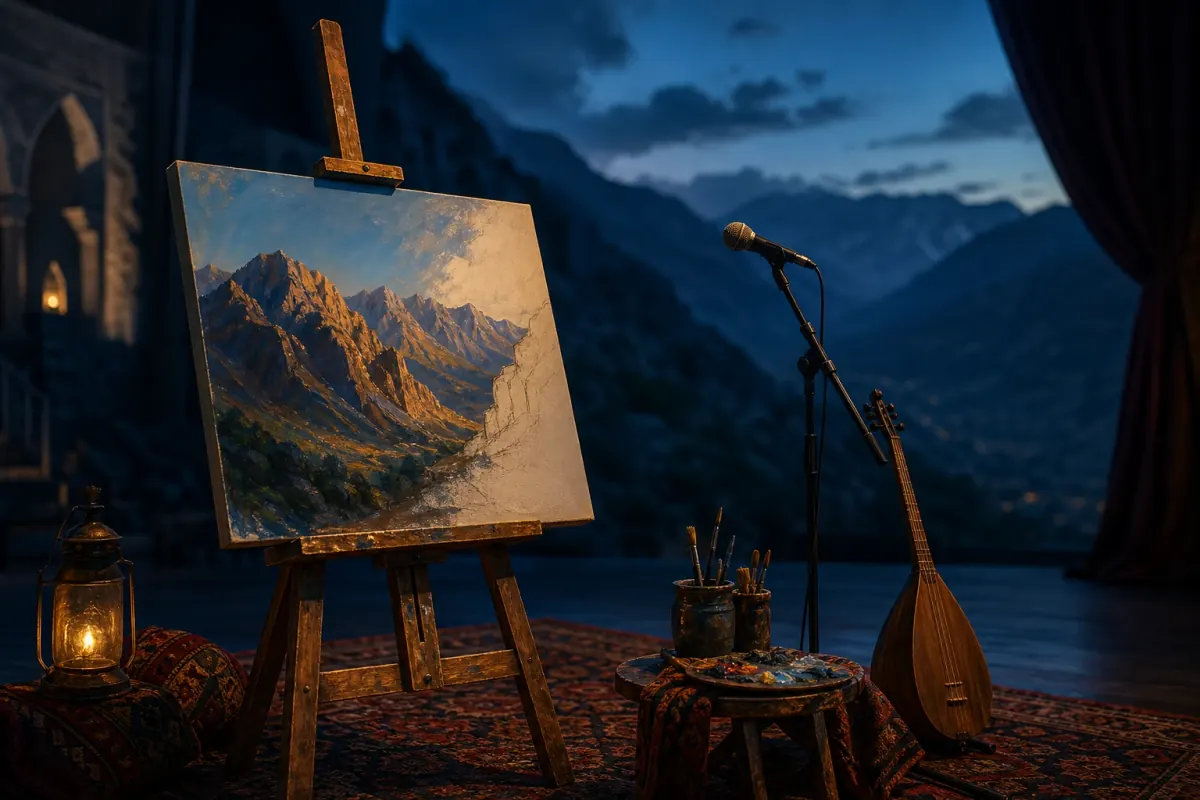
Adnan Karim is one of the most loved voices in Sorani Kurdish music. A painter, oud player and composer as well as a singer, he has spent more than four decades setting the verses of classical Kurdish poets to music, giving centuries-old poems a second life in living rooms, cars and concert halls. His songs are a staple of Kurdish evenings from Sulaymaniyah to Stockholm.
This article covers his life, his albums, the ten songs we think every listener should know, and where to start listening.
Quick facts
- Full name: Adnan Karim Rashid (Sorani: عەدنان کەریم ڕەشید)
- Born: 1963, Imam Qasim neighbourhood, Kirkuk
- Family origin: the village of Jajla, Sharbazher district (per Sorani Wikipedia)
- Lives in: Sweden, since 1992
- Genre: Kurdish classical and traditional song, sung poetry
- Instruments: Voice, oud
- Also: Painter, graduate of the Institute of Fine Arts, Sulaymaniyah (1985)
- Known for: Peyamî Min, Henasey Aşiqan, Dilî Min, Desmalê, Sozî Dil
Early life: Kirkuk and Sulaymaniyah
Adnan Karim was born in Kirkuk in 1963. Sorani Wikipedia places his birth in the city's Imam Qasim neighbourhood and traces the family's roots to the village of Jajla in the Sharbazher area. Like many Kurdish families in Kirkuk at the time, they were pushed out by the Ba'ath regime's deportation and Arabisation policies and settled in Sulaymaniyah. Kurdish Globe describes a low-income household where the parents put education first despite the hardship.
In Sulaymaniyah he trained as a visual artist. He graduated from the Institute of Fine Arts as a painter in 1985, and painting has stayed a parallel career ever since: his work has been exhibited internationally, and he later held a post as an assistant lecturer in painting at the University of Sulaymaniyah.
Career
Sulaymaniyah beginnings (1979–1991)
His first public performance came in 1979, with the Sulaymaniyah Music Ensemble, singing Desmalê. According to Sorani Wikipedia, the next year he recorded Kaziwe for a stage play in the city. Through the 1980s he recorded with several of Sulaymaniyah's ensembles and worked with leading composers of the time, including Anwar Qaradaghi and Salah Raouf. One of the songs from that period is Azîzekem (1984), with music by Salah Raouf and words by the poet Hasib Qaradaghi.
That early work already showed the pattern of his career: well-crafted melodies built around serious Kurdish poetry rather than light dance lyrics.
Exile and a new start in Sweden (1991–1999)
In 1991 Adnan Karim left Kurdistan in the mass exodus that followed the collapse of the uprising. Sorani Wikipedia says he spent a period in Mahabad, in Iranian Kurdistan, working as an oud player with musicians of the Mukriyan region. In 1992 he reached Sweden, where he has lived ever since. He holds Iraqi and Swedish citizenship.
In Sweden he had to rebuild his career almost from scratch. His first release abroad was the cassette Birtan Ekem ("I Miss You", 1993). Sorani Wikipedia notes that he then took a one-year course in sound and music recording, which let him produce his own records. Then came Raz (1995), Şewî Yelda (1996, his first CD) and Eroy Oxir (1999).
The international years (2000–2010s)
In 2000 he gave a concert at Stockholm's main concert hall, a milestone that English Wikipedia and Kurdish Globe both highlight. The 2000s brought his best-known albums:
- Şney Ba ("Breeze", 2002), which contains Peyamî Min
- Tafgeyek le Işq ("A Waterfall of Love", 2005), which contains Sozî Dil
- Emşew ("Tonight", 2006), recorded in Tehran with the Kamkars, the celebrated family ensemble from Sanandaj
- Wefayî (2010), named after the classical poet Wafayi
- Xatûn (2011) and Badey Gulrreng (2012), followed by later albums including Habîbe (2017) and Şewba (2019)
He has also toured widely, with concerts in London, the Netherlands, the Kurdistan Region and Sanandaj, and more recently at London's Opera Holland Park.
Kurd Idol
In 2017 he returned to a wide television audience as a judge on Kurd Idol, the Kurdish-language singing competition launched in Sulaymaniyah. He sat on the panel alongside Bijan Kamkar, Kanî and Nizamettin Ariç.
Signature works
- Sung poetry. His defining contribution is setting classical and modern Kurdish poetry to music. The album Wefayî is the clearest example, built around the verse of one of the great Sorani classical poets.
- The oud. He composes at the oud, and his arrangements keep its warm, intimate sound at the centre even when a full ensemble plays. Our article on the oud in Kurdish music gives more background on the instrument.
- ***Emşew* with the Kamkars.** A meeting of Iraqi-Kurdish and Iranian-Kurdish art music. Read more about the ensemble in our article on the Kamkars.
10 essential songs (best songs)
- Peyamî Min (پەیامی من), "My Message": Şney Ba, 2002. The song people search for most.
- Henasey Aşiqan (هەناسەی ئاشقان), also known as Weku Ney (وەکو نەی): a much-loved duet with Tara Jaff, whose harp adds a rare colour to Kurdish song.
- Dilî Min (دڵی من), "My Heart": Emşew, with the Kamkars, 2006.
- Azîzekem (ئازیزەکەم), "My Dear": a 1984 recording, music by Salah Raouf, words by Hasib Qaradaghi.
- Sozî Dil (سۆزی دڵ), "The Heart's Vow": Tafgeyek le Işq, 2005.
- Desmalê (دەسماڵێ): his very first song from 1979, re-recorded in later years.
- Şewî Yelda (شەوی یەڵدا), "Yalda Night": title track of his first CD, 1996.
- Eroy Oxir (ئەڕۆی ئۆغر), "Farewell": title track, 1999.
- Birtan Ekem (بیرتان ئەکەم), "I Miss You": title song of his first album in exile, 1993.
- Xatûn (خاتوون): title track, 2011.
A note for musicians: Adnan Karim's Azîzekem is a different song from the folk song Ezîzekem associated with Hassan Zirek. KurdNote has sheet music for Hassan Zirek's Ezîzekem, not for Adnan Karim's song.
Adnan Karim's voice and style: what to listen for
If you have never heard Adnan Karim, it helps to know what to listen for.
The voice. Opera Holland Park describes him as having an expressive baritone, and that is the first thing most listeners notice. He rarely pushes for volume. He leans into long, held phrases and lets the ornaments grow out of the melody, the way the older Sulaymaniyah radio singers did.
The words come first. Because so many of his songs are settings of existing poems, the melody follows the metre and the meaning of the verse. You will hear him slow down on a key image or repeat a line so that it sinks in. For listeners who grew up with these poems at school, part of the pleasure is hearing a familiar text suddenly become a song.
The ensemble. His arrangements usually centre on the oud, often with strings and frame drums such as the daf, and sometimes a full orchestra. Sorani Wikipedia includes a photograph of him in concert with the Iraqi National Symphony Orchestra, and his 2002 Swedish concert album features a daf feature with the percussionist Hussein Zahawi.
Modes, not chords. Like most Kurdish art song, his melodies move within the maqam system rather than Western harmony. His Badey Gulrreng albums (2012 and 2015) even name tracks after modes, such as Hîcaz, Çwarga and Bayat. If those names are new to you, our page on maqam Hijaz and our explainer What is a maqam? are a good place to start.
Adnan Karim's legacy
Adnan Karim's legacy rests on three things.
He made classical poetry popular. Kurdish classical verse can be dense and difficult on the page. Sung to his melodies, it became something people hum, and a generation of listeners first met the old poets through his albums.
He kept Kurdish art music alive in exile. Leaving Kurdistan in 1991 could have ended his career. Instead he learned to record and produce himself in Sweden and built an international audience from there. His path is part of the wider story told in our article on Kurdish diaspora music.
He bridged Kurdish regions. His work with the Kamkars from Sanandaj and his concerts across the Kurdistan Region, Iran and Europe helped connect the Sorani-speaking music scenes of Iraq and Iran.
Adnan Karim on KurdNote
Our library includes **Pepule (پەپولە)**, a book by Adnan Karim, free to read as a PDF. His artist page gathers his biography and key songs in one place, his duets with Tara Jaff link him to another of our artist pages, and the oud has a page of its own. For the wider picture of the singers around him, see our guide to famous Kurdish singers.
Listening guide: where to start
- First listen: Peyamî Min, then Henasey Aşiqan with Tara Jaff.
- A full album: Şney Ba (2002), or Emşew (2006) if you also want to hear the Kamkars.
- For poetry lovers: Wefayî (2010).
- To hear where it began: Desmalê and Azîzekem from the Sulaymaniyah years.
- Related reading: Zakaria Abdulla, a very different Kurdish singer who also built his career in Sweden; read his biography.
Sources
- Adnan Karim, English Wikipedia
- عەدنان کەریم, Sorani Wikipedia
- Adnan Karim, Kurdish Globe
- Adnan Karim in London, Opera Holland Park
- Kurd Idol, English Wikipedia and Kurd Idol full cast, IMDb
- Tara Jaff, English Wikipedia
Want to go further? Visit Adnan Karim's artist page, download his book Pepule for free, or explore our Sorani sheet music and play these melodies yourself.