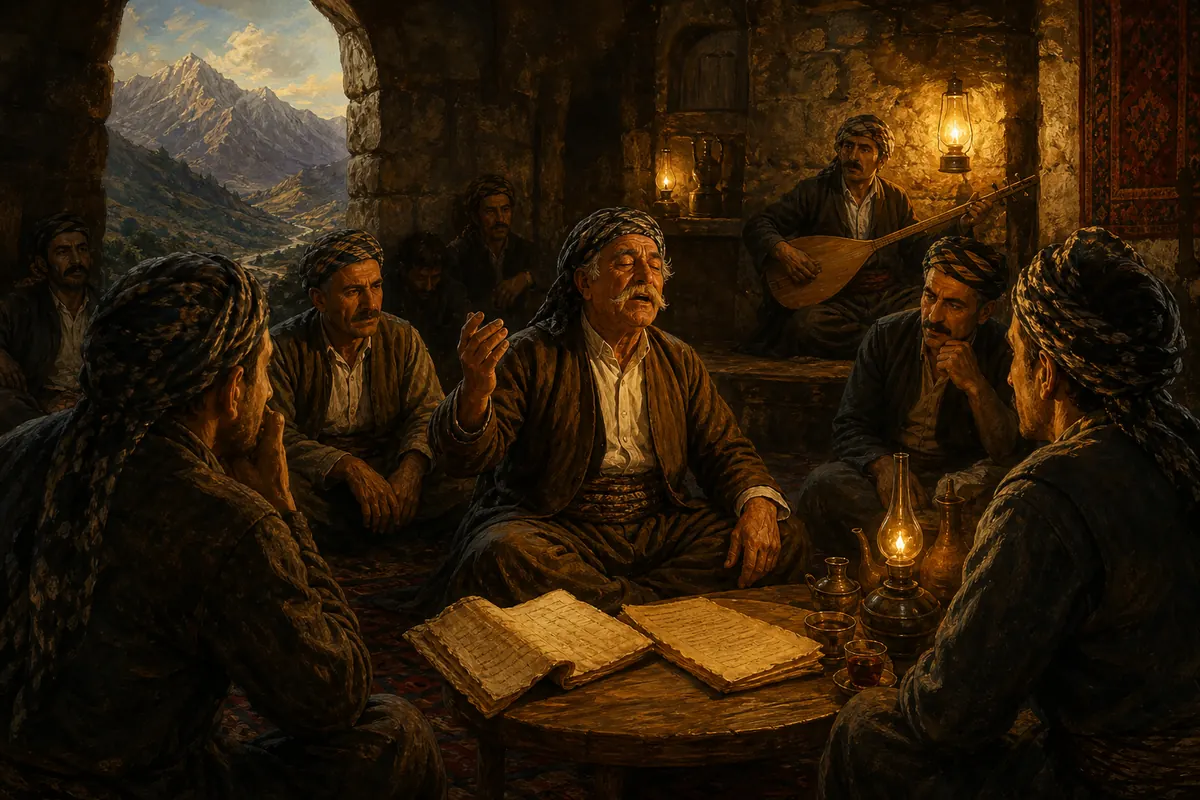
For most of Kurdish history, music wasn't written down — it was remembered. A dengbêj could recite a thousand-line epic from memory; a wedding singer could perform fifty songs without ever seeing a page of notation. This worked beautifully for centuries, until the 20th century made it dangerous.
This is a short history of how Kurdish music finally got transcribed, who fought to preserve it, and why the work isn't finished.
Before notation: the oral tradition (pre-1900)
Kurdish music sat inside an oral framework that included:
- Dengbêj singers carrying historical epics
- Mullahs and dervishes preserving sacred song repertoire (especially Yarsani and Alevi traditions)
- Wedding professionals transmitting the dance cycle (govend / halay)
- Stranbêj (women singers) holding the lullaby and lament repertoire
A song might exist in dozens of regional variants, transmitted parent to child, master to apprentice. The "score" was the singer's memory, refined over decades.
This system worked when communities stayed put. It started failing when Kurdish populations were dispersed by 20th-century borders, displacement, and political pressure.
The first transcriptions (1920s–1950s)
The earliest systematic Kurdish music transcriptions came from outside Kurdistan:
- Soviet ethnomusicologists documented Yezidi Kurdish songs in Armenia and Georgia in the 1920s–30s. These early recordings and notations are now in the archives of Yerevan and Tbilisi.
- Cemil Demirkır and a small group of Turkish Kurdish intellectuals quietly transcribed Kurmanji folk songs in the 1940s–50s, often at personal risk. (Kurdish was banned in Turkey for decades — even the language itself was illegal in public.)
- Iranian Kurdish musicians like Ali Akbar Sheida (active in the 1940s) began notating Sorani folk pieces using the Iranian radif notation system.
These transcriptions were scattered, uncatalogued, and often lost.
The Mahabad and Sulaymaniyah generation (1950s–1970s)
The post-WWII period brought Kurdish nationalism to the surface, and with it, formal music education:
- Mahabad (Iran) became a center of Sorani musical scholarship. Musicians like Hassan Zirek, Mazhar Khaleqi, and the Khaleqi family wrote down songs — sometimes for performance archives, sometimes for radio.
- Sulaymaniyah (Iraq) developed its own tradition through the Institute of Fine Arts and Iraqi Radio. Notation was Western-staff based, with Iraqi maqam annotations.
- Yerevan Radio (Armenia) ran a regular Kurdish-language music program that transcribed and archived songs from the diaspora.
This is the era most of the notation in our library traces back to. The transcriptions you can download from KurdNote are descendants of work done by these mid-century musicians.
The dark decades (1980s–1990s)
For a long stretch, Kurdish music transcription was politically dangerous:
- In Turkey, Kurdish-language broadcast was banned (1980–1991); printing Kurdish was severely restricted. Many musicians went into exile in Sweden, Germany, France.
- In Iraq, the Anfal campaign (1986–89) destroyed Kurdish villages — and with them, oral tradition holders.
- In Iran, the post-revolutionary period restricted female vocal music and certain Kurdish styles.
Yet the work continued in exile. The diaspora — especially Stockholm, Berlin, Paris, and London — became the new archives. Musicians like Şivan Perwer worked from Sweden to record and notate Kurmanji repertoire that couldn't be preserved at home.
The digital turn (2000s–present)
Two technologies changed everything:
- Affordable digital recording — suddenly musicians could capture and share songs without state apparatus.
- MusicXML and PDF distribution — notation became transmissible across countries with no print run, no physical book.
But quality varied wildly. A song might exist in twelve different YouTube recordings and three contradictory transcriptions. There was no central library.
That's the gap KurdNote is trying to fill.
What KurdNote does now
We've collected, cleaned, and standardized 45 notation pieces and 26 Kurdish music books. Each transcription has:
- A standard PDF score
- Where available, an MP3 reference recording
- Where available, a MusicXML file for software import
- Clear labeling of dialect (Sorani / Kurmanji), maqam, and tempo
This is a small library compared to what exists for, say, Persian classical music — but it's growing, and unlike scattered YouTube transcriptions, it's findable. We've built Sorani-specific and Kurmanji-specific collections so researchers can navigate by tradition.
What's not done — yet
This work is incomplete. Three big gaps:
- Hawrami and Zazaki music — the smaller Kurdish dialects deserve their own collections. We don't have transcriptions yet.
- Religious music — Yarsani, Yezidi, and Alevi sacred traditions are sparsely documented. Sensitive cultural work, requiring partnership with community elders.
- Contemporary composition — most of our library is folk; modern Kurdish composers (Dilshad Said, Tara Jaff, Aynur Doğan's transcribed works) deserve documentation too.
If you have transcriptions, recordings, or knowledge that can fill any of these gaps, please reach out.
Why preservation matters
Cultural archives are political. Every song that gets written down is a song that survives an extra generation. Every PDF in this library is a small refusal — a tiny "not yet" against the slow erosion of oral tradition.
For Kurdish music, this isn't abstract. The dengbêj tradition is at risk. The kamancheh masters are aging. The wedding singers in some villages are the last generation who learned songs from grandparents.
You can help just by listening — every play, every download, every share keeps the tradition alive.
Further reading
- How to Read Kurdish Music Notation — beginner's guide
- Sorani vs Kurmanji Music Traditions — the two great rivers explained
- Browse all Kurdish notation — 45 pieces, free PDF download
- Browse Kurdish music books — 26 titles in our library
This article is a living document. If you have historical sources, corrections, or stories that should be in here, contact us.