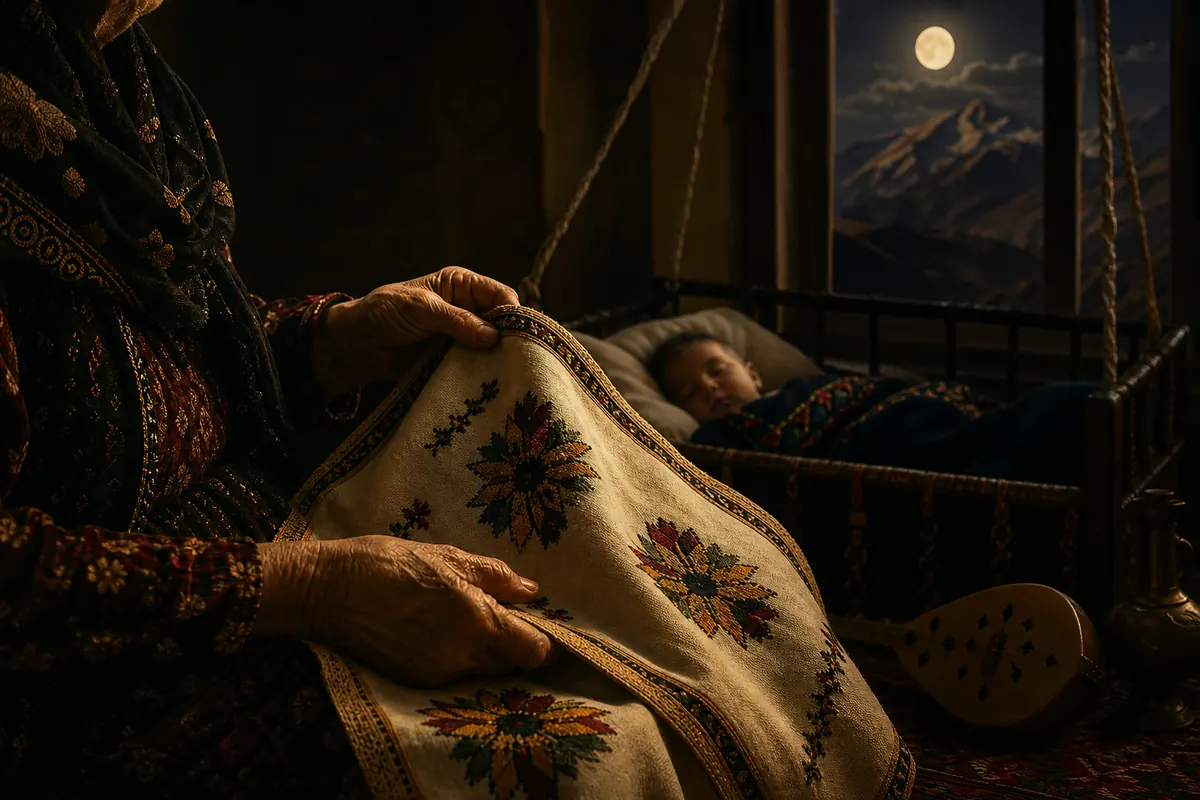
There's a category of Kurdish music almost no one writes about: the songs Kurdish mothers and grandmothers have sung to babies for centuries. They don't have famous performers, weren't recorded for radio, and rarely made it into official archives. They're called lawk and heyran depending on the dialect and tradition — and they're some of the most beautiful, fragile, and endangered material in the Kurdish canon.
This is a guide to that hidden tradition.
Lawk — the Kurmanji form
In Kurmanji Kurdish, the word lawk (sometimes lawik) refers broadly to a short folk song. Within the Kurmanji oral tradition, lawk encompasses:
- Lullabies addressed to a sleeping or fretful child
- Work songs sung during repetitive household tasks (grinding wheat, weaving, milking)
- Short narrative vignettes about love, family, or village life
- Wedding songs for specific moments (henna application, the bride's farewell)
What unites lawk is brevity (compared to the long destan epics of the male dengbêj) and the women-centered context of their performance. Lawk lived in courtyards, kitchens, and bedrooms. They were the soundtrack of Kurdish domestic life.
Typical features
- Short. Often 4-12 lines repeated.
- Repetitive melodic structure. A single melodic phrase elaborated through verses.
- Modal scales — often maqam Bayati or maqam Kurd, giving them their characteristic plaintive quality.
- Direct address. "My child," "my dove," "my flower" — the singer speaks TO someone (the baby, the absent husband, the loved one).
- Often without instrumental accompaniment. Voice alone, or with the rhythm of whatever task is being done.
Heyran — the Sorani form
In Sorani Kurdish, heyran is a more formal classical vocal genre. The word literally means "wandering" or "lost in love" — pointing to the genre's emotional territory.
Heyran songs are typically:
- Slow and meditative
- Long-phrased — extended melismatic vocal lines
- Centered on themes of love, separation, longing, spiritual seeking
- Often performed in the unmeasured "âvâz" introduction of larger pieces, before a meter establishes
- Connected to the Persian-influenced classical tradition common in Sanandaj and Mahabad
A heyran can stand alone or serve as an opening to a longer ballad. Mazhar Khaleqi was a recognized master of heyran-style singing.
Why these traditions almost disappeared
Three reasons the lullaby and women's vocal traditions are particularly endangered:
1. They were never publicly performed
Lawk and heyran lullabies happened in domestic spaces. They weren't recorded by Iraqi Radio or Yerevan Radio in significant volume because they weren't seen as performance material. They were assumed to be too informal for archive.
2. The women who sang them rarely traveled
Male dengbêj traveled between villages and cities, performing for paying audiences. Their repertoire spread. Women's lullaby repertoire stayed local — passed mother-to-daughter, sometimes unique to a single village or family.
3. Modernization broke transmission
When Kurdish women migrated to cities or to the diaspora, the social structures that had supported lullaby transmission collapsed. A grandmother in a Stockholm apartment cannot teach lullabies the way she could in a Diyarbakır courtyard. The chain breaks.
The result: even within Kurdish families, the lullaby canon often skipped a generation. Children born in the 1990s and 2000s in cities or diaspora may know contemporary Kurdish folk (Şivan Perwer, Aynur Doğan) but never have heard a single traditional lawk.
What we know about themes
From the recordings and academic transcriptions that DO exist, recurring themes in Kurdish lullabies include:
Direct address to the child
"Sleep, my flower." "Little dove, sleep." "My moon, my heart, sleep."
Promises and protection
Songs that promise the child future love, beauty, marriage, prosperity. Sometimes that the child will avenge family losses (a particularly Kurdish lullaby motif — protection through future strength).
The absent father
Many Kurdish lullabies address a father who is away — at war, at work, in exile. The mother sings for the child but also for herself.
Mountains and flowers
The same imagery that pervades Kurdish folk poetry generally appears in lullabies. Mountains as protectors, flowers as symbols of fragility.
The cradle (lîlîk, gûhar)
Specific lullaby formulas address the cradle itself, often with onomatopoeic words for its rocking motion.
Where to hear traditional lullabies
This is one of the harder parts of the Kurdish canon to access, but options exist:
Ayşe Şan's recordings
Ayşe Şan is the most important preserver of Kurmanji women's repertoire. Her recordings include lullaby material that is otherwise undocumented. Search her name on YouTube.
Yerevan Radio archive
Some Yerevan Radio Kurdish broadcasts included women singers in the 1950s-70s. The archive is not fully digitized but excerpts circulate.
Aynur Doğan's contemporary work
Aynur has revived several traditional Kurmanji women's pieces in modern recording. Her album "Keçe Kurdan" includes material with traditional roots.
Academic field recordings
SOAS, Inalco (Paris), and several Turkish universities have field recordings of Kurdish village music including lullabies. Most are not publicly accessible but research arrangements are possible.
Family recordings
This is the hard truth: the most authentic source is your own family. If you have Kurdish grandparents (or great-grandparents) still living, ASK THEM TO SING. Record them. Even fragments matter.
A short Kurmanji lullaby
Here's one widely-known traditional lullaby (multiple regional variants exist; this is one common form):
Lorî lorî lawiko Lawê min ê delalo Bav û bira derên Tu xewê ya halê min Lorî lorî, my little one My beautiful son Father and brothers are away You are the dream of my state
The "lorî lorî" is the rhythmic onomatopoeia of the cradle's rocking — found across many Kurdish lullaby openings.
Why this tradition matters now
Three reasons this particular material deserves preservation effort:
- It's a women's archive. Most Kurdish musical preservation has focused on male performers. Lawk and women's heyran are crucial for representing the FULL canon.
- It's a domestic archive. Cultural heritage isn't just what happened on stages. The lullabies sung in Kurdish homes were the actual everyday sound of the culture.
- It's the most fragile material. Because it lived in oral, intimate contexts, it disappears fastest. What's not recorded in the next decade may be lost permanently.
What KurdNote can do — and what we can't
Our notation library doesn't yet include traditional lullaby material. The reasons:
- Lullabies often weren't transcribed historically because they weren't seen as "real" music
- Many surviving lullaby recordings are private family materials not in public domain
- The musicological work to standardize lullaby variants for transcription is significant
We're actively interested in changing this. If you have:
- Recordings of Kurdish family lullabies
- Knowledge of regional lullaby traditions
- Academic transcriptions you're willing to share
- Connections with Kurdish elderly women whose memory we should record
Please get in touch. This is preservation work that benefits massively from individual contribution.
Continue exploring
- What is Dengbêj? — the male oral tradition that lawk complements
- Sorani vs Kurmanji Music Traditions — the dialect contexts
- Browse Kurdish notation — the public-canon material we currently host
- Ayşe Şan biography — the most important lullaby preserver
Kurdish lullabies are the music of Kurdish childhood. Help us preserve them.