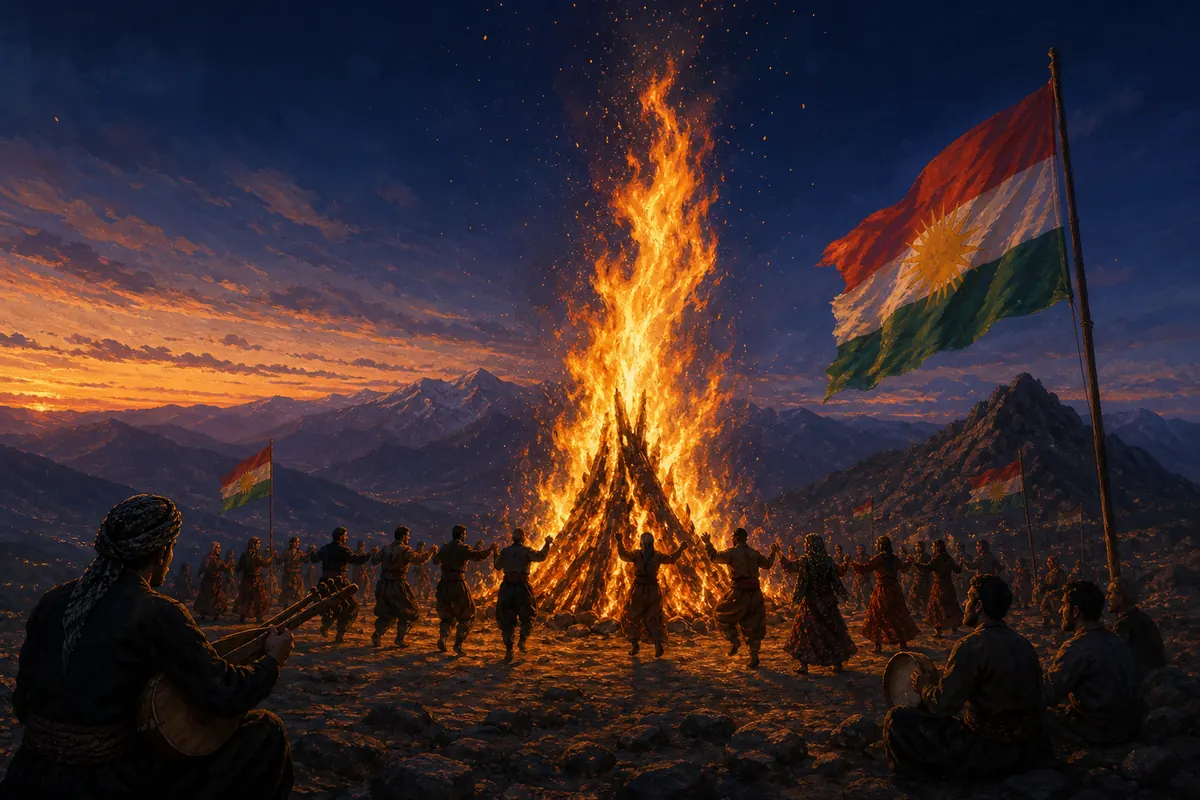
Every March 21, Kurdistan turns into something else. Bonfires burn on every hill. Children jump over flames. Govend lines stretch across town squares. Drums play until 3am.
This is Newroz — the Kurdish New Year, celebrated for at least 3,000 years on the spring equinox. And it has its own music.
What Newroz is
Newroz is the festival of the spring equinox, celebrated on March 21 across a vast region — Kurdistan, Iran, Afghanistan, Tajikistan, parts of Turkey, parts of Central Asia. It's much older than any of the modern states that occupy this region. It's older than Islam. It's older than Christianity. It's older than the Roman Empire.
The festival is rooted in Zoroastrian tradition, a religion that predominated in Iran and surrounding regions for over a thousand years before Islam arrived in the 7th century. Newroz survived the religious change because it was already integrated into the agricultural and seasonal life of the people. You can ban a religion. You can't ban a season.
The legend
The Kurdish version of Newroz comes with a specific story:
In ancient times, an evil king named Zahhak (or Dehak) ruled Kurdistan. He had snakes growing from his shoulders that demanded the brains of two young Kurds every day to eat.
A blacksmith named Kawa lost six children to Zahhak. When the seventh was about to die, Kawa rose up against the king. He led the people in revolt, killed Zahhak with his blacksmith's hammer, and lit a great bonfire on a mountaintop to signal that the tyrant was dead and Kurdistan was free.
That bonfire is the origin of the Newroz fire ceremony. Every Kurdish bonfire on March 20 (Newroz eve) repeats Kawa's signal. Every spark says: tyranny ends.
The story is mythic but the political resonance is exact. For 20th-century Kurds living under suppressive states, Newroz became — without anyone explicitly planning it — the central political ritual of Kurdish identity. The fire is not metaphor; it's memory.
How Newroz sounds
Music at Newroz follows a typical sequence:
Daytime gatherings
Families travel to picnic grounds — riverside spots, mountain meadows, parks. Recorded music plays, often pan-Kurdish hits from the wedding canon. The tone is celebratory and informal.
Bonfire lighting (sunset on March 20)
The community gathers around the fire. A speaker may read a poem or speech. Traditional zurna-davul music begins.
Jumping the fire
Each person jumps over the fire (or, increasingly, over a smaller managed flame) — an act of purification. The drums punctuate each jump.
Govend until dawn
The big govend starts. Often two or three lines form simultaneously. The zurna-davul plays for hours. Specific Newroz songs come up in rotation.
Fireworks
Modern Newroz includes fireworks, sometimes coordinated municipal displays in major cities, sometimes informal local launches.
Famous Newroz songs
"Newroz Pîroz Be"
Translation: "Happy Newroz" The standard greeting song. Multiple regional variants — Sorani and Kurmanji each have their own melody but the lyric core is the same.
"Newroz Ahengê" (Şivan Perwer)
Şivan Perwer's anthem-style modern Newroz piece. Often played at major outdoor Newroz celebrations across the diaspora and Kurdistan.
"Roja Newrozê"
Kurmanji folk song specifically about the Newroz day, common at Turkish-Kurdish celebrations.
"Em Hatîne ji Bo Newrozê"
"We have come for Newroz" — a Kurmanji greeting song common at gatherings.
Regional variants
Each major region has Newroz songs that are particularly local. The Diyarbakır Newroz canon overlaps but isn't identical to the Mahabad canon. Diaspora celebrations often mix sources.
Where Newroz is celebrated publicly
Newroz is a public holiday or major informal celebration in:
- Iraqi Kurdistan — official holiday, massive public celebrations in Erbil, Sulaymaniyah, Duhok
- Turkey — historically restricted (often violently in the 1990s and 2000s), now legally celebrated though sometimes with police presence
- Iran — celebrated as Nowruz; Iranian Kurds add Kurdish-specific elements
- Syria/Rojava — celebrated since 2012
- Diaspora — major celebrations in Stockholm, Berlin, London, Paris, Toronto, US cities. Often the largest annual Kurdish-community event of the year
The political weight of public Newroz celebration shouldn't be understated. Until the 1990s, holding a public Newroz event in southeastern Turkey could result in violence from authorities. The fact that Newroz is now celebrated openly across Kurdistan is a marker of cultural recovery.
Newroz in the diaspora
For Kurdish-diaspora communities, Newroz is often THE annual cultural anchor. A typical diaspora Newroz includes:
- Public outdoor gathering at a park or community space
- Speakers — community leaders, often with political content
- Live music — usually a hired Kurdish band or DJ with zurna-davul live segment
- Food — traditional Kurdish dishes (dolma, kebab, sweets)
- Govend — the central activity
- Fire ceremony if local fire codes permit (they often don't)
For Kurdish kids growing up in Stockholm, Berlin, or Toronto, Newroz is often where they learn govend, hear traditional music live, and meet other Kurdish-heritage children. It's the cultural transmission moment of the year.
Why Newroz survived everything
Newroz is one of the few cultural traditions that has continuously existed:
- Through the Islamic conquest (7th century)
- Through Mongol invasion (13th century)
- Through Ottoman rule (16th-20th century)
- Through state suppression (20th century)
- Through diaspora dispersion (1980s-present)
Why? Three reasons:
- It's seasonal. Spring equinox happens whether or not anyone celebrates. The natural anchor doesn't depend on permission.
- It's familial. Even when public celebration was banned, families gathered privately. The transmission chain stayed intact.
- It transcends border. Kurds in Turkey, Syria, Iraq, Iran, and the diaspora ALL celebrate the same day. Whatever divides them politically, Newroz unifies.
For Kurdish music specifically, this means: Newroz songs are some of the most widely-known across all Kurdish dialects. A Sorani Kurd in Sulaymaniyah and a Kurmanji Kurd in Diyarbakır may not share many songs — but they both know "Newroz Pîroz Be."
Listening for Newroz
If you want to prepare for or experience Newroz musically:
- Listen to Şivan Perwer — his Newroz anthems are the modern reference
- Listen to Aynur Doğan — particularly "Keçe Kurdan" which has become a Newroz favorite
- Find local Newroz radio broadcasts — Kurdish radio in Stockholm, Berlin, and London does Newroz specials
- Watch live YouTube streams of major outdoor celebrations — Erbil and Diyarbakır events are usually streamed
- Search "Newroz pîroz be" on YouTube for endless variants
Continue exploring
- Kurdish Wedding Music — Govend, Halay — the dance forms that dominate Newroz too
- 12 Famous Kurdish Singers — including Newroz anthem performers
- Kurdish Musical Instruments Guide — the zurna and davul that drive every Newroz fire
- How Kurdish Music Was Banned — context for why Newroz political weight runs deep
Newroz Pîroz Be — Happy Newroz, whenever you read this.
If you have Newroz recordings or regional variants we should add to KurdNote, contribute here.