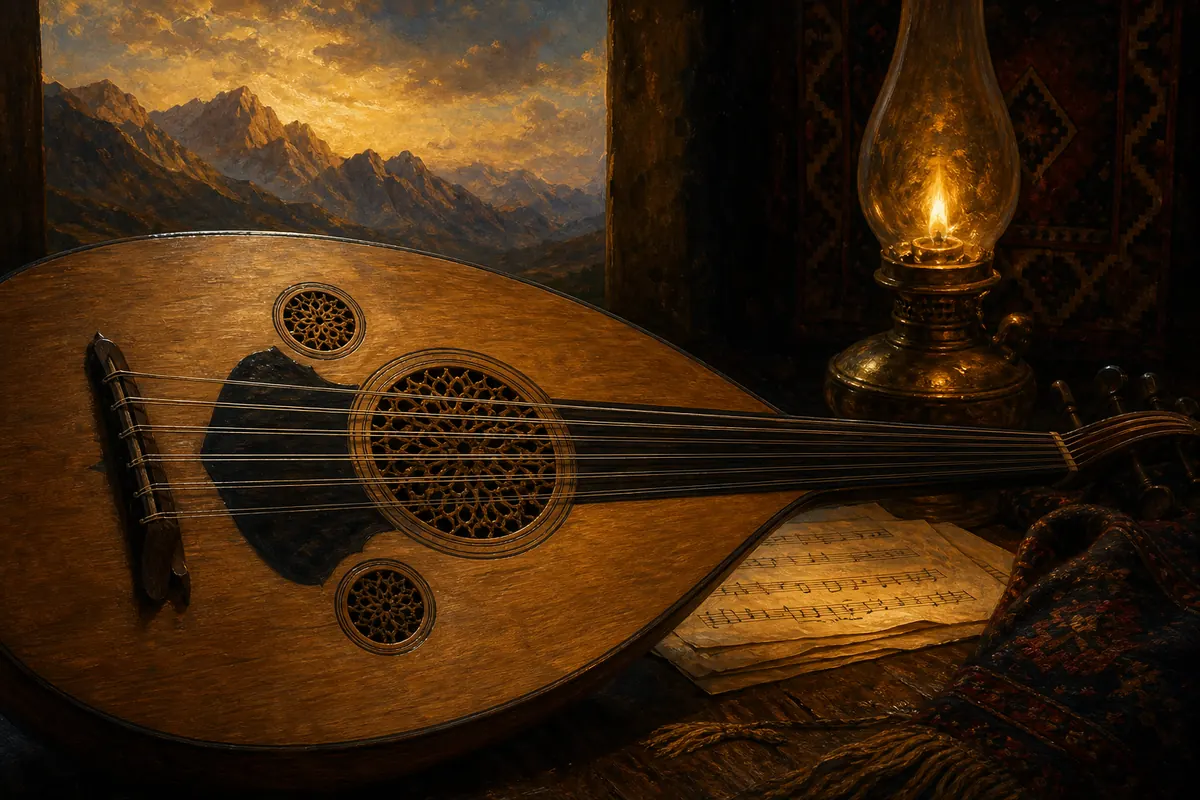
If the kamancheh is the voice of Kurdish music, the oud is its harmonic foundation. An 11-string fretless lute, played with a flexible plectrum, with a deep resonant body that anchors any ensemble it joins. Where the kamancheh sings, the oud builds the room.
This is a guide to the oud in Kurdish music — what makes it distinctively Kurdish, who plays it, and how to start.
What is an oud?
An oud is a short-necked, fretless, pear-shaped lute with these defining features:
- A deeply rounded body (the "bowl") — typically constructed from many wooden ribs glued together
- A short, fretless neck
- 11 strings in a particular configuration: 5 doubled courses (10 strings playing in pairs at the same pitch) plus 1 single bass string
- A flat bridge glued to the soundboard
- One or three soundholes with carved decorative rosettes
- A risha (plectrum) — traditionally a quill, now often plastic or shell, used to pluck the strings
Oud derives from the Arabic word العود (al-ʿūd) meaning "the wood" — both a reference to the wooden body and to the wooden plectrum traditionally used. Through Islamic Spain, the oud became the European lute and eventually influenced the development of the guitar.
How the oud sounds
Three defining sonic features:
1. Deep resonance
The deep bowl produces a fuller bass response than a guitar. Low notes ring with a chest-vibrating depth.
2. Sustain and decay
A plucked oud note rings for several seconds before fading. The instrument breathes between notes.
3. Microtonal capability
With no frets, the player can produce ANY pitch. Essential for Kurdish maqam music — the half-flats and half-sharps that define Bayati, Hijaz, and Saba modes.
Where the oud fits in Kurdish music
The oud has central roles across Kurdish musical contexts:
Sorani classical-folk ensembles
The standard urban-folk ensemble in Sulaymaniyah, Erbil, Mahabad, and Sanandaj features oud + kamancheh + santur + tonbak + voice. The oud provides harmonic anchor and frequent solo passages.
Solo classical performance
Like the kamancheh, the oud carries solo classical Kurdish music — extended improvisations (taqasim) exploring single or multiple maqamat. A skilled oud player can hold a 15-minute solo improvisation entirely.
Singer accompaniment
Many Kurdish singers play oud and accompany themselves, or work closely with a primary oud player. This vocal-oud duet format is fundamental to Sorani song.
Cross-genre work
Modern Kurdish oud players use the instrument in fusion contexts — jazz, Western classical, world music. The oud is a frequent guest in cross-cultural projects.
What makes Kurdish oud playing distinctive
The instrument is shared with Arabic, Turkish, Persian, Armenian, and Greek traditions. What makes Kurdish oud playing distinct:
Repertoire
Kurdish oud players work primarily through Kurdish folk and classical-folk repertoire. Songs by Hassan Zirek, Mazhar Khaleqi, and other Sorani vocal canon define what Kurdish oud accompaniment IS.
Maqam emphasis
Kurdish oud playing emphasizes maqamat common in Kurdish folk: Bayati, Hijaz, Kurd. Less time spent on the more elaborate Arabic classical maqamat (Nahawand variations, complex Hicaz Kar developments) than an Arab oudist would invest.
Rhythmic character
Kurdish oud accompaniment often supports 6/8 dance rhythms, the driving 4/4 of Sorani folk, and the free-rhythm âvâz introductions characteristic of Kurdish vocal music.
Ornamentation style
Kurdish oud ornaments lean toward tasteful restraint compared to virtuosic Arabic or Turkish oud styles. The role is supportive — let the singer or kamancheh take the lead.
This isn't a hard line — many Kurdish oud players cross genres and play Arab classical, Turkish art music, and other repertoires. But within the Kurdish folk tradition, these stylistic preferences hold.
Famous oud players to know
Kurdish oud players
- Hama Jaza (Iraqi Kurdish) — widely respected within the Sorani folk world
- The supporting oud players on classic Hassan Zirek recordings — names often unrecorded but musically foundational
- Modern Iraqi Kurdish oud players associated with Sulaymaniyah and Erbil music institutes
Broader oud canon (essential listening)
- Munir Bashir (Iraqi) — perhaps the most internationally famous oudist; pioneered solo oud as concert format
- Naseer Shamma (Iraqi) — modern virtuoso, founder of Bait al-Oud (Oud House) educational institutions
- Anouar Brahem (Tunisian) — fusion-oriented oud master
- Necati Çelik (Turkish) — Turkish classical oud
- Cinuçen Tanrıkorur (Turkish) — Turkish classical-folk
If you're new to oud, start with Munir Bashir's solo recordings.
How the oud is played
Holding the instrument
The oud is held with the body resting on the right thigh (for right-handed players), the bottom of the body against the chest, and the neck angled slightly upward. The right hand plucks; the left hand frets the strings on the neck.
The risha (plectrum)
Traditional oud playing uses a flexible plectrum — historically an eagle quill, now usually plastic or shell. The risha is held between thumb and forefinger and produces oud's distinctive percussive yet warm attack.
The risha grip and motion are the FIRST thing to master. Wrong grip technique creates years of bad habit. Get a teacher to show you in person if possible.
Left hand
Without frets, intonation depends on muscle memory. Beginning oud students spend significant time training their hand to find Bayati's half-flat second, Hijaz's augmented second, and other interval distances reliably.
Common chord/double-stop techniques are limited compared to Western instruments — oud is a primarily melodic instrument with occasional harmonic embellishment.
Tuning
Standard Arabic-style oud tuning (low to high): C - F - A - D - G - C Many Kurdish players use this or slight variants. The bottom string can be tuned differently for specific repertoire.
How to start learning
Year 1
- Find a teacher (in person preferred, online possible)
- Master risha grip and basic strokes
- Learn the open string note positions and basic Bayati scale
- Practice 30+ minutes daily
Year 2
- Add ornaments (slides, vibrato, trills)
- Learn 5-10 Kurdish folk pieces
- Begin basic taqasim (single maqam, slow tempo)
- Play with other musicians
Year 3-5
- Multi-maqam taqasim
- Learn modulation between maqamat
- Develop solo repertoire
- Begin performing
Realistic timeline for committed adult learner: 1 year to be enjoyable to listen to, 3-5 years for ensemble-ready competence.
Resources for learning
KurdNote has two Kurdish-language oud tutorial books:
- Fundamentals of Oud Learning Level 1 — beginner foundations
- Fundamentals of Oud Learning Level 2 — intermediate techniques
Plus the historical book The Oud in the History of the East for context on the instrument's broader development.
Beyond KurdNote:
- Bait al-Oud (Cairo, Naseer Shamma's institution) — most prestigious oud school
- Sulaymaniyah Institute of Fine Arts — Iraqi Kurdish institutional training
- Online schools — multiple platforms now offer remote oud instruction
- YouTube — quality varies; Munir Bashir and Naseer Shamma demonstrations are useful
Where to buy an oud
Beginner ouds ($300-800) — Turkish or Egyptian made, available from specialty Middle Eastern instrument retailers. Avoid the cheapest Amazon listings — quality is unreliable.
Intermediate ($800-2,500) — Custom-built from established workshops in Cairo, Istanbul, or specialized European luthiers.
Professional ($3,000+) — Master-luthier instruments, often with multi-month wait times.
For Kurdish-music-focused buyers: a good Turkish or Egyptian oud works perfectly. There's no separate "Kurdish oud" tradition of construction — the instruments are standardized across the broader region.
The cultural status of oud in Kurdish music
In Kurdish musical hierarchy, the oud sits at the center. It's:
- The instrument that anchors classical-folk ensembles
- The instrument associated with serious musical study (more than saz, more than zurna)
- The instrument that crosses genres most easily — Kurdish oudists work with Arab, Turkish, Persian, and Western musicians
- The instrument that appears in formal Kurdish music education programs
Learning oud signals commitment to Kurdish musical tradition in a way that learning, say, electric guitar doesn't. It's a culturally weighted choice.
Continue exploring
- The Kamancheh in Kurdish Music — oud's frequent partner in classical-folk ensembles
- Kurdish Musical Instruments Guide — full instrument family
- Kurdish Music Theory — Maqamat — what you'll be playing
- Hassan Zirek biography — many of his recordings feature oud accompaniment
If you're a Kurdish oud player, teacher, or luthier — get in touch. We're building Kurdish oud resources and welcome contributions.