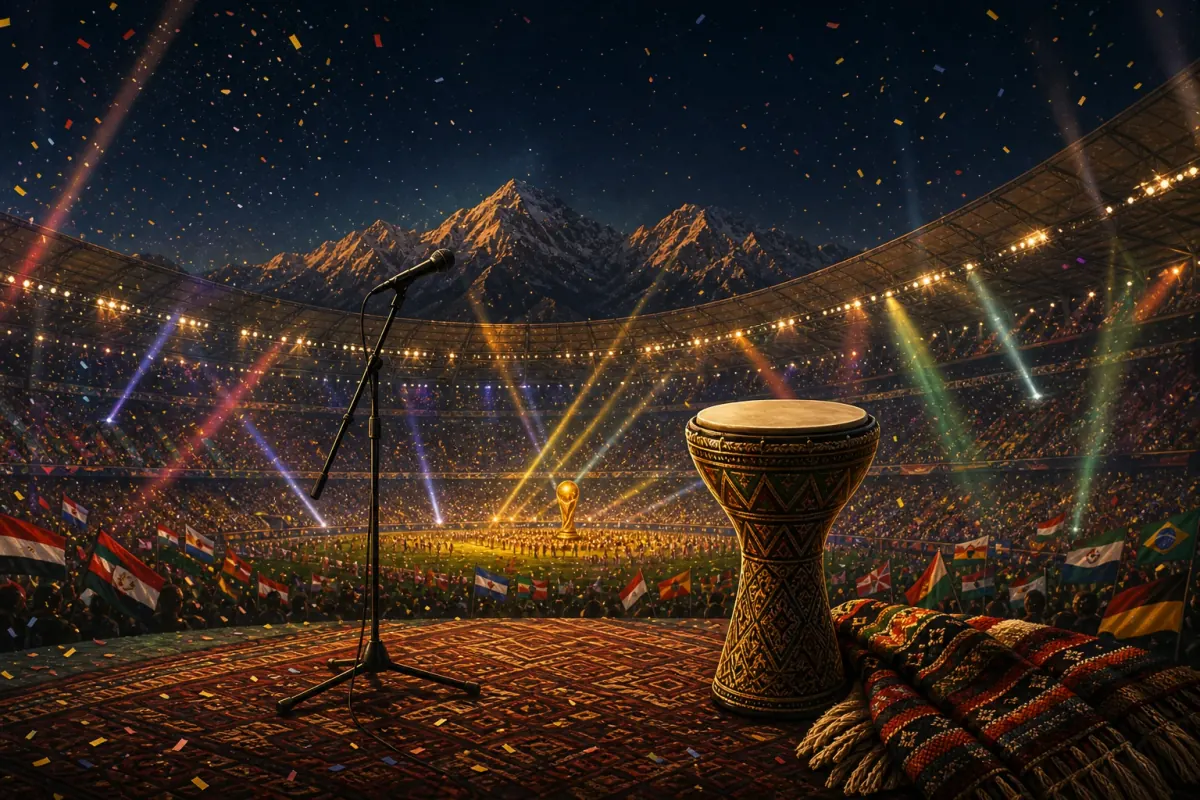
Shakira is one of the most successful Latin artists in history and the voice behind the most famous World Cup songs of the last two decades. She is also a Colombian star with a Lebanese family name, a singer whose hips, drums and melodies owe a visible debt to the Arab world. In 2026 she released Dai Dai, the official song of the FIFA World Cup, which Sorani-speaking fans search for under the word مۆندیال.
This Shakira biography covers her life, her Lebanese roots, the belly dance and Arabic influence in her music, her best songs, and where she stands in 2026.
Quick facts
- Full name: Shakira Isabel Mebarak Ripoll
- Born: 2 February 1977, Barranquilla, Colombia
- Heritage: Colombian; Lebanese on her father's side
- Genre: Latin pop, pop rock, dance-pop, with Arabic and Colombian influences
- Roles: singer, songwriter, dancer, producer
- Instruments: voice, guitar
- Known for: "Hips Don't Lie", "Waka Waka", "Ojos Así", belly dance on stage
- Awards: four Grammy Awards and many Latin Grammys
- Children: Milan and Sasha
Early life and Lebanese roots
Shakira was born in Barranquilla, on Colombia's Caribbean coast, the only child of William Mebarak Chadid and Nidia Ripoll Torrado, with several older half-siblings from her father's first marriage. Her father was born in New York to Lebanese parents and moved with them to Colombia at the age of five. Colombia's Caribbean coast has a large community of Lebanese and Syrian descent, and the Mebarak family is part of it. Her first name is Arabic and is usually explained as meaning "grateful".
Her Arabic heritage entered her life through sound. According to Wikipedia, when she was four her father took her to a Middle Eastern restaurant, where she heard the doumbek, the Arabic goblet drum, and started dancing. She went on to belly dance at her Catholic school on Friday mornings, encouraged by her teachers and parents. She also wrote her first song at the age of eight.
In July 2018 she brought her El Dorado World Tour to Lebanon, opening the Cedars International Festival, and visited Tannourine, the northern Lebanese town connected to her father's family.
Career
Early albums (1991 to 1998)
Shakira signed with Sony Colombia as a teenager. Her debut album, Magia (1991), sold only about 1,200 copies. Her breakthrough came with Pies Descalzos (1995), which sold over 5 million copies and spread her name across Latin America with songs like "Estoy Aquí".
¿Dónde Están los Ladrones? (1998) was even bigger. It includes "Ojos Así", the song where her Lebanese heritage is most audible: an Arabic-flavoured melody, Middle Eastern percussion, and a verse sung in Arabic. The song became a staple of her concerts, usually performed with a belly dance. In interviews she has credited her father and his heritage with shaping this side of her music. Belly dance became a signature of her live shows for the next two decades.
Crossover: Laundry Service (2001)
Her first English-language album, Laundry Service, sold over 15 million copies. "Whenever, Wherever" mixed Andean pan pipes and charango with pop, and its video introduced her belly-dance-influenced style to the world.
Hips Don't Lie and Waka Waka
"Hips Don't Lie" (2006), with Wyclef Jean, became her first number one on the US Billboard Hot 100. In 2010 she recorded "Waka Waka (This Time for Africa)", the official song of the FIFA World Cup in South Africa, which became a worldwide hit and made her the voice of football for a generation.
Later albums and the Super Bowl
Albums such as Sale el Sol (2010), Shakira (2014) and El Dorado (2017) kept her at the top; El Dorado won the Grammy for Best Latin Pop Album. In February 2020 she and Jennifer Lopez headlined the Super Bowl LIV halftime show, where Shakira again included belly dance and a Middle Eastern-style vocal trill.
Break-up, Session 53 and Las Mujeres Ya No Lloran
Shakira and the Spanish footballer Gerard Piqué were together from 2010 to 2022 and have two sons. After their separation, her January 2023 song with the Argentine producer Bizarrap, "Bzrp Music Sessions, Vol. 53", broke several streaming records. Her 2024 album Las Mujeres Ya No Lloran ("Women No Longer Cry") won the Grammy for Best Latin Pop Album in February 2025, her fourth Grammy, and was followed by a world tour.
Legal matters
In Spain, Shakira faced a tax fraud case over the years 2012 to 2014. In November 2023, on the first day of the trial, she reached an agreement with prosecutors and accepted a fine, while maintaining that she was confident a court would have found her innocent. A separate investigation into later years was dropped in 2024 for lack of evidence.
2026: Dai Dai and the Hall of Fame
In May 2026 Shakira released "Dai Dai" with the Nigerian star Burna Boy, the official song of the FIFA World Cup 2026 hosted by Canada, Mexico and the United States. The title is an Italian expression meaning "come on", and the chorus mixes several languages. The same year she was nominated for the Rock and Roll Hall of Fame, although she was not selected for the 2026 class.
Signature works
- ***Pies Descalzos* (1995):** the Latin American breakthrough.
- ***¿Dónde Están los Ladrones?* (1998):** her rock-inflected masterpiece, with "Ojos Así".
- ***Laundry Service* (2001):** the global crossover.
- "Hips Don't Lie" (2006): her biggest US hit.
- "Waka Waka" (2010): the World Cup anthem.
- ***Las Mujeres Ya No Lloran* (2024):** the Grammy-winning return.
Shakira's best songs
- Hips Don't Lie (2006)
- Waka Waka (This Time for Africa) (2010)
- Ojos Así (1998)
- Whenever, Wherever (2001)
- Estoy Aquí (1995)
- La Tortura (2005)
- She Wolf (2009)
- Chantaje (2016)
- Bzrp Music Sessions, Vol. 53 (2023)
- Dai Dai (2026)
Legacy
Shakira showed that a Latin American artist could sing in Spanish and English and still conquer the global charts without giving up her roots. More unusually, she made roots from another region part of her identity. Her Lebanese heritage is not a biography footnote: it shaped how she dances and some of the melodies she writes, and it put belly dance and the Arabic drum in front of audiences of hundreds of millions.
Her work off stage is part of her legacy too. In 1997 she set up the Pies Descalzos (Barefoot) Foundation, which shares its name with her breakthrough album and builds and runs schools for children from poor communities in Colombia. She has been a UNICEF Goodwill Ambassador since 2003, and in 2011 the Latin Recording Academy named her its Person of the Year. For many fans in Colombia, the foundation matters as much as the hits.
She is also, more than anyone, the voice of the modern World Cup. From "Waka Waka" in 2010 to "Dai Dai" in 2026, her songs have become part of how the world celebrates football.
The Kurdish connection
Shakira has no documented Kurdish connection, and we will not claim one. Her link to our part of the world runs through Lebanon and Arabic music, which Kurdish music shares a neighbourhood with.
- Kurdish search interest. Sorani Google searches about her centre on the World Cup (مۆندیال), her songs (گۆرانی) and her age (تەمەنی). Football unites Kurdish fans as much as any other audience, and her World Cup songs are the ones they know.
- The same drums and dances. The Arabic goblet drum that got her dancing at four is a close relative of the percussion used across the region. In Kurdish music the frame drum daf plays a similar role in weddings and dances; our article on Kurdish wedding music, govend and halay shows how central dance rhythm is to Kurdish celebration.
- The "Middle Eastern" sound. When Western listeners hear a melody as Arabic, it is often because of the augmented second, the step typical of maqam Hijaz, a mode that Kurdish, Arabic and Turkish musicians all use. Our guide what is a maqam? explains how these modes work. We compare the four traditions in Kurdish vs Persian, Arabic and Turkish music.
Where to start listening
- "Ojos Así" (live). The clearest window into her Lebanese side, with the belly dance.
- "Estoy Aquí". The young rock-pop Shakira of the 1990s.
- "Hips Don't Lie". Her global peak.
- "Waka Waka". Then compare it with "Dai Dai", sixteen years later.
- Super Bowl LIV halftime show (2020). Watch it for the dance as much as the music.
Sources
- Shakira – Wikipedia
- Who is Shakira's Lebanese father William Mebarak Chadid? – The National
- World Cup official song is 'Dai Dai' by Shakira, Burna Boy – NPR
- Shakira and Burna Boy release Dai Dai – FIFA
- Shakira wins Grammy for Best Latin Pop Album 2025 – Billboard
- Shakira reaches deal to avoid tax fraud trial – TIME
- El Dorado World Tour – Wikipedia
- Shakira Mebarak – UNICEF Goodwill Ambassadors
If Shakira's drums got you moving, try the rhythms of Kurdish celebration: explore the daf or play through our Kurdish wedding evening playlist.