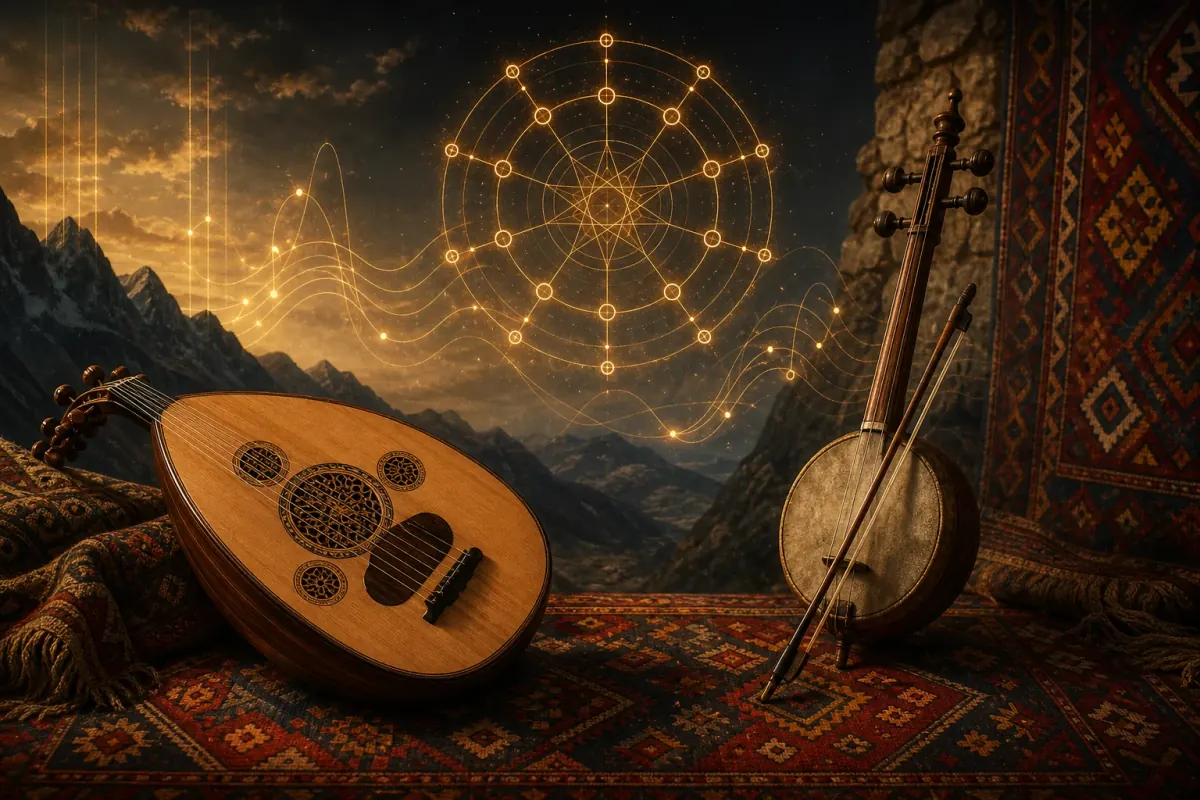
If you have ever tried to play a Kurdish song on a piano and felt that something was "missing," you have already met the maqam. The maqam is the modal system that shapes most Kurdish, Arabic, Turkish and Persian-related music. It explains why a Kurdish lament sounds the way it does, why some notes seem to fall "between" the keys, and why a good singer can take one short melody and spin it out for ten minutes.
This guide explains what a maqam is in plain language, introduces the six Kurdish maqams we cover on KurdNote, and gives you songs to learn each one. No prior theory is needed.
What is a maqam?
A maqam (Arabic maqām, Kurdish مەقام, plural maqamat) is a melodic mode. It has three layers:
- A set of notes. Like a scale, it has a starting note (the tonic) and a series of steps above it.
- Building blocks. The scale is made of small groups of three to five notes, called jins (plural ajnas). A maqam typically has a lower jins and an upper jins. Each jins has its own recognisable flavour.
- A path. This is the part a scale alone cannot tell you. Each maqam has typical phrases, notes where the melody likes to rest, a usual direction of travel and familiar places to modulate. Arabic theory calls this the sayr, the "path" of the maqam.
That third layer matters most. Two maqams can share nearly the same notes and still sound different because the melody moves through them in different ways. That is why musicians say you learn a maqam by listening, not just by reading its scale.
Maqam, makam, dastgah: one family, several systems
The maqam idea is shared across a wide region, but each tradition has its own version:
- Arabic maqam, the system described above, with dozens of named maqamat grouped into families.
- Turkish makam, closely related, with its own theory and names.
- Persian dastgah, a different organisation built on the radif, a body of melodies passed from teacher to student.
Kurdish music sits in the middle of all three. Kurds in Iraq have long shared maqam practice with Baghdad; Kurds in Iran live alongside the Persian dastgah; Kurds in Turkey share much with the Turkish makam. Many maqam names used by Kurdish musicians, like Bayat, Segah, Rast and Hijaz, are common to all of them.
Quarter tones in maqam music, explained without the maths
Western music divides the octave into 12 equal semitones, the keys of a piano. Many maqams also use a note roughly halfway between two piano keys. It is written with a half-flat sign and often called a "quarter tone."
A few honest caveats:
- The 24-step "quarter-tone" grid is a notation convention. In practice the exact height of a half-flat note varies from maqam to maqam and region to region. A half-flat E in Bayati and in Rast may not be identical.
- That is why maqam music is learned by ear as much as from paper. Notation tells you which note; recordings tell you where exactly to put it.
- Instruments without fixed pitches, such as the voice, oud, violin, kamancheh and ney, handle these notes naturally. The tanbur and saz use extra frets.
Kurdish maqams for beginners: the six to know first
Kurdish music uses many maqams. The Sorani Wikipedia article on maqam lists families such as Kurd, Ajam, Segah, Bayat, Nahawand, Rast, Hijaz, Hicaz Kar, Saba and Nawa, each with several members. For a beginner, six are enough to start. Each links to its full KurdNote page with the scale and examples.
1. Maqam Bayati (بەیاتی)
Scale (from D): D, E half-flat, F, G, A, B-flat, C, D
Bayati is the heart of a great deal of Kurdish song. The half-flat second degree gives it a warm, slightly melancholy colour that sits between major and minor. Laments, lullabies and love songs often live here. Analyses of Hassan Zirek's melodies find that Bayat and Segah are the scales he used most.
Learn it with: Arami Giyanim, Akh li Guli and Bay Shemall. Full page: Maqam Bayati
2. Maqam Kurd (کورد)
Scale (from D): D, E-flat, F, G, A, B-flat, C, D
Maqam Kurd uses only ordinary semitones and whole tones, so it can be played on a piano. It is close to the Western Phrygian mode. The lowered second degree gives it a dark, grounded sound. In Arabic theory it is the main maqam of the "Kurd family," built from jins Kurd on the tonic and jins Nahawand above. The name is Kurdish, but the maqam is used throughout the region.
Learn it with: Akh li Dinê Torinê. Full page: Maqam Kurd
3. Maqam Hijaz (حیجاز)
Scale (from D): D, E-flat, F-sharp, G, A, B-flat, C, D
The big jump between the second and third notes (an augmented second) makes Hijaz the most instantly recognisable "Middle Eastern" sound. It is intense and yearning, and it also works on a piano.
Learn it with: Ashna, a Sorani love song with rich ornamentation. Full page: Maqam Hijaz
4. Maqam Rast (ڕاست)
Scale (from C): C, D, E half-flat, F, G, A, B half-flat, C
Rast is often compared to "C major with a twist": balanced and noble, but with half-flat third and seventh degrees. Many teachers treat it as the reference maqam from which others are explained.
Full page: Maqam Rast
5. Maqam Saba (سابا)
Scale (from D): D, E half-flat, F, G-flat, A, B-flat, C, D
Saba starts like Bayati but then flattens the fourth note, which gives it a uniquely sorrowful, almost aching quality. It is often associated with mourning and deep longing.
Full page: Maqam Saba
6. Maqam Hicaz Kar (حیجاز کار)
Scale (from C): C, D-flat, E, F, G, A-flat, B, C
A more elaborate cousin of Hijaz, with two augmented seconds. It is closely associated with Ottoman-Turkish art music and entered Kurdish urban song through that route.
Full page: Maqam Hicaz Kar
Maqam singing: the second meaning of "maqam" in Kurdish
When Sorani speakers say مەقام they often mean more than a scale. They mean a genre: a free-rhythm, highly ornamented vocal performance, often on classical poetry, in which a singer (a maqambêj) explores a named mode while an instrumentalist answers each phrase.
The great master of this art in Iraqi Kurdistan was Ali Mardan (1904–1981), born in Kirkuk. He learned Kurdish maqams as a boy, later studied Persian and Arabic maqams in Baghdad, and became the first Kurdish singer on Baghdad Radio. Kurdish sources list maqams he made famous under names such as Mahur, Homayun, Khurshidi, Alawaysi, Bayati Shur, Urfa, Dasht and Hijran. Several of these names are not the same as the scale names above. In the Kurdish vocal tradition, a "maqam" can be a named melodic model with its own opening phrases and cadences, not only a scale.
Hassan Zirek also recorded many free-rhythm maqam pieces, such as Sewzelê and Firmêskî Gesh. We list them in our guide to Hassan Zirek's greatest songs.
Neighbouring traditions have similar forms: the Kurmanji dengbêj art (see what is dengbêj) and the Iraqi maqam, which UNESCO proclaimed a Masterpiece of the Oral and Intangible Heritage of Humanity in 2003 and inscribed on its Representative List in 2008.
How to learn a Kurdish maqam: a practical routine
You do not need to master theory before you start. Try this routine with one maqam, ideally Bayati.
- Listen first, for a week. Pick two or three recordings in the maqam and listen daily. Don't analyse; just get used to the colour.
- Find the tonic. Hum the note where the song feels "at home." In most Bayati songs it is the last note of the melody.
- Sing the first four notes. That is the lower jins: for Bayati on D, sing D, E half-flat, F, G. Aim for the half-flat E by ear: lower than E, higher than E-flat. Check yourself against a recording.
- Learn one song from notation. Use a KurdNote sheet like Arami Giyanim and play or sing it slowly. If you are new to reading music, our guide on how to read Kurdish music notation walks you through the symbols.
- Notice the resting points. Where does the melody pause? Which note does it return to before the end? This is the maqam's "path" in action.
- Only then, add a second maqam. Kurd or Hijaz is a good next step because the contrast with Bayati is easy to hear.
Instrument tips:
- Piano or keyboard: start with Kurd and Hijaz, which need no half-flats. Some keyboards have a quarter-tone or "Oriental" setting for the others.
- Oud, violin or kamancheh: you can play every maqam. Practise the half-flat note slowly against a drone.
- Voice: singing is the most natural way to learn maqams, and the best way to hear what the notation cannot show.
Going deeper: books on maqam in our library
KurdNote's free book library has several works on Kurdish scales and maqam theory:
- Peyzhekani Musiqay Kurdi, on the scales of Kurdish music.
- Polinkrdni Form u Peyzhekani Mosiqay Kurdi, on classifying Kurdish musical forms and scales.
- Ru'ya al-Jadida fi Tahlil al-Maqamat al-Musiqiya, an Arabic-language study of maqam analysis.
To see how maqams relate to neighbouring traditions, read Kurdish vs Persian, Arabic and Turkish music.
Sources
- Arabic maqam, Wikipedia
- Maqam Kurd, Maqam World
- مەقام, Sorani Wikipedia
- عەلی مەردان, Sorani Wikipedia
- Ali Mardan, a maestro of Kurdish maqamat, Kurdish Globe
- Iraqi Maqam, UNESCO Intangible Cultural Heritage
Ready to hear a maqam for yourself? Open the Maqam Bayati page and play Arami Giyanim from our free notation.