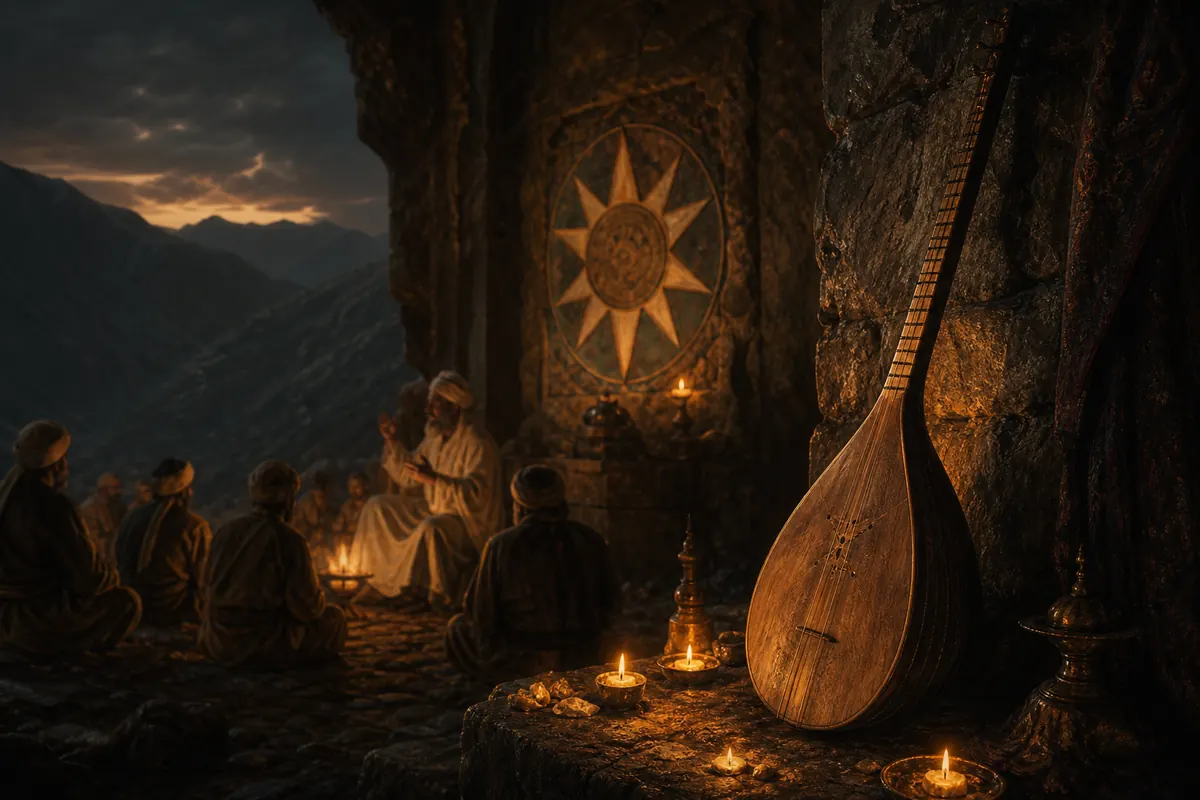
Most Kurdish instruments are musical objects. The tanbur is also a religious one.
For the Yarsan (Ahl-e Haqq) religious community of Kermanshah province and surrounding areas, playing the tanbur is itself a form of worship. The instrument is sacred. The repertoire is sacred. The playing is sacred.
This is one of the most distinctive things about Kurdish musical culture — a tradition where the line between music and prayer essentially disappears.
What is the Kurdish tanbur?
A Kurdish tanbur is a long-necked lute with these features:
- A small pear-shaped body carved typically from a single block of mulberry wood
- A long, narrow neck with frets (tied frets, traditional Persian-style)
- Two or three strings (sometimes doubled for four total) tuned in fourths and unisons
- Played with the fingers rather than a plectrum — fingertip plucking gives it a soft, intimate sound
Compared to other Kurdish instruments:
- Smaller body than oud — quieter
- Longer neck than oud — different harmonic capabilities
- Has frets unlike oud — different intonation approach
- Soft fingerpicking vs oud's plectrum strikes — completely different attack character
Tanbur ≠ Tanbur
The biggest confusion in Middle Eastern instrument naming: there are MULTIPLE instruments called "tanbur" across the region, and they're substantially different.
| Name | Region | Description |
|---|---|---|
| Kurdish tanbur (this post) | Kurdish Iran/Iraq | Small body, 2-3 strings, sacred Yarsan use |
| Turkish tanbur | Ottoman classical | Large body, 7 strings, classical court music |
| Persian setar | Iranian classical | "Three strings" but actually 4; close cousin of Kurdish tanbur |
| Afghan tanbur | Afghanistan | Yet another variant, larger body |
When people say "tanbur" in Kurdish musical context, they almost always mean the Kurdish (Yarsan) instrument. When in doubt, ask for clarification.
The Yarsan tradition
To understand the Kurdish tanbur, you need to understand the Yarsan religion.
Yarsan (Yârsân, Ahl-e Haqq, "People of Truth") is a syncretic religion practiced primarily by:
- Kurds in Kermanshah province, Iran (the largest Yarsan community)
- Parts of Iraqi Kurdistan, particularly around Khanaqin and Kifri
- Smaller communities in Turkey, Syria, and the diaspora
The religion combines:
- Pre-Islamic Iranian religious elements (some scholars trace to Zoroastrian and Mithraic traditions)
- Sufi mystical concepts (divine manifestation, esoteric knowledge)
- Indigenous Kurdish religious practices
- Some Islamic vocabulary in surface form
Yarsan is a closed religion — initiation typically requires birth into the community. Religious texts (the Kalâm) are partially secret and partially public, with the sacred core known only to initiated members.
For our purposes, the relevant point is: music is central to Yarsan worship. Specifically, music played on the tanbur, accompanying singing of the Kalâm.
Sacred tanbur playing
In Yarsan religious context, the tanbur is more than an instrument:
The instrument is sacred
A Yarsan tanbur is treated with religious respect. It's not played for entertainment in inappropriate contexts. The instrument is often blessed before use.
The repertoire is sacred
The Kalâm includes specific musical pieces tied to specific religious narratives, ceremonies, and devotional purposes. These pieces are not freely performed outside ritual context.
The performance is worship
A Yarsan religious tanbur performance is not "music about religion" — it IS the religious act. Playing the tanbur, singing the Kalâm, and the spiritual state of the performer/audience are inseparable.
Knowledge transmission is restricted
Sacred Yarsan tanbur repertoire is taught from master to student within the community, often within family lines. It's not widely published, recorded, or taught to outsiders.
Secular tanbur playing
The tanbur is ALSO used in secular Kurdish folk music — outside Yarsan religious context. In secular use:
- Played for folk songs, love songs, mountain ballads
- Open to non-Yarsan players and audiences
- Repertoire crosses with broader Kurdish folk
- Often appears in Kurdish folk fusion and world-music projects
The same physical instrument serves both contexts. The distinction is the music played and the social/religious framing.
Famous tanbur players
Within the Yarsan tradition, master tanbur players are revered religious figures as much as musicians. Their names matter to insiders but are less internationally publicized.
In the broader (more secular) Kurdish tanbur context:
- Ali Akbar Moradi — Iranian Kurdish (Yarsan) tanbur master, has performed internationally and recorded extensively. Probably the most internationally known Kurdish tanbur player
- Pejman Hadadi (and other Iranian Kurdish musicians) — work in both classical and Kurdish folk contexts
- Various Kermanshah-based players — the Kermanshah tanbur tradition is the strongest
If you want to hear what Kurdish tanbur sounds like, search "Ali Akbar Moradi tanbur" on YouTube. His recordings are a strong starting point.
How the tanbur is played
Playing position
Tanbur is held with the body resting on the lap, the neck pointing diagonally upward. Right-handed players hold the body on the right thigh.
Fingerpicking
Unlike oud (plectrum) or kamancheh (bow), tanbur is plucked with bare fingertips. The right thumb often plucks the bass string while index/middle fingers play melody on the higher strings. This produces a soft, intimate sound that wouldn't carry across a large hall.
Frets
Tanbur frets are TIED frets — gut or nylon ties wrapped around the neck rather than fixed metal frets. This allows fine adjustment of pitch (especially for the quarter-tones of Persian/Kurdish modal music) and gives the instrument a slightly different sound than fixed-fret instruments.
Drone and melody
Tanbur often plays a sustained drone on one string while melody happens on another — similar to Indian sitar playing. The drone-and-melody texture is foundational to tanbur sound.
Why the tanbur tradition matters
Three reasons this instrument is particularly significant:
1. It's a living religious tradition
Most religious music traditions are studied as historical artifacts. Yarsan tanbur performance is happening NOW, in active religious ceremonies. It's a continuous living practice.
2. It's a closed tradition
The fact that core repertoire is restricted to initiated members means tanbur preservation requires community engagement, not just academic recording. It's a different model than open-canon folk music.
3. It's geographically concentrated
Yarsan tanbur tradition is centered in a relatively small geographic area (Kermanshah province + nearby Iraqi Kurdistan). This concentration makes it both more vulnerable and more identifiable as Kurdish-specific.
Recording and preservation challenges
Unlike Sorani folk or Kurmanji dengbêj, the Yarsan tanbur tradition has specific preservation challenges:
- Religious sensitivity — much sacred material isn't appropriate for public recording
- Restricted teaching — community-based transmission limits academic/institutional documentation
- Political pressure — Yarsan communities have faced varying restrictions across the modern period
- Diaspora dispersion — younger Yarsan in cities or abroad may have less access to traditional teaching
Some recordings exist publicly (especially of more secular tanbur material), but a comprehensive Yarsan religious music archive doesn't currently exist in widely accessible form.
How to learn (and how to be respectful)
If you want to learn Kurdish tanbur:
For secular folk playing
- Find a teacher (in-person preferred, online available)
- Approach as you would any folk instrument — respect for tradition, but no special access requirements
- Focus on Kurdish folk repertoire, not religious material
For Yarsan religious tradition
- This requires community engagement
- If you're not Yarsan-born, you'd need to develop genuine relationship with the religious community
- Most non-community members study tanbur secularly and learn ABOUT Yarsan tradition academically rather than entering the religious lineage
Don't:
- Record sacred material without explicit permission
- Use Yarsan religious tanbur material in commercial contexts without engaging with the community
- Treat the tradition as "exotic" or "world music" without acknowledging its religious significance
Continue exploring
- Kurdish Musical Instruments Guide — full instrument family overview
- The Oud in Kurdish Music — companion deep-dive
- The Kamancheh in Kurdish Music — companion deep-dive
- Kurdish Music Theory — Maqamat — modal context
If you have knowledge of Yarsan tanbur tradition you can responsibly share — particularly around documentation that respects community boundaries — we'd be interested to hear from you.