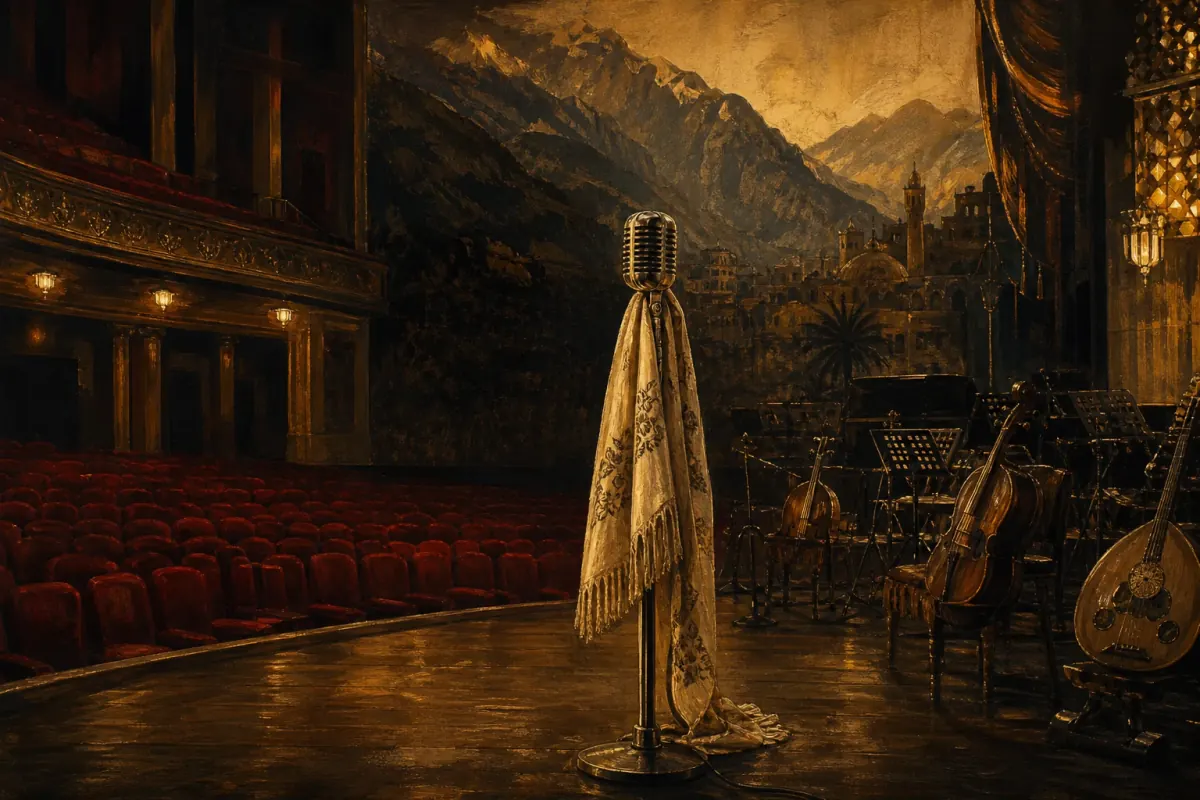
For half a century, on the first Thursday of every month, much of the Arab world stopped to listen to one voice. Umm Kulthum, the "Star of the East" (Kawkab al-Sharq), sang concerts that could last for hours, stretching a single song into an hour of variations while her audience cried out for more. When she died in 1975, millions of people filled the streets of Cairo.
This Umm Kulthum biography covers her life, her best songs, and the part of her art that matters most to KurdNote readers: the maqam. Her music is built on the same modal system that shapes Kurdish song, and one of her melodies even found its way into the repertoire of Hassan Zirek.
Quick facts
- Born: usually given as 4 May 1904 (the exact year is uncertain), Tamay ez-Zahayra, Dakahlia, Egypt
- Died: 3 February 1975, Cairo
- Birth name: Fatima Ibrahim el-Sayyid el-Beltagi
- Nicknames: Kawkab al-Sharq ("Star of the East"), "The Voice of Egypt"
- Voice: contralto
- Genre: Egyptian and Arabic classical and popular song
- Key collaborators: poet Ahmed Rami; composers Zakariya Ahmed, Mohamed El Qasabgi, Riad Al Sunbati, Mohammed Abdel Wahab, Baligh Hamdi
- Known for: Enta Omri, Al-Atlal, Alf Leila wa Leila, and monthly concerts broadcast for decades
Early life
Umm Kulthum was born in a small village in the Nile Delta. Her father, Ibrahim el-Sayyid el-Beltagi, was the village imam, and her grandfather was a respected Qur'an reciter. She learned to sing by listening to her father teach her older brother, and she also learned to recite the Qur'an. That training in recitation, with its precise diction and control of long phrases, shaped her singing for the rest of her life.
When she was about 12, her father brought her into the family ensemble, which sang religious songs at weddings and festivals. Because it was not considered respectable for a girl to perform in public, she appeared on stage dressed as a boy.
As a teenager she was noticed by the singer Abu al-Ila Muhammad, who taught her the classical Arabic repertoire, and then by the composer and oud player Zakariya Ahmed, who encouraged her to go to Cairo. After several visits, she moved there permanently in 1923.
Career
Cairo and the first records (1920s)
Cairo in the 1920s was full of competition. Umm Kulthum signed with Odeon Records in 1924 and moved to His Master's Voice in 1926. In 1924 she also met the poet Ahmed Rami, who became her mentor in literature and went on to write 137 songs for her. By the end of the decade she was one of Cairo's highest-paid performers. She had exchanged her boy's clothes for elegant dresses, and she was now working with the composer Mohamed El Qasabgi, a virtuoso of the oud.
Radio and the Thursday concerts (1934 onwards)
In 1934 she sang at the opening broadcast of Egyptian state radio. From then on she gave a concert on the first Thursday of every month, broadcast live, for around forty years. These concerts made her voice part of the rhythm of life from Morocco to Iraq.
A typical concert might last for hours and include only two or three songs. She would repeat a single line many times, changing it slightly each time in response to the audience. Recorded live versions of Ya Zalemni range from about 45 to 90 minutes.
The golden age (1940s to early 1950s)
In the 1940s and early 1950s she worked above all with Riad Al Sunbati, whose lyrical melodies suited her mature voice perfectly, and with Zakariya Ahmed on songs in colloquial Egyptian Arabic. She also starred in six films between 1936 and 1947. In 1950 she sang Sunbati's setting of Ahmed Rami's Arabic translation of **Omar Khayyam's *Rubaiyat***, one of the landmarks of her career.
She suffered from Graves' disease, and after treatment in the United States in 1953 she wore the dark glasses that became her trademark.
The late period (1960s to 1970s)
In the 1960s she began working with the younger composers Mohammed Abdel Wahab and Baligh Hamdi. Their longer instrumental introductions and larger orchestras gave her late songs a new sound. Her first song with Abdel Wahab, Enta Omri (1964), became perhaps her most famous. After the 1967 war her repertoire took on a more reflective tone, and in November 1967 she sang in Paris. Her last recorded song, Hakam Alayna Al Hawa, dates from 1973. She died on 3 February 1975. Estimates of the crowd at her funeral in Cairo range from three million to more than four million people.
Signature works
Umm Kulthum's art rests on three pillars:
- Poetry. She sang classical Arabic poetry, from Ahmad Shawqi to translations of Khayyam and Iqbal, as well as colloquial love lyrics. She was famous for her diction: every word was understood.
- Tarab. The Arabic word for the ecstatic emotional state that great music produces in a listener. Her whole performance style, with its repetitions and slow build-ups, was designed to create it.
- Maqam mastery. Her composers wrote long songs that travel through several maqams, and she could improvise within them with complete control.
Umm Kulthum's best songs
Here are the songs people search for most, with their years and composers:
- Enta Omri (إنت عمري, "You Are My Life"), 1964, music by Mohammed Abdel Wahab. Built on maqam Kurd.
- Al-Atlal (الأطلال, "The Ruins"), 1966, music by Riad Al Sunbati, poem by Ibrahim Nagi. It opens in maqam Rast and passes through a long chain of other maqams.
- Alf Leila wa Leila (ألف ليلة وليلة, "A Thousand and One Nights"), 1969, music by Baligh Hamdi.
- Seret el Hob (سيرة الحب, "Love Story"), 1964, Baligh Hamdi.
- Amal Hayati (أمل حياتي, "Hope of My Life"), 1965, Mohammed Abdel Wahab.
- Fakarouni (فكروني, "They Reminded Me"), 1966, Mohammed Abdel Wahab.
- Ya Zalemni (يا ظالمني, "My Oppressor"), 1954, Riad Al Sunbati.
- Hayart Albi (حيرت قلبي, "You Confused My Heart"), 1961, Riad Al Sunbati.
- Ruba'iyat al-Khayyam (رباعيات الخيام), 1950, Riad Al Sunbati.
- Ghanili Shwaya Shwaya (غنيلي شوية شوية, "Sing to Me Softly"), 1944, from the film Sallama, music by Zakariya Ahmed.
- El Hob Kollo (الحب كله, "All of Love"), 1970, one of her most popular late romantic songs.
Legacy
Umm Kulthum is widely regarded as the greatest singer in the history of Egyptian and Arabic music. Her recordings still sell and stream, her concerts are rebroadcast, and the Umm Kulthum Museum in Cairo keeps her dresses and her famous glasses. The 50th anniversary of her death in 2025 was marked with commemorations around the world.
Her influence is heard in generations of Arab singers, and in musicians far beyond the Arab world. For another great woman's voice of the region, read our Fairuz biography.
The Kurdish connection
We only include connections we could verify.
- The maqam itself. Umm Kulthum's music is built on the same modal system as Kurdish song: Bayati, Rast, Hijaz, Saba and the mode that carries the Kurdish name, maqam Kurd. Her most famous song, Enta Omri, is in maqam Kurd. If you want to understand these modes from a Kurdish point of view, start with our beginner's guide what is a maqam?.
- Hassan Zirek and "Ghanili Shwaya Shwaya". According to the Sorani Wikipedia article on Hassan Zirek, the Sorani master took the melody of Umm Kulthum's Ghanili Shwaya Shwaya and sang it in Kurdish, under titles such as Bom Bille Toze Toze. The same source notes he had permission to use the tune. More in Hassan Zirek's greatest songs.
- A shared regional stage. Writing about Umm Kulthum's reception in Turkey, the magazine Al Majalla notes that in cities like Aleppo, Mardin, Hatay and Latakia this shared "Eastern music" is performed in Arabic and Turkish, and sometimes in Kurdish or Assyrian.
- The oud. Her composers Zakariya Ahmed and Mohamed El Qasabgi were oud players, and the oud is also at home in Kurdish music. See the oud in Kurdish music.
What we could not find: any reliable evidence that Umm Kulthum sang in Kurdish or performed in Kurdistan. If you know of a documented case, please let us know.
Where to start listening
- Enta Omri: start with the long instrumental introduction and listen for the dark colour of maqam Kurd.
- Al-Atlal: her most admired work. Notice how it opens in Rast and keeps changing mode.
- Alf Leila wa Leila: the late style, with a big orchestra and dance-like rhythm.
- Ghanili Shwaya Shwaya: a short, light film song. Then look for Hassan Zirek's Kurdish version and compare.
- A live concert recording: to hear tarab at work, choose any full live performance and listen to how she repeats and transforms one line.
If you play the oud, KurdNote's free book Seretakani Firbuni Amiri Ud, Level 1 is a good way to start playing in these maqams yourself.
Sources
- Umm Kulthum, Wikipedia
- Umm Kulthum, EBSCO Research Starters
- Umm Kulthum (c. 1904–1975), Encyclopedia.com
- Inta Omri, Wikipedia
- Al-Atlal, Wikipedia
- New book captures Turkish adoration of Umm Kulthum, Al Majalla
- حەسەن زیرەک, Sorani Wikipedia
Hear the maqams behind Umm Kulthum's songs on our Maqam Kurd and Maqam Rast pages, and explore Kurdish songs in the same modes in our free notation library.