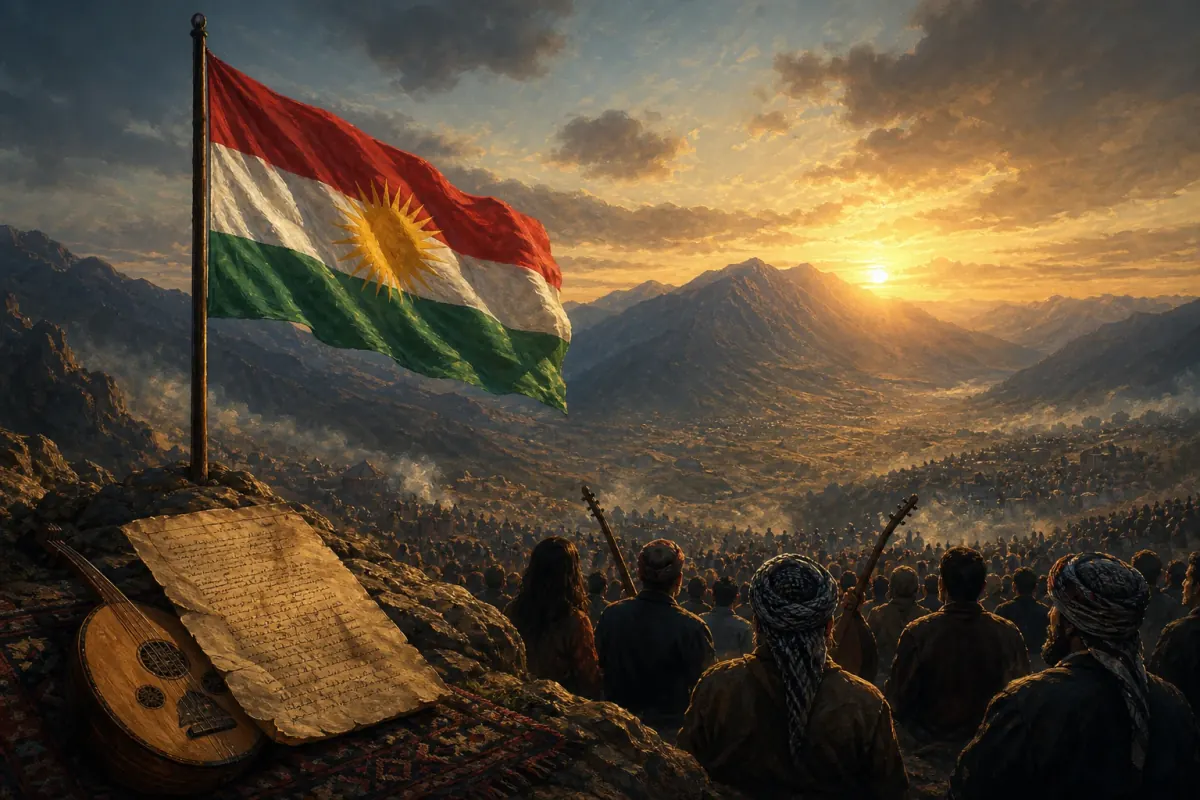
Every Kurd knows the first line. Ey reqîb, her mawe qewmî Kurd ziman: "O enemy, the Kurdish-speaking nation still lives." Ey Reqîb, the Kurdish national anthem, is sung at Newroz fires, football matches, funerals, school mornings and demonstrations from Erbil to Berlin. It is the official anthem of the Kurdistan Region of Iraq, and far beyond that region it is simply the anthem of the Kurds.
Yet for a song so familiar, surprisingly little about its making is certain. We know who wrote the words. We know roughly when. But who gave it its melody, and exactly where the poem was first spoken aloud, are questions Kurdish writers still argue about. This article sets out what is well documented, what is contested, and what the words actually say.
Quick facts
- Title: Ey Reqîb (ئەی ڕەقیب), "O Enemy"
- Lyrics: Dildar (Yûnis Reûf, 1918–1948), in Sorani Kurdish
- Written: usually dated 1938; some researchers say 1939 or 1940
- Melody: disputed; most often credited to Sheikh Hussein Barzinji
- First official use: Republic of Kurdistan (Mahabad), 1946
- Official today: anthem of the Kurdistan Region of Iraq since 1991
- Structure: five verses, each answered by the same refrain
The poet: Dildar
Dildar was the pen name of Yûnis Reûf, born on 20 February 1918 in Koya (Koy Sanjaq), then part of the Ottoman Mosul province. He went to primary school in Ranya, secondary school in Kirkuk, and studied law in Baghdad, qualifying as a lawyer in 1945. He was politically active in the Kurdish national movement of the 1940s. He died in Erbil on 20 October 1948 of a heart condition. He was only 30.
"Dildar" means roughly "the one with a heart" or "the lover," a fitting name for a poet whose best-known work is really a love poem addressed to a whole people.
When and where was Ey Reqib written?
This is the first point where the sources part ways.
- The prison story. The account repeated in most encyclopedias, including English Wikipedia and the anthem site eyreqib.com, says Dildar wrote the poem in 1938 while imprisoned for his political views, and that the "enemy" of the title refers to his guards. Some versions place that imprisonment in Iran, which is hard to square with the dates, since Dildar was still a student in 1938.
- The Kirkuk account. Kurdish researchers quoted in a detailed Sorani study by Kurdistan u Kurd describe Dildar reading the poem for the first time to a gathering of friends at a house in Kirkuk, with the year given as 1939. Another writer cited in the same study dates the poem to 1940.
What everyone agrees on: the poem was written by Dildar as a young man, in the late 1930s, in the atmosphere of a Kurdish national movement that had been crushed and scattered after the First World War. The title word reqîb can mean an enemy, a rival or a watchman. Whether he meant a specific prison guard or every power that had divided Kurdistan, the poem speaks straight to that opponent.
Who composed the melody?
This is the most contested part of the story, and we want to be careful here.
Sheikh Hussein Barzinji. The most common account, cited from the Kurdish writer Fexredîn Tahir, is that at that first reading in Kirkuk, Dildar said he wished someone would set the poem to music. Among the guests was Sheikh Hussein Barzinji, a man known for his fine voice who knew many Kurdish songs and the traditional maqams. He took on the task, and a few days later sang the poem back to Dildar to his own tune. Most Kurdish sources follow this attribution.
Abdulkhaliq Qutb. A second view, noted by the Sorani writer and musician behind Nawa, credits Abdulkhaliq Qutb, born in Koya in 1905, a cousin of Dildar who trained as a teacher in Kirkuk and died in 2002 at 97. The same writer notes how little documentation exists for either man and has called for the question to be researched properly.
The Mahabad musicians. It is also unclear whether the tune sung in Mahabad in 1946 was identical to the Kirkuk original. One study suggests the band of the Republic's Peshmerga forces, including the violinist Ali Tabani, who had studied music in Tabriz, may have shaped the version that spread from there. There is also an unconfirmed claim that the melody was first conceived in maqam Rast and later moved to a plain major scale, which every instrument can play. We mention it because it comes up often, not because it is proven.
The honest summary: the composer of Ey Reqîb is not documented beyond doubt. If you see a single name stated as fact, treat it with caution.
How Ey Reqib became the national anthem
By the mid-1940s the poem was already travelling. It was sung at gatherings of young Kurdish nationalists in Iraqi Kurdistan, and it crossed the border into Iranian Kurdistan.
- December 1945, Mahabad. According to Kurdish historians, Ey Reqîb was sung with its melody when the Kurdish flag was raised in Mahabad for the first time.
- 22 January 1946. At the proclamation of the Republic of Kurdistan in Mahabad's Chwarchra square, the crowd sang Ey Reqîb before the speeches began. The Republic adopted it as its national anthem. It was sung by choirs at official ceremonies and by schoolchildren before class, and broadcast daily once the Republic had its own radio station.
- Newroz 1946, Erbil. The anthem was performed at a large Newroz celebration in Erbil. Dildar himself, following news from Mahabad on the radio, is said to have heard his poem broadcast as the Republic's anthem and wept.
The Republic of Kurdistan fell within the year, but the anthem survived. It was carried on through the Kurdish movements of the following decades, sung in secret where Kurdish expression was banned. We cover that wider story in how Kurdish music was banned.
- 1991. After the uprising and the creation of Kurdish self-rule in Iraq, Ey Reqîb became the official anthem of the Kurdistan Region, alongside the Kurdish flag.
The lyrics of Ey Reqib
Dildar's poem is in the public domain. Below is the Sorani text as it is commonly sung, with a Latin-script transliteration and our own plain English translation. Small variants exist between printed versions.
Verse 1
ئەی ڕەقیب هەر ماوە قەومی کوردزمان نایشکێنێ دانەیی تۆپی زەمان Ey reqîb her mawe qewmî Kurd ziman Nayşikênê daneyî topî zeman
O enemy, the Kurdish-speaking nation still lives. The cannonballs of time cannot break it.
Refrain
کەس نەڵێ کورد مردووە، کورد زیندووە زیندووە قەت نانەوێ ئاڵاکەمان Kes nellê Kurd mirduwe, Kurd zînduwe Zînduwe qet nanewê allakeman
Let no one say the Kurds are dead. The Kurds are alive. They are alive, and our flag will never fall.
Verse 2
ئێمە ڕۆڵەی ڕەنگی سوور و شۆڕشین سەیری کە خوێناوییە ڕابردوومان
We are the children of the colour red and of revolution. Look how our past is soaked in blood.
Verse 3
لاوی کورد هەستایە سەر پێ وەک دلێر تا بە خوێن نەخشی بکا تاجی ژیان
The Kurdish youth has risen like a hero, to adorn the crown of life with his blood.
Verse 4
ئێمە ڕۆڵەی میدیا و کەیخوسرەوین دینمان، ئایینمان هەر نیشتمان
We are the children of the Medes and of Kay Khusraw. Our faith, our religion, is the homeland.
Verse 5
لاوی کورد هەر حازر و ئامادەیە گیان فیدایە، گیان فیدا، هەر گیان فیدا
The Kurdish youth is always ready, ready to give his life, his life, his life.
Each verse is followed by the refrain. In everyday use, many ceremonies sing only the first verse and the refrain.
What the words mean
A few details are worth pausing on:
- "Kurd ziman", the Kurdish-speaking nation. Dildar defines the nation by its language. For a people whose language was banned or restricted in several states, that choice carries real weight.
- "Kes nellê Kurd mirduwe". The refrain answers a claim, "the Kurds are finished", that was very much in the air after the failed revolts of the 1920s and 1930s. The whole anthem is a reply to that claim.
- The Medes and Kay Khusraw. Verse four reaches back to the ancient Medes and to Kay Khusraw, a legendary king whom Kurdish writers often identify with the Median ruler Cyaxares, to give the Kurds a deep past. This was a common theme in Kurdish nationalist poetry of the time.
- "Our religion is the homeland". This line has drawn criticism from some religious writers over the years. Others read it as a poetic way of putting the homeland above sectarian division, in a nation of Muslims, Yazidis, Yarsan, Christians and others.
Ey Reqib in other Kurdish dialects
Although Dildar wrote in Sorani, Ey Reqîb is sung across all Kurdish dialects. Kurmanji speakers sing Ey reqîb her maye qewmê Kurd ziman, and Zazaki and Hawrami versions exist too. The anthem has been recorded by many well-known voices, including Mihemed Mamle, Naser Razazi, Şivan Perwer, Rafiq Chalak, Qadir Dilan, Shwan Perwer and Dashne Morad. Each gives it a slightly different character: some martial, some almost tender.
In 2017 the composer Dilshad Said prepared a full orchestral arrangement, recorded with a Czech orchestra in Prague with support from the Kurdistan Regional Government. That arrangement is a good example of how the anthem's musical dress keeps changing while the words stay the same.
How to sing and play Ey Reqib
The melody is simple on purpose: it has to work for a stadium full of people, a classroom of children and a grieving family. A few tips:
- Learn the refrain first. It returns after every verse and carries the emotional weight. Once you know Kes nellê Kurd mirduwe, you can join any gathering.
- Keep a steady march tempo. It is sung in a firm, even pulse. Resist the urge to ornament it like a folk song.
- Watch the long vowels. Words like zînduwe and allakeman are stretched across several beats. Breathe before the refrain, not in the middle of it.
- On an instrument, the tune sits comfortably in a major key within about an octave, so it suits the piano, violin, oud or ney. It is also a good first piece for someone learning to read notation. See our guide on how to read Kurdish music notation.
About sheet music: KurdNote does not yet have its own notation of Ey Reqîb. A notation is being prepared and will be added to our Sorani notation library when it is ready. In the meantime, the library has many folk songs to practise on.
Why Ey Reqib still matters
National anthems are usually written by states. Ey Reqîb is the other way round: it was written by a 20-year-old poet with no state at all, and a nation adopted it on its own. It spread by mouth, radio and cassette, through prisons, mountains and diaspora cities, long before any government made it official. That is why so many Kurds stand up the moment they hear the first notes.
It also belongs to a larger tradition of patriotic song that we explore in music and revolutionary movements and in our piece on Newroz music. For a playlist of songs for that season, try our Newroz evening playlist.
Sources
- Ey Reqîb, Wikipedia
- ئەی ڕەقیب, Sorani Wikipedia
- Dildar (poet), Wikipedia)
- Ey Reqîb: The Kurdish National Anthem, eyreqib.com
- ئەی ڕەقیب، چۆن بوو بە سروودی نەتەوەیی؟, Kurdistan u Kurd
- ئەی ڕەقیب و سروودی نیشتمانیی کوردستان, Nawa
- Kurdish anthems, Wikipedia
While we prepare our notation of Ey Reqîb, explore the Sorani notation library and the story of how Kurdish music was first written down.