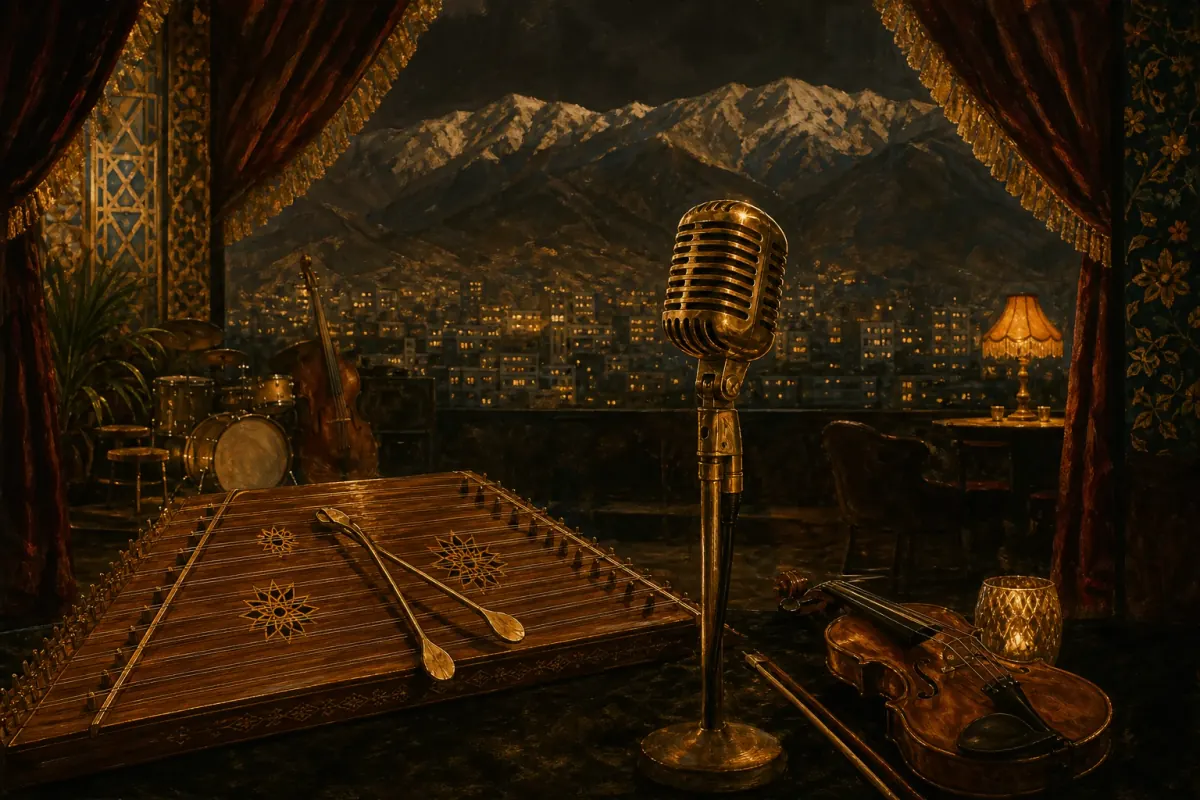
Few voices from 20th-century Iran carry as much emotional weight as Hayedeh's. A deep, powerful contralto trained in classical Persian singing, she moved easily between the refined repertoire of Radio Tehran and the pop songs of the 1970s. After the revolution she became one of the defining voices of the Iranian exile community. More than three decades after her death, her songs are still shared, searched and subtitled, including in Kurdish.
This Hayedeh biography covers her life, her best songs, how she died, and why Kurdish listeners keep coming back to her music.
Quick facts
- Birth name: Ma'soumeh Dadehbala
- Born: 10 April 1942, Tehran, Iran
- Died: 20 January 1990, San Francisco, California (heart attack, age 47)
- Buried: Westwood Village Memorial Park Cemetery, Los Angeles
- Voice: contralto
- Genre: Persian classical song (avaz), Persian pop
- Family: elder sister of the singer Mahasti
- Teacher: violinist and composer Ali Tajvidi
- Known for: Azadeh, Soghati, Gol-e Sang, Saghar-e Hasti, Rouzhaye Roshan
Early life
Hayedeh was born Ma'soumeh Dadehbala in Tehran in 1942. Her father's family name came from Dadehbala, a village near Tabriz, and according to Wikipedia her mother also sang religious mawludi songs, so music was present in the house from early on. Her younger sister, Mahasti, would also become one of the best-known Iranian singers of her generation.
Hayedeh studied avaz, the art of Persian classical singing, with Ali Tajvidi, a violinist and composer closely connected to Iranian radio. Avaz is not a matter of simply learning melodies. The singer has to learn the radif, the body of traditional melodic models organised into the Persian dastgah system, and learn to improvise within it. That training gave Hayedeh the control, breath and ornamentation that would later make even her pop songs sound weighty.
Career
Golha and the 1968 debut
Her professional career began in 1968 on Golha-ye Rangarang ("Colourful Flowers"), part of the famous Golha series of Radio Tehran programs created by Davoud Pirnia. Golha was the most prestigious showcase for Persian classical music and poetry of its time, with orchestras of tar, santur, kamancheh, ney and violin accompanying the leading singers of Iran.
Her first official hit was "Azadeh" (1968), composed by Ali Tajvidi with words by the poet Rahi Moayeri. It showed off exactly what made her special: a low, dark voice that could suddenly open into huge volume, carried by classical phrasing.
The 1970s: from radio to pop stardom
Through the 1970s Hayedeh crossed from the classical world into the booming Tehran pop industry. She worked with some of the most important composers and lyricists of the era, among them Anoushiravan Rohani, Mohammad Heydari, Fereydoun Khoshnoud, Jahanbakhsh Pazouki and Leila Kasra. Songs such as "Gol-e Sang", "Bezan Tar" and "Soghati" became hits in this period.
What set her apart from many pop singers of the time was that she never left her classical training behind. Even in orchestral pop arrangements she sang with the ornaments, long held notes and sense of modal colour she had learned in avaz.
Exile: London and Los Angeles
On 29 August 1978, months before the Iranian Revolution, Hayedeh left Iran for the United Kingdom. After the revolution, women were barred from singing solo in public in Iran, and much of the pop industry moved abroad. In 1982 she settled in the United States, in Los Angeles, which was becoming the centre of Iranian music in exile.
The songs she recorded in exile, such as "Rouzhaye Roshan" ("Bright Days") and "Bahar Bahar", speak of homesickness and a lost Iran, and they made her one of the most important voices of that community. She also joined her sister Mahasti, Moein and Bahram on the 1987 album Saghar-e Hasti, with songs composed by Jamshid Sheibani.
Illness and death
In her later years Hayedeh lived with diabetes and high blood pressure, and she had been advised against long flights. In January 1990, after performing at the Casablanca club in San Francisco, she collapsed and died of a heart attack. She was 47. She had been working on a new album at the time. She was buried on 24 January 1990 at Westwood Village Memorial Park Cemetery in Los Angeles.
Signature works
- Azadeh (1968): her debut hit, by Ali Tajvidi and Rahi Moayeri. The best way to hear the classically trained Hayedeh of the Golha years.
- Soghati (1970s): composed by Mohammad Heydari with lyrics by Ardalan Sarfaraz, and often called one of the best-known songs in Persian pop. It has been covered by later singers.
- Gol-e Sang: composed by Anoushiravan Rohani, one of her most frequently covered songs.
- Saghar-e Hasti (1987): the title song of the album shared with Mahasti, Moein and Bahram.
- Rouzhaye Roshan: a song of farewell to "bright days" that became a symbol of exile.
Hayedeh's best songs
These are the titles people search for most, based on our own search data. We have listed songs we could confirm in her discography.
- Soghati ("Souvenir") – her signature song
- Saghar-e Hasti ("Cup of Existence")
- Shab-e Meykhooneh ("Night at the Tavern")
- Azadeh ("Free")
- Gol-e Sang ("Stone Flower")
- Ey Khoda ("O God"), composed by Homayoun Khorram
- Ey Yar-e Man ("O My Beloved")
- To Ke Nisti ("Now That You're Not Here")
- Bezan Tar ("Play the Tar")
- Rouzhaye Roshan ("Bright Days")
If you are new to her, start with Soghati and Azadeh back to back. One shows the pop star, the other the classical singer, and together they show the whole range of her voice.
Legacy
Hayedeh is usually remembered as one of the greatest voices in modern Iranian music. Three things explain why her records are still so widely played.
The voice itself. True contraltos are rare in popular music anywhere. Hayedeh's low register gave sad songs a gravity that lighter voices cannot reach, and her classical training meant she could hold and shape a phrase for a long time.
The bridge between classical and pop. She is one of the clearest examples of a singer who brought the discipline of avaz into popular song. Many later Iranian singers learned from her recordings exactly this blend.
The voice of exile. For Iranians who left after 1979, her Los Angeles songs became a soundtrack of homesickness. Her early death, only 47 and at the height of her popularity in exile, made that role even stronger.
A family of voices. Hayedeh and Mahasti are often mentioned in the same breath. The two sisters had distinct voices, and Hayedeh's deep contralto is what set her apart. Listeners who search for one very often end up listening to the other, and the Sorani search data we looked at shows exactly that overlap. For many families in Iran and Kurdistan, the two sisters together are the sound of the 1970s.
Her songs also live on through other singers. Soghati and Gol-e Sang have been sung again by later Iranian artists, and her recordings keep circulating on streaming services and video platforms, where new listeners find them without ever having heard the original radio broadcasts.
The Kurdish connection
Hayedeh was not Kurdish, and we found no reliable source showing that she sang in Kurdish. Her connection to Kurdish listeners is real, though, and it can be seen in the data.
- Kurdish search behaviour. In our research for this article, Google's Sorani autocomplete for her name included searches for her songs with Kurdish subtitles (ژێرنوسی کوردی), along with Soghati, Ey Khoda, Ey Yar-e Man and her work with Moein. Sorani-speaking listeners are clearly looking for her songs with translations. The same Sorani searches appear for her sister Mahasti.
- A shared soundscape. In Iranian Kurdistan, Persian radio and records were part of daily life, and the Golha programs that launched Hayedeh also featured instruments that are central to Kurdish music: the kamancheh, the santur and the ney.
- Shared classical training. Kurdish singers from Iran such as Mazhar Khaleqi came out of the same Persian classical (radif) training that shaped Hayedeh. If you want to understand how Persian, Kurdish and Arabic modal music relate, read our comparison of Kurdish, Persian, Arabic and Turkish music and our guide to what a maqam is.
- Exile. Like many Kurdish musicians, Hayedeh built the second half of her career far from home. Our article on Kurdish diaspora music and the songs of longing and exile playlist tell the Kurdish side of a very similar story.
Where to start listening
- "Azadeh" (1968): the Golha-era debut. Listen for the classical ornaments.
- "Soghati": the song everyone knows, and the one Sorani listeners search for most.
- "Gol-e Sang": a perfect example of 1970s Tehran orchestral pop.
- "Saghar-e Hasti": the 1987 exile-era album with Mahasti and Moein.
- "Rouzhaye Roshan": her farewell to Iran, and the best way to understand why the exile community holds her so dear.
Try one Golha recording and one pop song on the same evening. The contrast shows how much of the classical singer stayed in the pop star.
Sources
- Hayedeh – Wikipedia
- هایده – Persian Wikipedia
- ترانهشناسی هایده (Hayedeh discography) – Persian Wikipedia
- Soghati – Wikipedia
- Persian Diva: The Life of Hayedeh – Tuck Magazine
If Hayedeh's voice brought you here, stay for the Kurdish side of the story: browse our free Sorani sheet music or read about the instruments of the Golha orchestra in our guide to Kurdish musical instruments.