For most of the 20th century, the most important Kurdish music wasn't being made in Kurdistan. It was being made in apartments in Stockholm, in studios in Berlin, in Sufi-influenced concerts in Paris, and on the airwaves of Yerevan Radio in Soviet Armenia.
This is the story of how the Kurdish diaspora — driven into exile by political pressure across four homelands — became the unlikely custodian of Kurdish musical tradition.
Why exile became preservation
Throughout the 20th century, Kurdish musicians in their homelands faced varying degrees of restriction:
- In Turkey, performing in Kurdish was severely restricted before 1991 and effectively banned 1980-1991
- In Iraq, the Anfal campaign (1986-89) destroyed thousands of villages and displaced millions
- In Iran, post-revolutionary restrictions limited certain styles, particularly female vocal performance
- In Syria, Kurdish-language broadcasting was prohibited; many singers faced statelessness
The result: Kurdish musicians who wanted to record in their own language often had to leave. And once they left, they kept making music — but in countries that allowed it.
The Yerevan Radio archive (1940s-1980s)
Before the European diaspora became central, Soviet Armenia's Yerevan Radio served as the unexpected sanctuary for Kurdish music.
From the 1940s through the 1980s, Yerevan Radio ran a Kurdish-language broadcast that:
- Recorded Kurmanji folk singers systematically
- Documented Yezidi religious music
- Reached audiences across the Middle East via shortwave
- Created the first major archive of Kurmanji oral tradition
The most important figure here is Karapetê Xaço — an Armenian-Kurdish singer who recorded hundreds of Kurmanji folk songs at Yerevan. His archive is the foundation for much of what we know about pre-1980 Kurmanji folk repertoire.
Without Yerevan, the dengbêj tradition would have a far smaller documentary record.
Stockholm: the Kurdish music capital of Europe
Sweden absorbed many of the early Kurdish musical exiles, particularly after the 1980 Turkish coup. Stockholm became — somewhat unexpectedly — the most important Kurdish music city in Europe.
Why Stockholm?
- Generous asylum policy in the 1980s admitted many Kurdish refugees
- Government cultural support funded immigrant cultural institutions
- Established Kurdish community by the late 1980s included publishers, schools, and venues
- Kurdish-language radio broadcasting continuously since the 1980s
By the 1990s, Stockholm hosted:
- Multiple Kurdish recording studios
- Kurdish-language Sveriges Radio Kurmanji and Sorani programming
- Annual Newroz celebrations drawing thousands
- Concert venues and Kurdish-music event circuits
Many recordings made in Stockholm in the 1980s and 1990s are now considered foundational documents of contemporary Kurdish music — including significant work by Mihemed Şêxo and Şivan Perwer (Perwer based in Germany but recording across Europe).
Berlin: the political-folk capital
Germany's Kurdish population — heavily concentrated in Berlin, NRW, and Bavaria — became the second major center for Kurdish music in exile.
Berlin specifically developed:
- Kurdish concert circuits in venues like Tempodrom and various community halls
- Recording studios producing political-folk and contemporary Kurdish material
- Kurdish cultural institutions including the Kurdistan Cultural Center
- Newroz traditions with major outdoor celebrations annually
Şivan Perwer settled in Germany after fleeing Turkey in 1976. His major albums were recorded in Berlin and surrounding studios. His concerts in Germany became, for many German-Kurdish listeners, their primary connection to Kurdish musical tradition.
The German Kurdish music scene retained an explicitly political character throughout the 1980s and 1990s — songs about exile, suppression, and Kurdish identity dominated.
Paris: the Sufi and intellectual center
Paris's Kurdish music scene had a different character — smaller, more academic, more connected to French world music and Sufi traditions.
The Institut Kurde de Paris, founded in 1983, became a major hub for:
- Kurdish music research and publication
- Concert programming bringing together diaspora and homeland artists
- Documentation of dengbêj and other oral traditions
- Cross-cultural collaborations with French jazz and world music musicians
Paris also hosted significant performances by Kurdish-Iranian musicians in exile from the post-revolutionary restrictions.
London: the academic and global-music hub
London's Kurdish community is smaller than Stockholm or Berlin but has produced disproportionate cultural output:
- SOAS Department of Music has hosted multiple Kurdish music research programs
- Tara Jaff based in London has been one of the most internationally-visible Kurdish performers, particularly for Western world-music audiences. Read her biography.
- The Kurdistan Cultural Centre London supports community programming
- BBC Persian Service and other UK broadcasters have featured Kurdish music
London's contribution has been more about international visibility than mass community programming.
The new diaspora: North America
A more recent wave of Kurdish migration — especially after 2003 in Iraq and 2011 in Syria — has built Kurdish musical communities in:
- Toronto (one of the largest Kurdish populations in North America)
- Nashville (a growing Iraqi Kurdish community)
- Berlin via the US (many secondary migrations)
- California cities (LA, San Francisco)
These communities are still building cultural infrastructure but already host annual Newroz celebrations and small concert circuits.
How diaspora music influenced the homelands
The Kurdish music made in exile didn't stay in exile. Three transmission channels:
Cassette smuggling (1980s-90s)
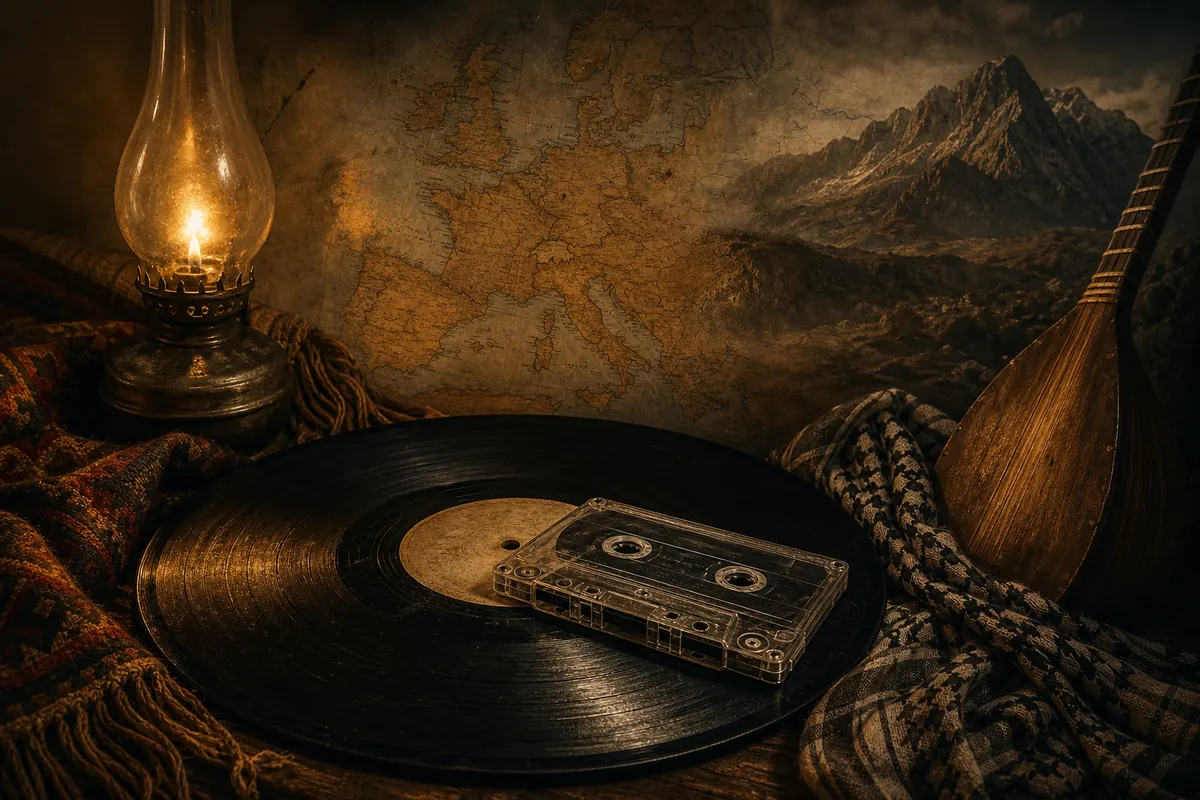
Albums recorded in Stockholm and Berlin were copied informally and smuggled into Turkey, Syria, and Iraq. Cassettes were sometimes labeled with Turkish or Arabic song titles to evade detection. Despite the risks, this was how millions of Kurds in restricted regions heard contemporary Kurdish music.
Radio (1940s-present)
Yerevan Radio broadcast Kurdish music throughout the Cold War. Later, Voice of America Kurdish, BBC Persian, and other international broadcasters carried diaspora-recorded material into Kurdish regions where local broadcasting was restricted.
The 1991 inflection point
With the no-fly zone in northern Iraq and the gradual easing of Turkish restrictions in the early 1990s, diaspora artists could begin returning home — at first temporarily, increasingly for full performances. Their music, which had developed in exile for a decade or more, merged into mainstream Kurdish music in the homelands.
By the 2000s, the distinction between "diaspora music" and "homeland music" was substantially eroded. Şivan Perwer can now perform in Diyarbakır. Aynur Doğan tours both Kurdistan and the diaspora. The two scenes have functionally merged.
What diaspora music sounds like
Common features of "diaspora-style" Kurdish music:
- Western recording quality (cleaner audio than 1970s homeland recordings)
- Mixed instrumentation combining traditional Kurdish (saz, kamancheh) with Western instruments (piano, guitar, drums)
- Politically explicit lyrics (more common than in homeland recordings, since exile artists weren't subject to censorship)
- Crossover collaborations with non-Kurdish musicians (jazz, world music, classical)
- Bilingual or multilingual albums sometimes including Turkish, German, English language tracks alongside Kurdish
This isn't a sub-genre — it's a feature of how Kurdish music developed when produced under freer conditions.
Where to find diaspora Kurdish music today
If you want to explore the diaspora Kurdish canon:
- Yerevan Radio archive recordings — many are on YouTube; sound quality varies
- Şivan Perwer's discography — most accessible introduction to political-folk diaspora style. Read his bio
- Mihemed Şêxo's albums — the more lyrical Kurmanji exile sound. Read his bio
- Aynur Doğan's albums — particularly "Keçe Kurdan" (2004) — the modern world-music wing of Kurdish diaspora music. Read her bio
- Tara Jaff's recordings — Kurdish-jazz fusion and Kurdish harp. Read her bio
Continue exploring
- 12 Famous Kurdish Singers — many of whom worked in diaspora
- How Kurdish Music Was Banned — the suppression that drove musicians into exile
- The History of Kurdish Music Notation — preservation history
- What is Dengbêj? — the tradition Yerevan Radio preserved
If you're a diaspora Kurdish musician — or if you have recordings, materials, or stories from the diaspora era — we'd love to hear from you. The diaspora archive remains incomplete, and every contribution counts.