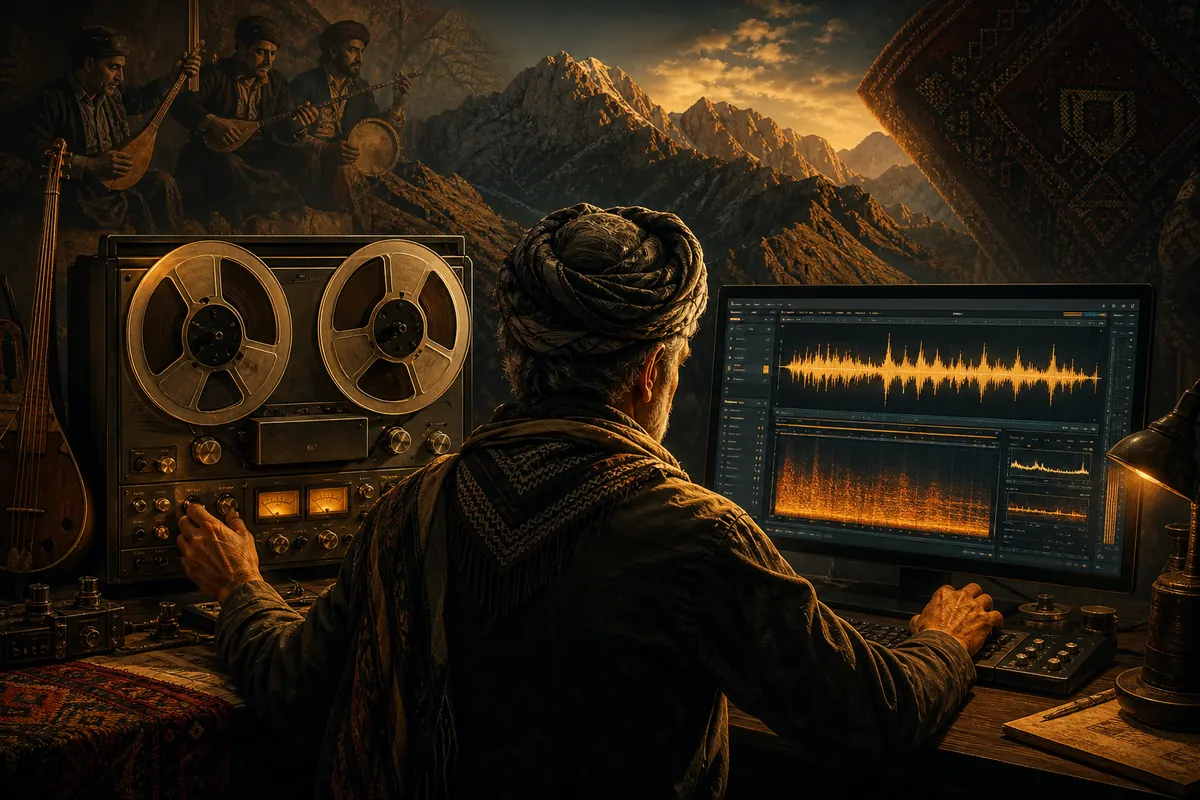
The 2020s have brought AI tools that can generate music in seconds, transcribe recordings into notation, and even clone specific voices. For an endangered musical tradition like Kurdish folk music, these tools raise both opportunities and serious questions.
This is an honest look at what AI can and can't do for Kurdish music — what we should embrace, what we should be careful with, and what we should refuse.
What AI can plausibly do for Kurdish music
1. Help transcribe recordings into notation
Many Kurdish folk recordings exist as MP3 or older audio formats with no corresponding notation. Modern AI transcription tools (AnthemScore, ScoreCloud, others) can:
- Detect approximate pitches in monophonic vocal lines
- Identify rhythmic patterns and tempo
- Generate a starting MusicXML file that human transcribers can refine
Reality check: AI transcription works better for Western pitched music than for Kurdish music with quarter-tones, free rhythm, and elaborate ornamentation. A transcriber who used to spend 8 hours per piece might now spend 4 hours — AI does the rough work, human does the precise work. That's a real productivity gain, but not a replacement.
2. Match modal scales and identify ornaments
For musicologists studying Kurdish music, AI tools can:
- Analyze pitch distributions across a recording to estimate which maqam it sits in
- Identify common ornament patterns
- Compare recordings to find melodic similarities (potentially useful for matching variants of the same song)
This is currently more research-tool than ready-for-public-use, but it's improving fast.
3. Voice processing and audio restoration
Older Kurdish recordings (Yerevan Radio archives, early Iraqi Kurdish radio) often have severe audio degradation. AI audio restoration tools can:
- Reduce noise and tape hiss
- Reconstruct clearer voice from degraded source
- Separate voice from instrumental backing for analysis
This is actively being used in archive preservation projects. It's one of the clearer wins for AI in cultural preservation.
4. Accessibility — bilingual interfaces
AI translation tools have improved Kurdish-language web accessibility significantly. Sites can now offer reasonable Kurdish-English translation, helping diaspora users access Kurdish-language resources and helping international users access Kurdish-only content.
What AI can't yet do well
1. Generate authentic Kurdish music
AI music generators (Suno, Udio, MusicGen) can produce something that sounds Kurdish-influenced when given the right prompt. But "Kurdish-influenced" and "authentically Kurdish" are very different.
What AI gets wrong:
- Quarter-tone intervals are usually missing or wrong
- Ornament styles don't match specific traditions (Sorani vs Kurmanji vs dengbêj)
- Rhythmic feels of govend dance music aren't captured precisely
- Vocal style — the specific Kurdish vocal techniques are not reliably reproduced
- Lyric content — AI generates plausible-sounding Kurdish text that often doesn't actually parse
What AI gets right:
- General modal flavor (with proper prompting)
- Approximate instrumentation (oud, kamancheh, daf names trigger reasonable instrument choices)
- Tempo and broad genre signaling
- Useful as a sketch or creative starting point
If you've used our /generate/ page or any generative music tool, you've seen this: the output is interesting and sometimes quite musical, but it's not Kurdish music in any rigorous sense.
2. Preserve oral tradition
The crucial insight: AI can preserve EXISTING recordings, but it cannot recover what was never recorded.
Most of the Kurdish musical tradition that's at risk — dengbêj epic narratives, women's lullaby traditions, Yezidi qewls, Hawrami religious music — wasn't recorded in the first place. AI can't help with material that exists only in the memory of an aging singer.
For unrecorded traditions, the only preservation tool is human field recording while practitioners are still alive. AI can help us PROCESS what we record, but we have to record it first.
3. Replace human cultural judgment
Decisions about what to preserve, how to present it, who has rights to publish it — these require human cultural understanding. AI cannot:
- Determine if specific religious music (Yarsan tanbur, Yezidi qewl) is appropriate for public release
- Navigate community consent for sensitive material
- Distinguish between commercial and ceremonial contexts
- Maintain relationships with practitioner communities
Cultural preservation is ultimately a human relationship-based activity. AI accelerates the technical work; it doesn't replace the human work.
How KurdNote uses AI
We're transparent about how we use AI:
What we use AI for
- The /generate/ page integrates Suno's API for users to experiment with AI music generation
- Translation assistance for some Kurdish-English content development (with human review)
- Sometimes audio restoration for noisy older recordings (with disclosure)
What we don't use AI for
- No AI-generated notation in the library — every PDF in /notes/ is human-prepared
- No AI-fabricated artist biographies — every page in /artists/ is hand-written
- No automated translation of sensitive cultural material — religious music topics, in particular, get human attention
- No voice cloning of Kurdish singers — we don't synthesize voices of real artists
What we're considering
- AI-assisted transcription for community-submitted recordings (where the recordings are clearly public-domain or contributor-cleared)
- AI search/recommendation to help users find related notation pieces
We'll publish updates as our AI policy evolves.
The ethical questions
Several issues genuinely require thought:
1. Voice cloning of dead Kurdish singers
Tools now exist that can clone the voice of Hassan Zirek or Ayşe Şan from existing recordings, then generate "new" Hassan Zirek songs. Should this happen?
Arguments for: Could create new content in styles that would otherwise stay dead. Could fill gaps in repertoire. Could let new singers learn by hearing what these voices "would have done" with new material.
Arguments against: Disrespects the artist's autonomy. Creates content the artist never approved. Risks fabrication of false historical record. Commodifies dead artists' identities.
Our position: voice cloning of identifiable Kurdish artists is something we would only support with explicit estate/family consent. It's not something we'll do casually.
2. AI-generated "Kurdish" music marketed as authentic
Music generators can produce content sounding vaguely Kurdish that gets uploaded to streaming platforms tagged as Kurdish folk. This pollutes the cultural record — listeners encounter machine-generated content thinking it represents the tradition.
Our position: AI-generated content should be clearly labeled. Platforms should distinguish AI material from human-performed material. If you use our /generate/ page, please don't pass off the output as authentic Kurdish folk music.
3. Training data without consent
Major AI music generators are trained on enormous datasets that probably include Kurdish music. Kurdish artists never consented to this training and aren't compensated.
This is a broader music-industry issue, not Kurdish-specific. But it disproportionately affects smaller traditions where individual artists have less leverage to negotiate.
4. Preservation vs creativity
Some argue AI generation will help preserve Kurdish music by exposing more people to Kurdish-style sounds. Others argue AI generation will dilute the tradition by mixing authentic and inauthentic in ways listeners can't distinguish.
There's no clean answer. Both effects are probably real simultaneously.
What you can do
If you care about Kurdish music preservation in the AI era:
Use AI tools, but transparently
If you generate Kurdish-influenced music, label it as AI-generated. Don't tag AI output as "traditional Kurdish folk."
Support human transcription work
Tools like KurdNote's notation library exist because humans did the transcription. AI can help — but human work still matters most.
Record elders before they're gone
The most valuable thing anyone can do for Kurdish music preservation is recording elderly tradition-bearers. AI can't recover what's never recorded.
Push for AI training transparency
If you have platform leverage, advocate for training data disclosure and artist consent in AI music generation.
Engage critically with our /generate/ page
The /generate/ page lets you experiment. Use it. But also notice what it gets wrong — that gap between AI output and authentic tradition tells you what's hard about Kurdish music, which is exactly what's worth preserving.
What's next
The AI capabilities will continue improving rapidly. By 2030 we'll probably see:
- AI transcription that handles quarter-tones and free rhythm reliably
- Voice cloning that's nearly indistinguishable from real performers
- AI-assisted music education tools for learning kamancheh, oud, etc.
- Automated cultural documentation pipelines
KurdNote's role will adapt. Our core commitment — human-prepared, community-accountable cultural preservation — won't change. But the tools we use will.
Continue exploring
- The /generate/ page — AI music studio — try it yourself
- The History of Kurdish Music Notation — preservation context
- How Kurdish Music Was Banned — what's at stake
- Browse human-prepared notation — what AI can't yet replace
Have thoughts on AI and Kurdish music? We'd be interested to hear them.