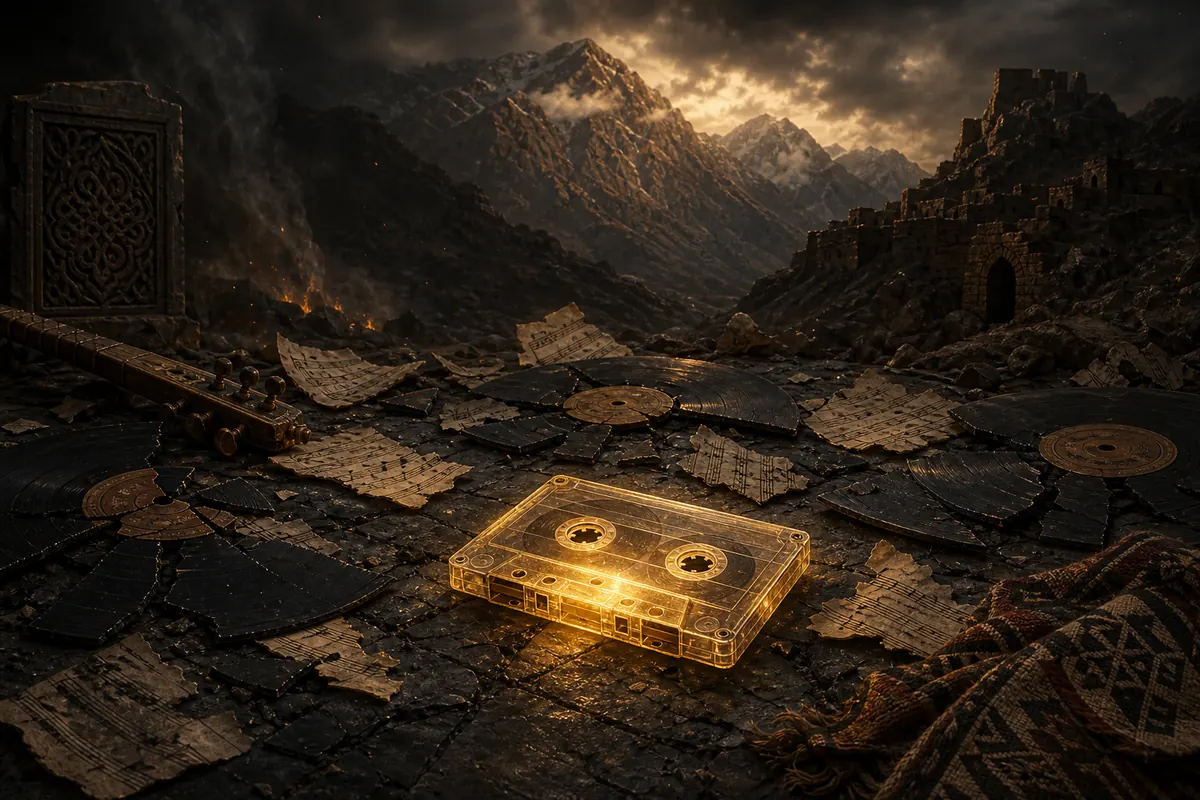
For most of the 20th century, performing in the Kurdish language could end your career — and in some places, your life. The story of Kurdish music since 1920 is the story of a tradition that survived organized state suppression across four countries, mass displacement, and decades of broadcasting bans.
This is a short history of how that suppression worked, who carried the music through it, and what was lost.
The pre-modern background
Until the early 20th century, Kurdish music coexisted with the dominant musical traditions of the Ottoman Empire and Qajar Iran. The dengbêj tradition flourished in Diyarbakır's coffeehouses. Sorani urban-folk developed in Sulaymaniyah and Mahabad. Religious music continued in Yarsan and Alevi communities.
The trouble started with the post-WWI redrawing of borders. Suddenly, Kurdish populations were divided between four new states — Turkey, Iraq, Iran, and Syria — each with its own Kurdish policy.
Turkey, 1923-1991: the most absolute suppression
The Turkish Republic was founded in 1923 with a strong nationalist ideology that did not formally recognize a Kurdish minority. Kurdish was treated as a "mountain Turkish" dialect; public expression in Kurdish was discouraged from the start.
The 1934 Surname Law
Required all citizens to adopt Turkish surnames. Many Kurdish family names disappeared from the public record.
Restrictions through the 1960s and 70s
Kurdish language could not be taught in schools. Kurdish books were difficult to publish. Kurdish names were sometimes refused at birth registration. But Kurdish music could still circulate, often in private settings.
The 1980 coup — total ban
On September 12, 1980, the Turkish military took power. Almost immediately, Kurdish-language broadcasting and publishing were criminalized outright. Cassettes of Kurdish music could be confiscated. Performing in Kurdish in public could result in arrest.
This drove an entire generation of musicians into exile.
Effects on the music
- Coffeehouses silenced. Diyarbakır's dengbêj scene effectively ended.
- Recordings smuggled. Kurdish cassettes were copied informally and passed hand to hand. Some musicians recorded under Turkish-sounding pseudonyms.
- Major artists exiled. Şivan Perwer fled to Germany. Nizamettin Ariç went to Sweden. The Stockholm and Berlin Kurdish music scenes became substitutes for what was lost at home.
Easing after 1991
Following the Gulf War and changing political conditions, restrictions eased gradually. Kurdish music returned to public spaces in the 1990s. Today it's legal but remains politically sensitive — concerts have occasionally been canceled or restricted in eastern Turkey, and Kurdish-language artists still face periodic harassment.
Iraq, 1980-1991: Anfal and cultural destruction
Iraq under Saddam Hussein took a different approach: not legal suppression of Kurdish music as such, but physical destruction of the communities that produced it.
The Anfal campaign (1986-89)
A series of military operations against Iraqi Kurdistan that destroyed an estimated 4,500+ villages and killed 50,000-100,000 Kurds, including the chemical attack on Halabja (March 1988) which killed 5,000 in a single day.
Effect on music
The Iraqi Kurdish music scene survived but lost an immeasurable amount of oral tradition. Elderly singers in destroyed villages took their repertoire with them. Much of what we know now about pre-1980s Iraqi Kurdish folk music exists only because Hassan Zirek, Mihemed Mamle, and other earlier-generation singers had already recorded extensively before the destruction.
After 1991
The 1991 no-fly zone and subsequent autonomy of Iraqi Kurdistan allowed the music scene to rebuild. Sulaymaniyah and Erbil now have flourishing music industries. KRG-funded cultural institutions have begun systematic preservation.
Iran, 1979-present: religious and gender restrictions
Pre-revolutionary Iran tolerated Kurdish music but limited Kurdish-language broadcasting. The 1979 revolution brought new restrictions:
- Female vocalists banned from public performance (a general restriction, not Kurdish-specific, but with disproportionate effect on women in Kurdish music)
- Some Kurdish styles discouraged as "non-Islamic," particularly secular love songs and certain wedding traditions
- Yarsan religious music marginalized
- Border restrictions limited movement between Iranian Kurdistan and the diaspora
Iranian Kurdish musicians like Mazhar Khaleqi and Naser Razazi navigated these restrictions through careful repertoire choices. Many spent significant time in Europe.
Today, Iranian Kurdish music continues to face ongoing restrictions, particularly around female performance. The 2022-23 Mahsa Amini protests highlighted these tensions.
Syria, 1962-present: stateless Kurds
Syria's 1962 census stripped about 120,000 Kurds of citizenship overnight. The non-recognition of Syrian Kurdish identity included Kurdish music — Kurdish-language radio was prohibited, Kurdish names could not be registered, and Kurdish singers worked under significant restrictions.
Mihemed Şêxo, born in Qamişlo in 1948, recorded primarily outside Syria for this reason — first in Damascus (Arabic-language venues), later in Sweden in exile.
The Syrian civil war (2011-present) and the rise of the Autonomous Administration of North and East Syria (Rojava) brought the first sustained period of legal Kurdish music in Syrian history — though under wartime conditions.
Soviet Armenia: the unexpected sanctuary
While Kurdish music was suppressed across most of the historical Kurdish region, one place broadcast it continuously: Soviet Armenia's Yerevan Radio.
From the 1940s through the 1980s, Yerevan Radio ran a Kurdish-language program. It became the primary archive for:
- Kurmanji folk songs that couldn't be recorded in Turkey
- Yezidi religious music (Yerevan was the cultural center of Soviet-area Yezidis)
- Diaspora connections — Kurdish radio audiences across the Middle East tuned in shortwave
The most important figure in this archive is Karapetê Xaço, an Armenian-Kurdish singer who preserved hundreds of Kurmanji folk songs in Yerevan Radio recordings. Without those recordings, the Kurmanji canon would be massively poorer.
How exile became preservation
By the late 1980s, Kurdish exiles in Stockholm, Berlin, Paris, and London had built an alternative Kurdish music infrastructure:
- Recording studios in Sweden and Germany producing Kurdish-language albums
- Kurdish radio stations in European cities
- Concert circuits in diaspora venues
- Distribution networks smuggling cassettes back to the homeland
Albums by Şivan Perwer, Nizamettin Ariç, Hozan Dilgeş, and others were recorded entirely in Europe. They became contraband in Turkey and Syria, passed hand to hand on cassettes labeled with Turkish or Arabic song titles to avoid detection.
This is how an exile generation kept the music alive while its homelands forbade it. By the time bans eased, there was a continuous tradition to return to.
What was lost
We can list what was preserved. Listing what was lost is harder.
Estimates from ethnomusicologists suggest:
- Hundreds of dengbêj lost to Anfal, the Turkish coups, and old age before recording was possible
- Dozens of regional song variants that existed only in specific villages destroyed in 1986-89
- Most of the women's repertoire outside of Ayşe Şan and a few others — women's lullaby and lament traditions were always least documented
- Most pre-1920 dialect material — the dialects of small Kurdish communities (Hawrami, Zazaki, certain regional Kurmanji variants) are particularly under-recorded
What KurdNote and similar archives can do now is preserve what survived. We can't recover what's gone.
Why this matters for SEO of Kurdish music
You're reading this on a blog about Kurdish music. The fact that this content can exist publicly — searchable, indexable, in both Kurdish and English — is itself a result of the political changes that happened in the 1990s and 2000s.
A site like KurdNote could not have legally existed in Turkey before 1991. The texts in our archive could not have been openly published in Iraq before 1991. The fact that Google can index Kurdish-language pages today is a small piece of cultural recovery from the bans.
That recovery is incomplete. There's still political pressure on Kurdish-language content in some regions. There's still self-censorship by Kurdish artists worried about touring restrictions. There's still missing repertoire from the suppressed decades.
What you can do, as a reader: listen, share, cite, link. Cultural recovery is a network effect.
Continue exploring
- The History of Kurdish Music Notation — preservation focus
- 12 Famous Kurdish Singers — many of whom worked through these bans
- What is Dengbêj? — the tradition most damaged by suppression
- Browse Kurdish notation — what survived
This article is a living document. If you have firsthand accounts, archival sources, or corrections, please contribute.