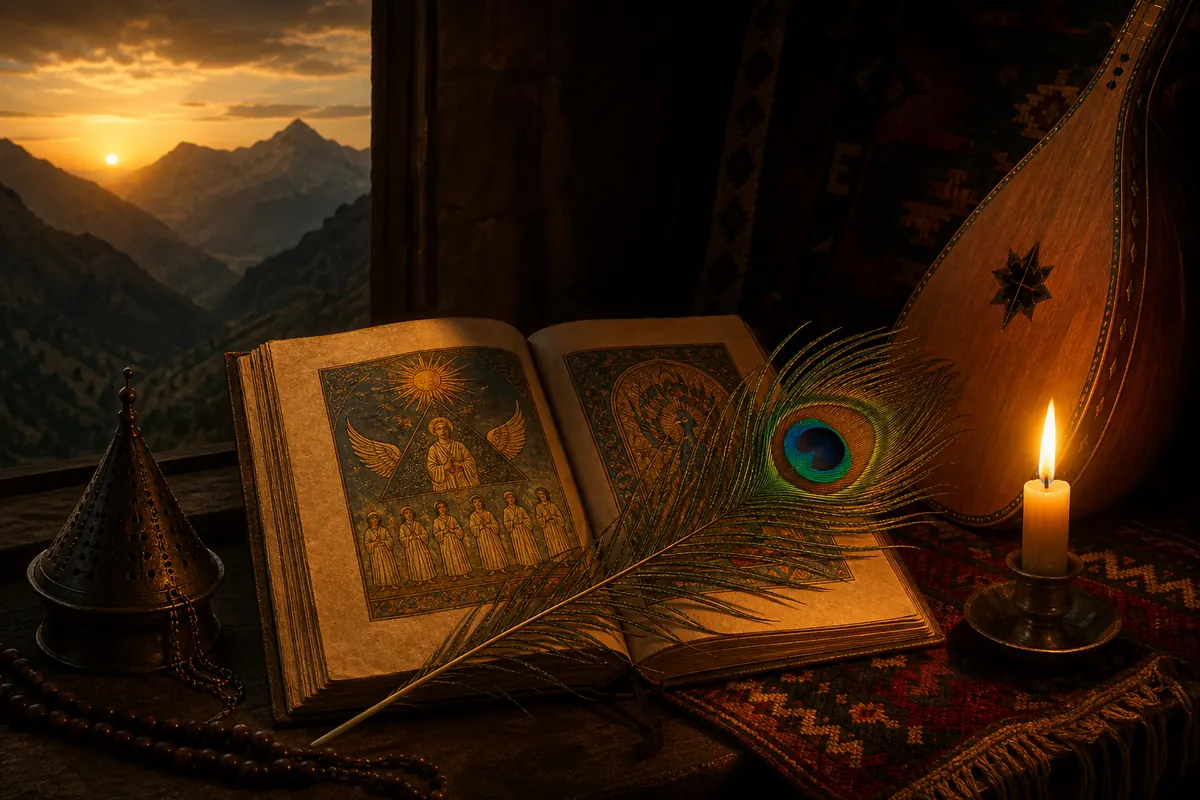
The Yezidis are one of the oldest religious communities in the world. Their faith — Yezidism (Êzîdîtî) — preserves elements of pre-Zoroastrian Iranian religion that nowhere else has survived. Their language is Kurmanji Kurdish. Their music is sacred.
In 2014, ISIS attempted to exterminate them in Sinjar. They survived, but barely. Today, Yezidi religious music exists in a state of urgent preservation effort — much of it never written down, much of it carried only by aging Qewals.
This is a guide to a tradition most people don't know exists.
Who are the Yezidis?
The Yezidis (Êzîdî or Ezdi in Kurdish self-designation) are a Kurdish religious community whose faith is distinct from Islam, Christianity, and Judaism — though the faith has historical contacts with all of those traditions and with even older Iranian religions.
Geographic concentration:
- Sinjar (Şingal) in northern Iraq — historical heartland
- Lalish — the central pilgrimage site, also in northern Iraq
- Qamişlo and surrounding areas — Syrian Kurdish Yezidi communities
- Armenia and Georgia — established Yezidi communities since the 19th century
- Germany — large Yezidi diaspora population, especially after 2014 displacement
- Smaller diaspora communities in Sweden, the US, Canada, the Netherlands
Population estimates suggest 500,000-700,000 Yezidis worldwide, with the largest communities in Iraq, Germany, and Russia.
The Yezidi religion (briefly)
Yezidism is:
- Monotheistic in core doctrine — one supreme deity
- Centered on the Peacock Angel (Tawûsî Melek) — a divine emanation, the central religious figure
- Built around seven holy figures including Sheikh Adi (12th century), who reformed and consolidated the religion
- Oral in tradition — sacred texts are largely transmitted orally rather than written
- Closed to converts — Yezidi identity is hereditary; one is born Yezidi or one is not
The religion has been violently persecuted throughout history. The 2014 Sinjar genocide is only the most recent chapter — the Yezidis estimate they have survived 74 attempted genocides across their history.
What is sacred in Yezidi music
Yezidi religious music includes several distinct categories:
Qewls (Qewl)
The most sacred category — orally transmitted religious hymns. Qewls cover:
- Cosmology (creation narratives)
- The seven holy figures and their roles
- Tawûsî Melek (the Peacock Angel)
- Sheikh Adi and the religion's founders
- Historical narratives and persecution memories
Qewls are not freely performed — they belong to specific ceremonial contexts and are traditionally performed only by Qewals (the hereditary religious-musical class).
Beyt (poetry)
Religious poetry that may or may not be sung. Some beyt are performed musically; others are recited. The genre overlaps with secular Kurdish poetic traditions.
Lalish ceremonial music
The annual pilgrimage to Lalish (the holy valley) involves specific ceremonial music — hymns, processional pieces, communal singing. This music is associated with specific rituals and locations within Lalish.
Wedding and life-cycle music
Yezidi communities also have folk music traditions for weddings, births, deaths, and seasonal celebrations. This music is more freely performed and shares roots with broader Kurmanji folk tradition.
The Qewals — the hereditary religious-musical caste
The Qewals (literally "speakers" or "singers") are unique to Yezidism. They are:
- A hereditary class — Qewal status passes from father to son
- Traditionally based in Bashik and Bahzani villages near Mosul
- Professional religious musicians — their primary work is performing qewls at religious ceremonies
- Caretakers of the qewl repertoire — their oral memory is the primary archive of Yezidi sacred music
Qewals play specific instruments:
- Daff (frame drum, similar to Kurdish daf) — central to qewl performance
- Şibab (or shibab) — a type of double-reed instrument
The Qewal tradition is severely endangered. The number of practicing Qewals has declined dramatically over the past century, and the 2014 displacement disrupted the geographic concentration that supported their tradition.
What Yezidi religious music sounds like
For listeners new to it, Yezidi sacred music has these characteristic features:
Vocal-led
The voice carries the sacred text. Instruments support but don't lead.
Modal scales
Like other Kurdish music, Yezidi sacred music uses modal scales related to broader maqam traditions, with characteristic Kurdish-Northern Mesopotamian inflections.
Free rhythm in many pieces
Like the dengbêj tradition (which is largely Kurmanji-speaking), much Yezidi religious music uses free or unmeasured rhythm.
Repetitive incantatory structure
Qewls often have repetitive melodic structures that support memorization and ritual repetition.
Daff-driven rhythmic pieces
Certain ceremonial pieces feature the daff drum prominently, providing rhythmic ground for chanted text.
The 2014 catastrophe and its musical consequences
In August 2014, ISIS attacked the Sinjar region. The result:
- Approximately 10,000 Yezidis killed in the initial weeks
- Thousands of women enslaved
- Hundreds of thousands displaced — many to Kurdish Iraqi camps, Germany, and the broader diaspora
- Sacred sites destroyed — temples, shrines, and ceremonial spaces in Sinjar
The musical-cultural consequences are severe:
- Older Qewals lost — elderly practitioners died or were displaced; some carried unrecorded repertoire
- Geographic concentration broken — the village-based context that supported Qewal training was disrupted
- Diaspora dispersion accelerated — younger Yezidis in Germany may have less access to traditional teaching
- Trauma effects — performance of sacred music has been complicated by the trauma of survival
In response, preservation efforts have accelerated. Several documentation projects are underway — by Yezidi cultural organizations, academic institutions in Germany, and international NGOs.
What's available publicly
If you want to hear Yezidi religious music:
Academic recordings
Several universities have field recordings from before 2014, particularly:
- SOAS (London) — the Yezidi religious music archive
- Various German universities — Yezidi diaspora research
- Armenian academic archives — older Yezidi material from Soviet-era recordings
Yezidi cultural organizations
Organizations including the Yezidi Cultural Council in Germany, the Yazda organization, and Lalish Cultural and Social Center have published some recordings.
YouTube
Some Yezidi cultural recordings are publicly accessible, though authenticity and context vary. Search "Yezidi qewl" or "Êzîdî muzîk" for examples.
Public Yezidi diaspora performances
Yezidi cultural events in Germany and elsewhere occasionally include public performance of religious music — though typically less restricted secular material.
How to engage respectfully
If you're a non-Yezidi interested in this tradition:
Do
- Read about Yezidi history and religion before approaching the music
- Engage with Yezidi cultural organizations as resources, not as material to extract from
- Cite Yezidi sources when writing or speaking about the tradition
- Support Yezidi-led preservation efforts (donations, academic partnerships)
Don't
- Record sacred ceremonies without explicit community permission
- Use Yezidi sacred music in commercial contexts without engagement
- Treat the tradition as "exotic" or "Yazidi" (a frequent misspelling that some find disrespectful — Yezidi or Êzîdî is preferred)
- Assume open access to material — much is appropriately restricted
Why this tradition matters
Yezidi religious music is significant for several reasons:
It preserves pre-Zoroastrian elements
Some scholars argue Yezidi religious tradition preserves elements of Iranian religion that predate Zoroastrianism — making it among the oldest continuous religious traditions on Earth.
It's a Kurmanji Kurdish tradition
Yezidi religious music is performed in Kurmanji Kurdish, making it part of the broader Kurdish musical canon. Kurdish musical heritage is incomplete without Yezidi material.
It survived deliberate erasure
The fact that any Yezidi religious music remains today is testament to extraordinary cultural resilience across centuries of persecution. Each surviving qewl represents an unbroken chain of memory.
It's actively endangered
Unlike academically interesting but stable traditions, Yezidi religious music is RIGHT NOW in a critical preservation window. Decisions made in the next decade will determine what survives.
What KurdNote can do — and can't
Our notation library doesn't currently include Yezidi religious music. The reasons:
- Sacred restrictions on public reproduction of qewl material
- Limited transcribed-and-cleared repertoire available
- Need for direct engagement with Yezidi community for any responsible publication
We're interested in evolving this responsibly. If you have:
- Academic transcriptions of Yezidi material that's appropriate for public sharing
- Yezidi community connections who'd guide responsible preservation
- Recommendations for partner organizations doing this work
Continue exploring
- What is Dengbêj? — the broader Kurmanji oral tradition Yezidi music sits within
- Sorani vs Kurmanji Music Traditions
- The Tanbur — Sacred Kurdish Lute — companion piece on Kurdish religious music (Yarsan tradition)
- How Kurdish Music Was Banned — broader cultural suppression context
Yezidi religious music belongs to the Yezidi community first. Outside engagement should support, not extract from, that community.