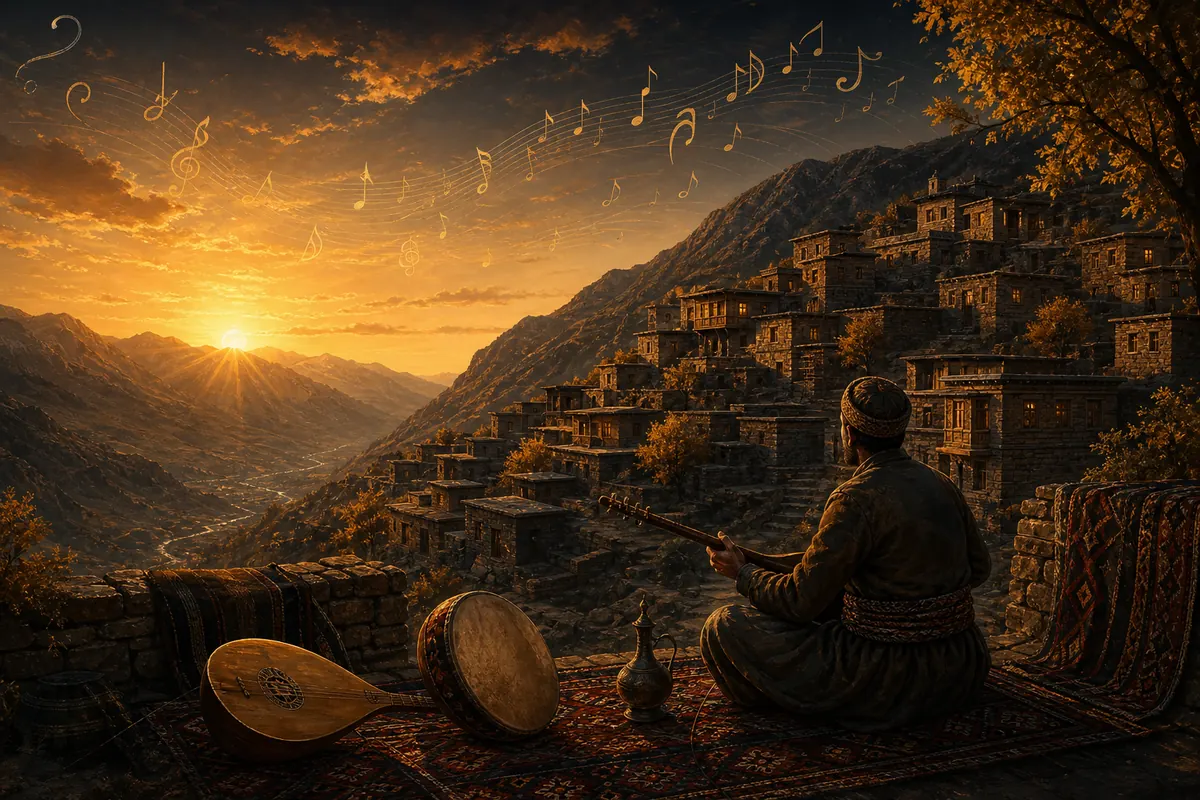
When people talk about Kurdish music, they usually mean Sorani or Kurmanji. But the Kurdish language family is bigger than two main dialects, and the smaller Kurdish dialects have their own musical traditions — distinct in form, content, and feel from what Sorani-Kurmanji listeners might expect.
This is a guide to Hawrami and Zazaki music — the two largest Kurdish minority dialects, and the music that lives within them.
The Kurdish dialect map
Kurdish isn't a single language — it's a continuum of related dialects, with substantial variation. The major divisions:
| Dialect | Speakers (est.) | Region | Script |
|---|---|---|---|
| Kurmanji (Northern) | ~20 million | Turkey, Syria, parts of Iraq/Iran | Latin (Hawar) |
| Sorani (Central) | ~10 million | Iraqi Kurdistan, Iranian Kurdistan | Arabic-derived |
| Hawrami / Gorani | ~50,000-500,000 | Iraq-Iran border (Hawraman) | Arabic-derived (when written) |
| Zazaki | ~2-4 million | Eastern Turkey | Latin |
The Hawrami and Zazaki populations are smaller but historically and culturally significant. Their music traditions deserve attention beyond academic obscurity.
Hawrami music
The dialect
Hawrami (also called Hewrami or Gorani) is spoken in the Hawraman region — a mountainous area on both sides of the Iraq-Iran border, including parts of Sulaymaniyah province (Iraq) and Kurdistan province (Iran).
Linguistically, Hawrami is more conservative than Sorani or Kurmanji — it preserves older Iranian linguistic features that the larger Kurdish dialects have lost. For linguists, it's a window into Kurdish linguistic history.
Historical importance
Hawrami had a notable literary tradition:
- The Hawrami language was used for classical Kurdish poetry from at least the 17th century
- It was the literary prestige dialect in some Kurdish regions for centuries
- Sufi religious literature was written in Hawrami
- Major Kurdish poets including Mahzuni used Hawrami
This literary status meant Hawrami music absorbed influences from broader Iranian classical tradition, Sufi music, and sophisticated poetic forms.
Musical features
Hawrami music tends toward:
- Modal sophistication — uses a wide range of maqamat including some less common in Sorani folk
- Long ornamental vocal phrases influenced by Iranian classical singing
- Mountain folk character — the landscape's isolation produced distinct local melodic styles
- Yarsan religious music overlap — many Yarsan communities are in Hawrami-speaking areas, so tanbur traditions overlap with secular Hawrami folk
Famous Hawrami performers
- Sayyid Khalil Alinejad (Iranian Hawrami) — modern preservationist
- Various Iraqi Kurdish musicians from Hawraman — work in both Sorani and Hawrami repertoire
- The Hawrami repertoire is not as commercially recorded as Sorani, so individual performer fame is more local
Where to hear it
- YouTube searches: "Hawrami music" or "Hewrami muzîk"
- Some Iranian Kurdish radio archives include Hawrami material
- Academic ethnomusicology archives at Iranian universities
- Field recordings from the Hawraman region
Zazaki music
The dialect
Zazaki (also Zaza, Dimili, or Kirmanjki depending on region) is spoken primarily in:
- Tunceli (Dersim) — Alevi-majority Zazaki area
- Bingöl — Sunni Muslim Zazaki area
- Elazığ — mixed
- Diyarbakır province (parts) — Sunni Zazaki communities
There's ongoing linguistic debate about Zazaki:
- Some scholars classify it as a Kurdish dialect
- Others classify it as a separate Iranic language closely related to Kurdish
- Many Zazaki speakers self-identify as Kurdish; some don't
For our purposes, we treat Zazaki music as part of the broader Kurdish musical canon, while acknowledging the linguistic complexity.
Historical context
Zazaki music has been shaped by several factors:
Alevi religious tradition — much of Tunceli (Dersim) is Alevi, a syncretic religion with strong musical components. Alevi cem (religious gathering) ceremonies feature singing and saz performance. This adds a religious-musical dimension to Zazaki music distinct from Sunni Kurdish areas.
The Dersim massacres (1937-38) — the Turkish state's violent repression of the Dersim Alevi-Kurdish region devastated the cultural fabric. Many Zazaki musical traditions were disrupted or lost.
Cultural suppression in Turkey — like all Kurdish dialects, Zazaki was suppressed in Turkey through the 20th century. This affected musical transmission.
Diaspora resurgence — German Zazaki communities have led significant musical revival since the 1990s, recording and performing in Zazaki.
Musical features
Zazaki music tends toward:
- Strong vocal-led tradition — like broader Kurmanji, voice is primary
- Saz-centered — bağlama (saz) is the dominant instrument
- Alevi religious-folk fusion — in Dersim repertoire, religious cem music influences secular folk
- Modal preferences — overlap with Kurmanji but with regional distinctive flavors
- Lament tradition — historical persecution produced significant lament repertoire
Famous Zazaki performers
- Aynur Doğan — born in Tunceli, draws from Zazaki/Alevi tradition (though performs across Kurdish dialects)
- Mikail Aslan — Zazaki-Alevi artist with significant international recognition
- Metin Kahraman — Tunceli-Zazaki tradition modern voice
- Kemal Kahraman — Metin's brother, also significant in Zazaki music
- Hozan Comerd — Zazaki saz tradition
Where to hear Zazaki music
- YouTube has substantial Zazaki music content — search "Zazaki muzik" or specific artist names
- German-based Zazaki labels have produced significant recordings since the 1990s
- Tunceli-region cultural events feature Zazaki music
- Mikail Aslan's albums are widely accessible internationally
Why the smaller dialects matter
For the broader Kurdish musical picture, Hawrami and Zazaki matter because:
They preserve older Kurdish musical features
Both dialects are linguistically more conservative than Sorani or Kurmanji. Their music similarly preserves features that broader Kurdish music has lost — older modal patterns, archaic vocabulary, traditional ornament styles.
They represent geographic Kurdish diversity
Kurdish identity isn't homogeneous. Hawrami music documents the highland border culture between Iraq and Iran. Zazaki music documents the eastern Turkish Kurdish-Alevi cultural zone. Without these, Kurdish music would lose significant geographic-cultural representation.
They're more endangered
Smaller speaker populations mean smaller musician pools, smaller listener audiences, and faster cultural erosion under modernization. Hawrami and Zazaki music are more urgent preservation priorities than the larger Sorani and Kurmanji canons.
They contradict simplistic Kurdish identity
Some political framings present Kurdish identity as monolithic. The reality of Hawrami, Zazaki, and other minority Kurdish dialects shows a more complex picture — Kurdish identity as a federation of related linguistic and cultural traditions, not a single uniform group.
Preservation status
Both traditions face urgent challenges:
Hawrami
- Severely under-recorded in commercial music context
- Yarsan-overlap material has religious restrictions
- Speaker population declining as younger generations shift to Sorani or Persian/Arabic
- Limited institutional support — neither Iraqi Kurdistan nor Iran has prioritized Hawrami music preservation
- Some academic archive efforts at Iranian and Iraqi universities
Zazaki
- Better documented than Hawrami, partly due to active diaspora
- Stronger commercial recording presence in Germany and Turkey
- Linguistic-political tensions (debate over Kurdish vs separate language status) sometimes complicate preservation politics
- Alevi religious-music tradition has its own preservation efforts that overlap with Zazaki music
- Generational transmission challenges as younger Zazaki diaspora may speak Turkish or German more fluently than Zazaki
What KurdNote includes — and doesn't
Our current notation library is overwhelmingly Sorani and Kurmanji. We don't yet have Hawrami or Zazaki notation in the library.
This is a gap we'd like to fill, but the gap reflects the real situation:
- Less Hawrami/Zazaki material has been transcribed historically
- Available transcriptions often have rights complications
- Native-language expertise (Hawrami, Zazaki) is essential for accurate transcription work
If you have Hawrami or Zazaki notation, recordings, or expertise to contribute, please get in touch. This is exactly the gap KurdNote aspires to address.
Continue exploring
- Sorani vs Kurmanji Music Traditions — the larger dialect picture
- The Tanbur — Sacred Kurdish Lute — Yarsan religious music (overlapping with Hawrami areas)
- Yezidi Religious Music — another Kurdish minority tradition
- Aynur Doğan biography — Zazaki/Alevi artist
The smaller Kurdish dialects deserve their own preservation effort. Help us include them.