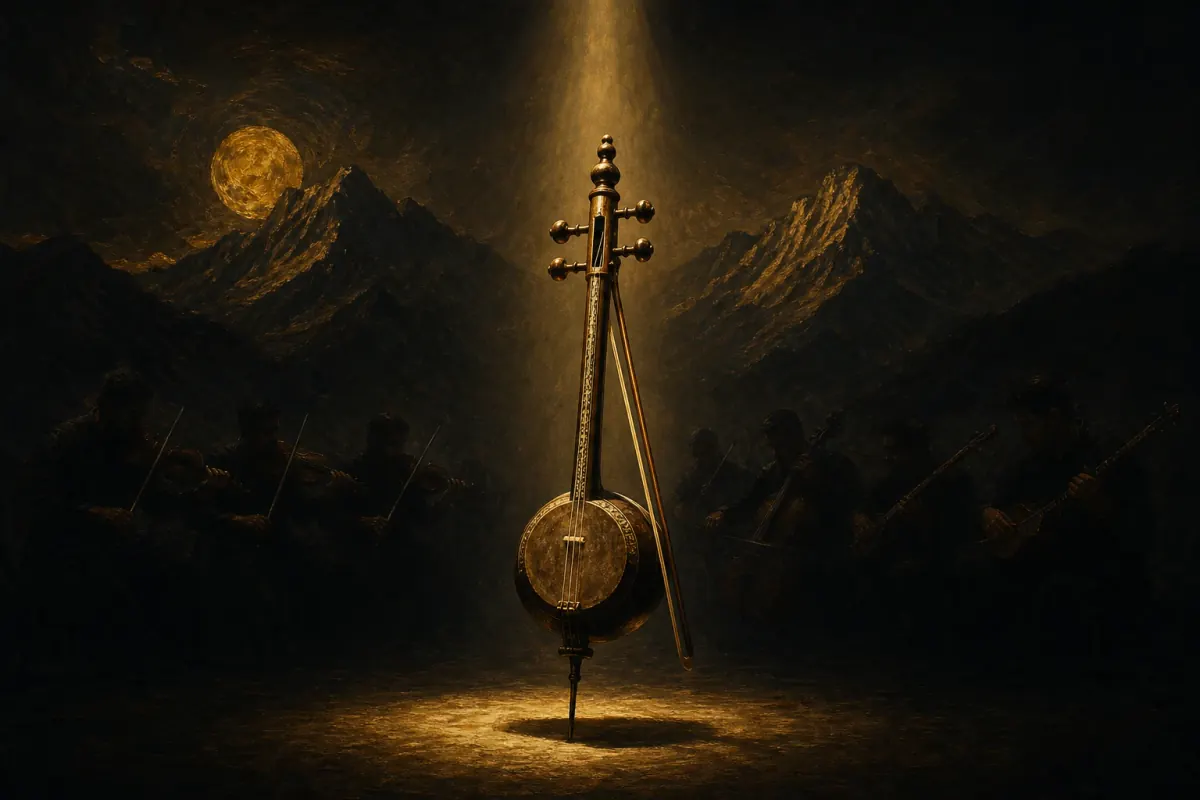
If one musician made the kamancheh known around the world, it is Kayhan Kalhor. He has played with Yo-Yo Ma, the Kronos Quartet and the great Persian singer Mohammad Reza Shajarian, won a share of a Grammy, and taken an instrument once heard mainly in Iranian and Kurdish homes to concert halls on every continent.
What's often left out in English-language profiles is that Kalhor is a Kurd from Kermanshah. This biography tells his story, from Kermanshah to the world stage, and looks at the Kurdish threads that run through his music.
Quick facts
- Born: 24 November 1963 (most sources) or 1964 (English Wikipedia)
- Origin: a Kurdish family from Kermanshah, western Iran. Most sources name Kermanshah as his birthplace, while a few give Tehran.
- Genre: Persian classical music, Kurdish music, world music, contemporary composition
- Instruments: kamancheh, setar
- Ensembles: co-founder of Dastan, Ghazal and Masters of Persian Music; member of the Silk Road Ensemble
- Known for: improvisation, cross-cultural collaborations, and making the kamancheh an international solo instrument
- Awards: Grammy with the Silk Road Ensemble (2017), Isaac Stern Human Spirit Award (2018), WOMEX Artist Award (2019)
Early life: a Kurdish prodigy
Kalhor was born into a Kurdish family from Kermanshah, the largest Kurdish city in Iran. English Wikipedia, the Silkroad organisation and Qantara all place his origins there, and the Kurdish History site describes his Kurdish identity from Kermanshah as central to his artistic sensibility.
He started studying music, and the kamancheh, at the age of seven. By thirteen he was playing with the National Orchestra of Radio and Television of Iran, according to both Wikipedia and World Music Central. He went on to play in the Shayda Ensemble of the Chavosh cultural centre, directed by the tar master Mohammad Reza Lotfi.
While learning the radif, the classical repertoire of Persian music, he also travelled through Iran's provinces, including Khorasan and Kurdistan, to learn their folk music. Qantara quotes his view that "there is no traditional Iranian music without folk music". That belief would shape everything he did later.
Leaving Iran and studying abroad
As a teenager in the years after the revolution, Kalhor left Iran. Wikipedia says he went to Italy at about seventeen, and Qantara records his studies at the Santa Cecilia Conservatory in Rome in the mid-1980s. He then studied at Carleton University in Ottawa, Canada, where he graduated in music. Both Wikipedia and World Music Central mention the Carleton degree.
This mix of Persian classical training, Kurdish and regional folk music, and Western conservatory study became the base of his style.
Career: ensembles and collaborations
Dastan, Ghazal and Masters of Persian Music
The Silkroad organisation credits Kalhor as co-founder of three ensembles:
- Dastan, a Persian classical ensemble, founded in 1991 according to Qantara.
- Ghazal: Persian and Indian Improvisations, with the sitar player Shujaat Husain Khan. The group put the kamancheh and sitar in conversation, improvising across Persian and North Indian traditions.
- Masters of Persian Music, which brought him together with the singer Mohammad Reza Shajarian and other leading figures of Persian classical music.
Yo-Yo Ma and the Silk Road Ensemble
Kalhor was an original member of Yo-Yo Ma's Silk Road Ensemble, and his compositions have been central to its repertoire. In 2017 the ensemble's album Sing Me Home won the Grammy for Best World Music Album. Wikipedia and Qantara both count this as a Grammy for Kalhor as a member of the ensemble. Silkroad notes that his own recordings have received four Grammy nominations. Wikipedia describes three nominations for Best Traditional World Music Album and further nominations with the ensemble, so the exact count depends on how the nominations are grouped.
String quartets: Kronos and Brooklyn Rider
He recorded Caravan with the Kronos Quartet in 2000. In 2008 he released Silent City with the New York string quartet Brooklyn Rider, an album that includes two of his compositions written for the group.
Erdal Erzincan: a meeting with the bağlama
Some of his most loved recordings are with the Turkish bağlama master Erdal Erzincan. The Wind, released on ECM in 2006, was their first album together, a set of instrumental pieces that flow into one another like a single long work. It was followed by Kula Kulluk Yakışır Mı, a live album recorded in Bursa and released by ECM in 2013.
The bağlama is a close relative of the Kurdish saz, so these albums are a meeting of two instruments that both live in Kurdish music. Read more about the long-necked lute on our saz instrument page.
What makes his playing distinctive
If you are hearing Kalhor for the first time, three things stand out.
Improvisation. Much of his work is built on improvisation, as in the radif tradition he trained in. A piece can start with a few slow notes and grow into a fast, intense conversation with the other players.
Long forms. Many of his albums, such as The Wind, are shaped as one long work rather than a set of short songs. They reward patient listening from start to finish.
A singing tone. He makes the kamancheh sound like a human voice, with slides and delicate ornaments that come from Kurdish and Persian folk song. You can hear the same vocal quality in the Kurdish songs on our kamancheh pages.
Awards
- 2017 Grammy Award, Best World Music Album, as a member of the Silk Road Ensemble for Sing Me Home
- 2018 Isaac Stern Human Spirit Award, from the Shanghai Isaac Stern International Violin Competition, recognising the humanitarian message of his projects
- 2019 WOMEX Artist Award, received in Tampere, Finland, for his mastery of the kamancheh and his work bringing Persian classical music to audiences around the world
Signature works
- The Wind (2006), with Erdal Erzincan
- In the Mirror of the Sky (2004), with Ali Akbar Moradi
- Silent City (2008), with Brooklyn Rider
- Kula Kulluk Yakışır Mı (2013), live with Erdal Erzincan
- Caravan (2000), with the Kronos Quartet
- Sing Me Home (2016), with the Silk Road Ensemble, Grammy winner
Best pieces to start with
Kalhor is mostly an instrumental musician, so instead of songs, search for these recordings:
- The Wind, the full album, best heard from start to finish.
- In the Mirror of the Sky, for the kamancheh with the Kurdish tanbur.
- Silent City, the title track, with Brooklyn Rider.
- Kula Kulluk Yakışır Mı, the live concert with Erzincan.
- Sing Me Home, to hear him inside the Silk Road Ensemble.
The Kurdish connection
Kalhor is usually introduced as an "Iranian musician". That is true, but incomplete. Here are the connections to Kurdish music that sources confirm.
Kermanshah roots. He comes from a Kurdish family from Kermanshah, a city with a deep musical tradition, especially in the sacred music of the Yarsan.
In the Mirror of the Sky. His 2004 album with Ali Akbar Moradi, one of the great masters of the Kurdish tanbur, explores the tanbur repertoire of the Yarsan. It is one of the most important recordings of Kurdish sacred music made for an international audience. Our article on the tanbur, the sacred Kurdish lute, explains the tradition behind it.
Folk music at the core. He has spoken of Kurdish and regional folk music as essential to Persian music, and his travels in Kurdistan as a young man shaped his improvising.
The shared instrument. The kamancheh is central to Eastern Kurdish music, from the Sanandaj ensembles to the Kamkars, whose Ardeshir Kamkar is one of the leading players of the next generation. Read their story in the Kamkars.
Legacy
Before Kalhor, the kamancheh was known mainly inside Iranian, Kurdish, Azerbaijani and Armenian music. Today it appears on concert programmes with string quartets and symphony orchestras, largely because of him. The WOMEX jury in 2019 praised his "ceaseless innovation and collaboration to create exciting new musical languages".
He has also inspired a generation of young players, many of them Kurdish, to take up the instrument. If you are one of them, our guide kamancheh or violin: what should a Kurdish beginner learn? is a good first step, and our older article on the kamancheh in Kurdish music covers the instrument in depth.
Where to start listening
- First album: The Wind. Put it on and let it play through.
- For the Kurdish side: In the Mirror of the Sky with Ali Akbar Moradi.
- For Persian classical music: his recordings with Masters of Persian Music and Mohammad Reza Shajarian.
- For the crossover: Silent City with Brooklyn Rider.
- On KurdNote: our kamancheh spotlight playlist, to hear the instrument in Kurdish songs.
Inspired to play? Visit Kalhor's artist page, download the Sorani method book Learning the Kamancheh from our library, and start with a song from our Sorani notation collection.
Sources
- Kayhan Kalhor, Wikipedia
- Kayhan Kalhor, Silkroad
- Portrait of Iranian musician Kayhan Kalhor, Qantara.de
- Artist Profiles: Kayhan Kalhor, World Music Central
- Kayhan Kalhor wins WOMEX Artist Award 2019, World Music Central
- Kayhan Kalhor: Kurdish Master of the Kamancheh, Kurdish History
- The Wind (album), Wikipedia)
- Silk Road Ensemble wins 2017 Grammy for Best World Music Album, UCI Claire Trevor School of the Arts