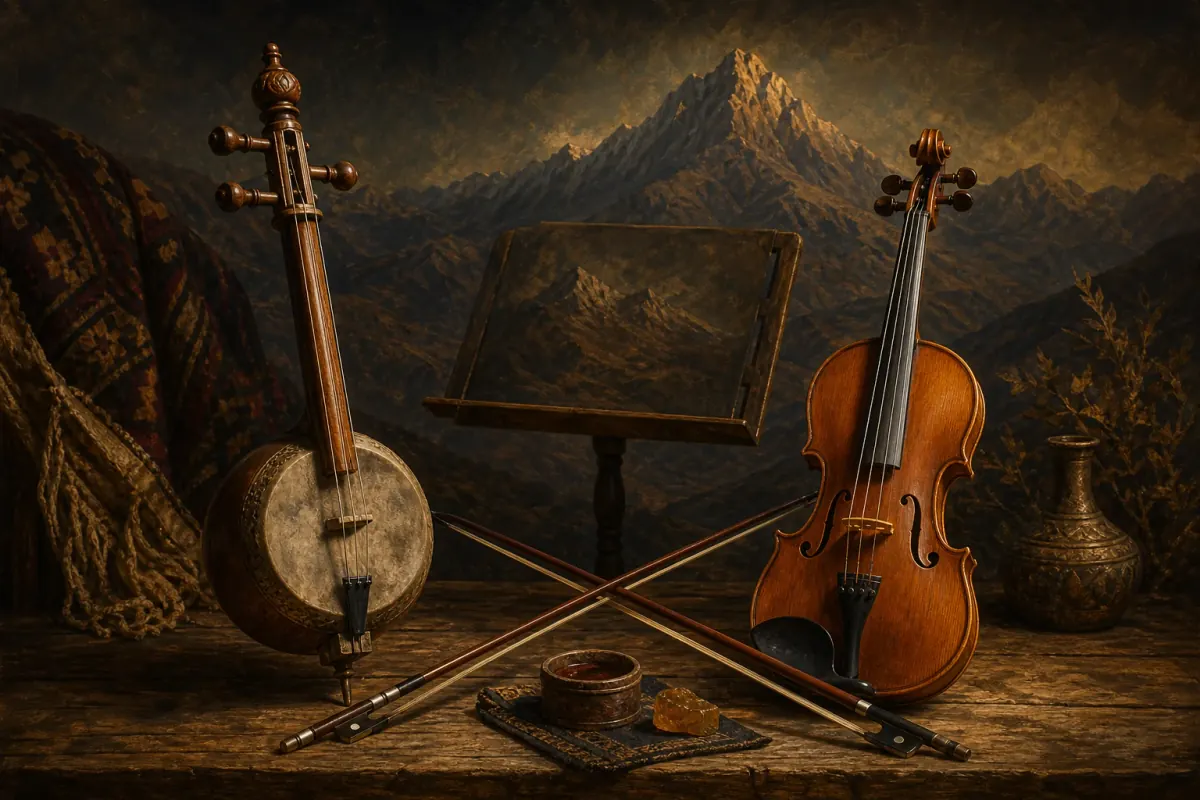
If you love the sound of Kurdish bowed-string music, you've probably asked yourself this: should I learn the kamancheh or the violin? Both are fretless, both are bowed, and both are heard all over Kurdish music, from the Sanandaj ensembles to the radio orchestras of Sulaymaniyah and Erbil.
This guide is a practical comparison. We look at how the two differ in sound, posture and cost, what learning each one feels like, and which suits which goals. Then we give you a first-month plan for either choice.
If you want the full background on the kamancheh itself, its history and famous players, read our in-depth guide to the kamancheh in Kurdish music and our kamancheh instrument page.
Quick comparison
| Kamancheh | Violin | |
|---|---|---|
| Body | Small round bowl with a skin membrane | Flat wooden body |
| Held | Upright, spike on the knee, seated | Under the chin, on the shoulder |
| Strings | Four metal strings (older ones had three silk strings) | Four strings |
| Usual tuning | G D A E, adjusted for the mode | G D A E |
| Frets | None | None |
| Changing strings | Rotate the instrument toward the bow | Move the bow across the strings |
| Sound | Nasal, vocal, intimate | Brighter, louder, more projecting |
| Teachers | Fewer, concentrated in Iranian Kurdistan and online | Almost everywhere |
How they differ
The sound
The kamancheh's body is a small bowl covered with a thin skin, traditionally lamb, goat or fish skin, according to Wikipedia. That membrane gives it a soft, nasal, very vocal sound. It shadows a singer beautifully, which is why it is so loved in slow Kurdish songs and laments.
The violin's wooden body gives a brighter, stronger tone that carries in a large hall or a loud wedding. In Kurdish music it often plays the same role as the kamancheh, answering the singer, but with more projection.
Posture and technique
This is the biggest practical difference.
A kamancheh is played seated, held upright with its spike resting on your knee or thigh. To move from one string to another, you rotate the instrument toward the bow rather than changing the angle of the bow. Wikipedia and specialist sellers such as Tapadum both describe this as the kamancheh's defining technique, and one that takes deliberate practice.
A violin is held between the chin and shoulder, and your bow arm changes angle to reach each string. It's a more familiar picture for most people, but it's also a posture that can cause neck and shoulder tension if it isn't set up well.
The bow is different too. Kamancheh players often use a bow whose hair tension they control with their fingers while playing, which gives them a very flexible tone. Violin bows have a fixed tension set by a screw.
Tuning and intonation
Here the two instruments are closer than people expect. According to Wikipedia, the modern four-string kamancheh is usually tuned like a violin: G, D, A, E. Players adjust the tuning for particular modes, but the starting point is the same.
Neither instrument has frets. This matters a lot for Kurdish music, which uses intervals that fall between the notes of a piano. Maqams such as Bayati and Rast need notes a little lower or higher than Western notes, and a fretless instrument lets you place them exactly. If this is new to you, our beginner's guide what is a maqam? explains it.
The flip side: on either instrument, playing in tune is the long-term challenge. There's no fret to catch you.
Teachers and materials
Violin teachers are everywhere: in schools, music institutes and online, in almost every language. Finding a good kamancheh teacher is harder. Iranian Kurdistan, especially Sanandaj, has the strongest teaching tradition, and many teachers now give lessons online.
For Sorani readers there is also a written method. Our library has **Learning the Kamancheh** (فێربوونی کەمانچە) by Salah Rauf, a Kurdish-language tutorial book, free to download.
Cost
A beginner kamancheh from a specialist seller usually costs a few hundred US dollars or euros. That's roughly the range of a decent student violin outfit. Very cheap instruments of either kind are a false economy: bad strings, bad setup and poor pegs make it almost impossible to play in tune, and beginners blame themselves.
Repertoire
The violin opens more doors: Kurdish music, but also Western classical, Arabic and Turkish music, film music and pop. The kamancheh is more specialised. Its home is Kurdish, Persian, Azerbaijani and wider regional classical and folk music. In 2017, UNESCO inscribed the art of crafting and playing the kamancheh on its intangible heritage list, for Iran and Azerbaijan.
Both belong in Kurdish music. Kurdish masters have played the violin for decades: the composer Qadir Dilan in Sulaymaniyah and Hassan Kamkar, father of the Kamkars, in Sanandaj were both violinists.
The kamancheh, meanwhile, is the instrument of Ardeshir Kamkar and of Kayhan Kalhor, the Kurd from Kermanshah who became its best-known player in the world. Our profile of Kalhor suggests which of his albums to hear first.
Which should you choose?
Choose the kamancheh if:
- You love the sound of Eastern Kurdish ensembles and slow, vocal songs
- You mainly want to play Kurdish and Persian music
- You have access to a teacher, in person or online
- You're happy playing seated and focusing on one tradition
Choose the violin if:
- You want the widest choice of teachers, books and instruments
- You want to play in school orchestras or Western styles as well as Kurdish music
- You plan to play standing, for example at weddings or on stage with a band
- You might switch to the kamancheh later. Your bowing and ear will transfer.
Honestly, there's no wrong answer. Many kamancheh players started on the violin, and many Kurdish violinists play with the ornaments and phrasing of kamancheh style.
Your first month on the kamancheh
- Set up the posture. Sit on a chair without arms. Rest the spike on your left knee or thigh, with the instrument upright. Your left hand holds the neck lightly.
- Learn to rotate. Without the left hand, bow the open strings one by one by turning the instrument, not the bow. Keep the bow in one plane.
- Long bows. Play slow, full-length bows on each open string. Listen for a clean, steady tone.
- First notes. Add the first finger, then the second, on the A string. Check them against a tuner or a drone.
- First melody. Pick a simple, slow song. Try Aminê Gyan or Azîzekem from our notation library, and play only the first phrase until it's in tune.
Your first month on the violin
- Set up the hold. Get a teacher or a shop to fit a shoulder rest and chin rest that suit your neck.
- Open strings. Play long bows on each string, changing strings by changing your bow arm's angle.
- Scale on one string. Learn the first few finger positions on the A string.
- Listen to the neutral notes. Once you can play a simple scale, try the neutral second of maqam Bayati, a little lower than the Western note. Record yourself and compare with a Kurdish recording.
- First Kurdish melody. Use the same songs as above. They work on both instruments because the tuning is the same.
Switching from violin to kamancheh
If you already play the violin, you have a head start, but expect a few surprises.
- Your bow arm will want to move. On the violin you change strings with the bow. On the kamancheh, keep the bow on one plane and turn the instrument. At first, practise open-string changes very slowly.
- Don't force violin habits. Sala Muzik's guide warns beginners not to impose violin technique on the kamancheh and to follow a teacher's method instead. The bow grip and the way you shape a note are different.
- Check your strings. Some players use violin strings on a kamancheh, but not every gauge suits its scale length and tuning. Ask the seller or your teacher.
- Relearn the ornaments. Slides, trills and the soft, vocal attacks of Kurdish style matter more than a big Western vibrato.
Practice tips for either instrument
- Twenty to thirty minutes a day beats one long session a week.
- Record yourself every week. Intonation problems are much easier to hear on playback.
- Play with a drone. A steady note underneath you trains your ear for Kurdish intervals.
- Listen more than you play. Our kamancheh spotlight playlist is a good daily listening routine.
- Learn to read notation so you can use written scores. Our guide on how to read Kurdish music notation covers the basics.
Final thoughts
The kamancheh and the violin are close cousins in Kurdish music. One is more intimate and specialised, the other more versatile and easier to find teachers for. Pick the one whose sound makes you want to practise, because that's the one you'll stick with.
Download Learning the Kamancheh from our library, open a song from our Sorani notation collection, and play your first phrase today.