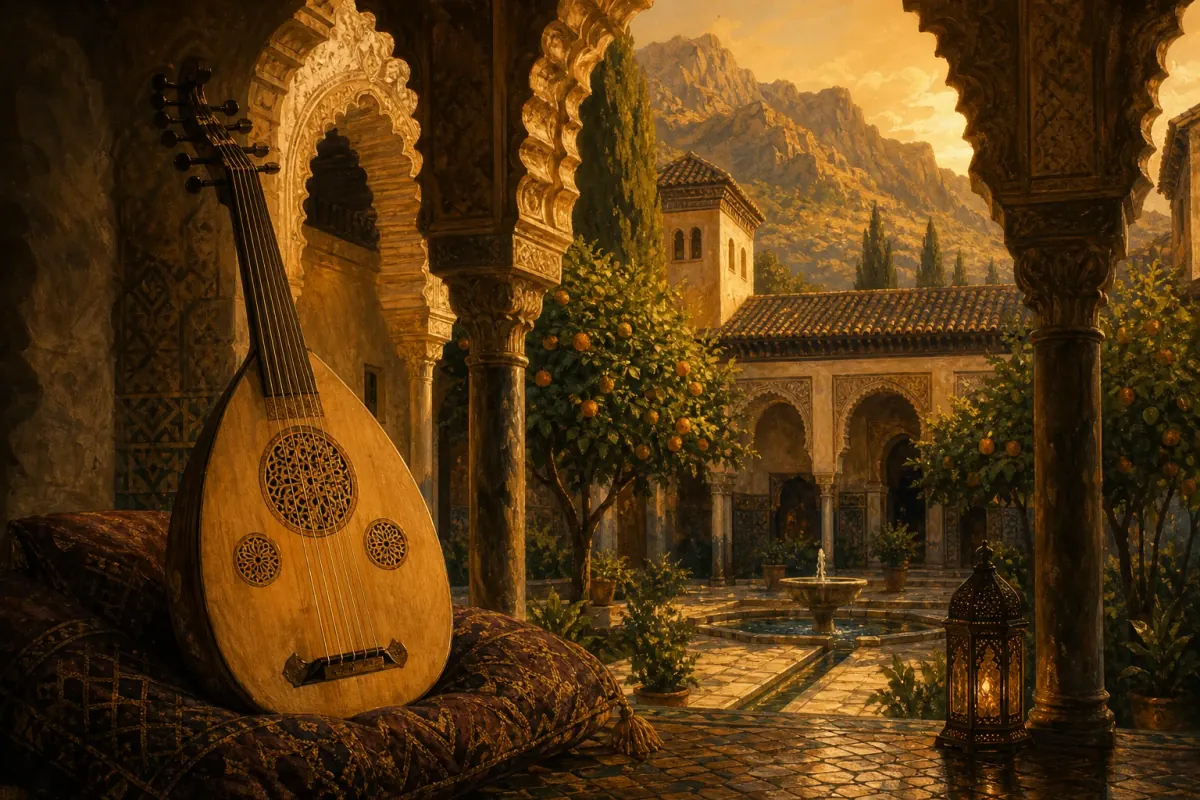
Every oud player, from Baghdad to Sulaymaniyah to Seville, eventually hears the name Ziryab. In the 9th century this singer and oud master left Baghdad, crossed North Africa and arrived in Córdoba, the capital of Muslim Spain (al-Andalus). There he became the most celebrated musician at the court of the emir Abd al-Rahman II, set up a school of music, and changed the oud itself. Later writers also credited him with changing how people dressed, cut their hair and even ate.
Ziryab is also one of the most argued-over figures in music history. Historians disagree about where he came from: Persian, Kurdish and African origins have all been proposed. This article tells his story, separates what the sources say from what grew into legend, and explains why he matters to anyone who plays the oud today.
Quick facts
- Name: Abu al-Hasan Ali ibn Nafi, known as Ziryab ("blackbird")
- Born: around 789, probably in or near Baghdad
- Died: around 857, Córdoba, al-Andalus
- Origin: disputed: Persian, Kurdish, African and mixed origins have all been proposed
- Teacher: the Mawsili school of Baghdad; most accounts name Ishaq al-Mawsili
- Patron: Abd al-Rahman II, Umayyad emir of Córdoba
- Instrument: oud
- Known for: the fifth course of oud strings, the eagle-quill plectrum, a school of music in Córdoba, and the roots of the Andalusian nuba tradition
Early life in Baghdad
Almost everything we know about Ziryab comes from Arabic historians who wrote long after him, above all Ibn Hayyan (11th century), whose work survives partly through al-Maqqari (17th century). These writers mix history with good stories, so some details should be read with care.
Ziryab was born around 789, during the golden age of Abbasid Baghdad, when the city was the musical capital of the Islamic world. His real name was Abu al-Hasan Ali ibn Nafi. "Ziryab" was a nickname, usually translated as "blackbird", and said to refer to his dark complexion and his clear, sweet voice.
He trained in the circle of the Mawsili family, the most famous musicians of Baghdad. Most accounts name Ishaq al-Mawsili, the son of the great Ibrahim al-Mawsili, as his teacher. According to one historian's reading of the early Arabic sources, the generations right after Ziryab remembered him as a freed slave of the Mawsili household.
The famous story, and the doubt
The best-known tale is told in al-Maqqari's history. Ziryab is summoned to sing before the caliph Harun al-Rashid. He refuses to play his teacher's oud and brings his own, which he says is about a third lighter and strung with silk and lion-gut strings. The caliph is delighted. Ishaq, jealous, warns his student to leave Baghdad or face his anger, and Ziryab flees west.
It is a wonderful story, but many historians treat it as legend. Other accounts suggest he left Baghdad later, after the upheaval that followed the death of the caliph al-Amin in 813. What is certain is that he went west.
Career: from Kairouan to Córdoba
Ziryab travelled through Syria and North Africa and spent time at the court of the Aghlabid ruler Ziyadat Allah in Kairouan (in today's Tunisia). He then accepted an invitation to al-Andalus. When he arrived in 822, the emir al-Hakam I who had invited him had just died, but his son Abd al-Rahman II renewed the offer.
The terms were extraordinary. The sources describe a monthly salary of 200 gold dinars, extra payments at festivals, and houses and farmland. Whether or not every figure is exact, the message is clear: Córdoba wanted to be Baghdad's rival, and Ziryab was its star.
He spent the rest of his life there, about 35 years, and died around 857, a few years after his patron.
What Ziryab changed: the oud, teaching and the nuba
The oud
Tradition credits Ziryab with two lasting changes to the oud:
- A fifth course of strings. The classical oud of Baghdad had four courses. Ziryab is said to have added a fifth, which later writers explained with the medieval theory of the four humours: the four strings matched the body's humours and the fifth stood for the soul. Some modern scholars doubt that he invented it, noting that the position claimed for his new string does not fit the old tuning well. The safest statement is that he is credited with it.
- The eagle-quill plectrum. He is said to have replaced the wooden plectrum with one cut from an eagle's quill, giving a lighter touch, more speed and less wear on the strings. Today's risha is the direct descendant of that idea.
The modern oud, the one played in Kurdish, Arab, Turkish and Persian music today, has changed a great deal since the 9th century. If you want to trace that story, the Kurdish book The Oud in the History of the East in our library covers it in detail.
A school of music
In Córdoba, Ziryab set up what is often described as a school or conservatory, where students were trained in a fixed order: rhythm and metre first, then melody, then ornament. Accounts say he tested students' voices before accepting them. His sons and daughters also became musicians and carried on his teaching.
The nuba
Ziryab is traditionally named as a founder of the Andalusian suite, the nuba (nawba), a long sequence of songs and instrumental pieces in one mode. Later tradition says there were 24 nubas, one for each hour of the day. The Andalusian music of today's Morocco, Algeria and Tunisia, such as al-Ala, gharnati and malouf, descends from this tradition, although it has changed greatly over the centuries.
Beyond music
Later historians credit Ziryab with bringing Baghdad fashions to Córdoba: seasonal clothing, new hairstyles, toothpaste, and serving food in courses rather than all at once. Some of this may be exaggerated. It shows, though, how Ziryab became a symbol of elegance and refinement for later generations.
Ziryab's legacy
No recording, and no music written down by Ziryab, survives. Nobody can play "a Ziryab song" today. What he left behind is:
- the five-course oud and the quill plectrum, as tradition tells it,
- the idea of systematic music teaching,
- the nuba tradition of North Africa,
- and the model of the oud player as a learned, refined artist.
Was Ziryab Kurdish? The debate over his origin
This is where the story matters most to Kurdish readers. Ziryab's origin is not settled, and any honest account has to say so.
- Persian: Several respected reference works describe him as Persian. Encyclopaedia Britannica labels him a Persian musician, and historians such as Joseph O'Callaghan describe him the same way.
- Kurdish: Some writers, including John Gill in Andalucía: A Cultural History, describe him as Kurdish.
- African: Other scholars point to his nickname and to early Arabic sources that describe him as a Black freed slave. These historians argue for an African or mixed Arab-African origin.
- Other proposals include Sindhi origin.
The early sources simply do not give his family background clearly, and later writers filled the gap with their own assumptions. We think the best position is the plain one: Ziryab's origin is disputed. The Kurdish claim is one serious possibility among several, not an established fact. We make the same point in our short history of Kurdish music.
Ziryab and Kurdish music
Whatever his ancestry, Ziryab's instrument is at the heart of Kurdish music today. The oud is played in Sorani ensembles, accompanies singers, and is taught in the music institutes of Sulaymaniyah and Erbil. Singers such as Adnan Karim compose at the oud and keep it at the centre of their arrangements, much as Ziryab is said to have done in Córdoba. Our article on the oud in Kurdish music explains its role and its Kurdish players.
The modal thinking behind the nuba is also shared. Kurdish, Arab, Persian and Turkish musicians all build music on modes (maqams), and several of them, like maqam Kurd and maqam Hijaz, are played on the oud across the whole region. If the word maqam is new to you, start with our guide, what is a maqam?.
For Kurdish students who want to follow in Ziryab's footsteps, KurdNote hosts two Kurdish-language oud primers: Basics of Learning the Oud, Level 1 and Level 2.
Where to start listening
Since no music by Ziryab survives, listen to the traditions and tributes connected to him:
- **Andalusian nuba from Morocco (al-Ala).** The closest living descendant of the tradition he is said to have founded.
- **Algerian gharnati and Tunisian malouf.** Two other branches of the same family.
- **Paco de Lucía, Zyryab (1990).** The flamenco guitarist named this album after him. It is a tribute, not a reconstruction, but a beautiful bridge between Spain and the oud world.
- Iraqi solo oud by masters such as Munir Bashir, to hear the Baghdad instrument Ziryab carried west.
Sources
- Ziryab – Wikipedia
- Ziryāb – Encyclopaedia Britannica
- Flight of the Blackbird – AramcoWorld (2003)
- Ziryab – Muslim Heritage
- Zyryab by Paco de Lucía – AllMusic
Ziryab's instrument is waiting for you. Visit our oud page, download the oud primer, and try your first Kurdish melodies from our free sheet music.