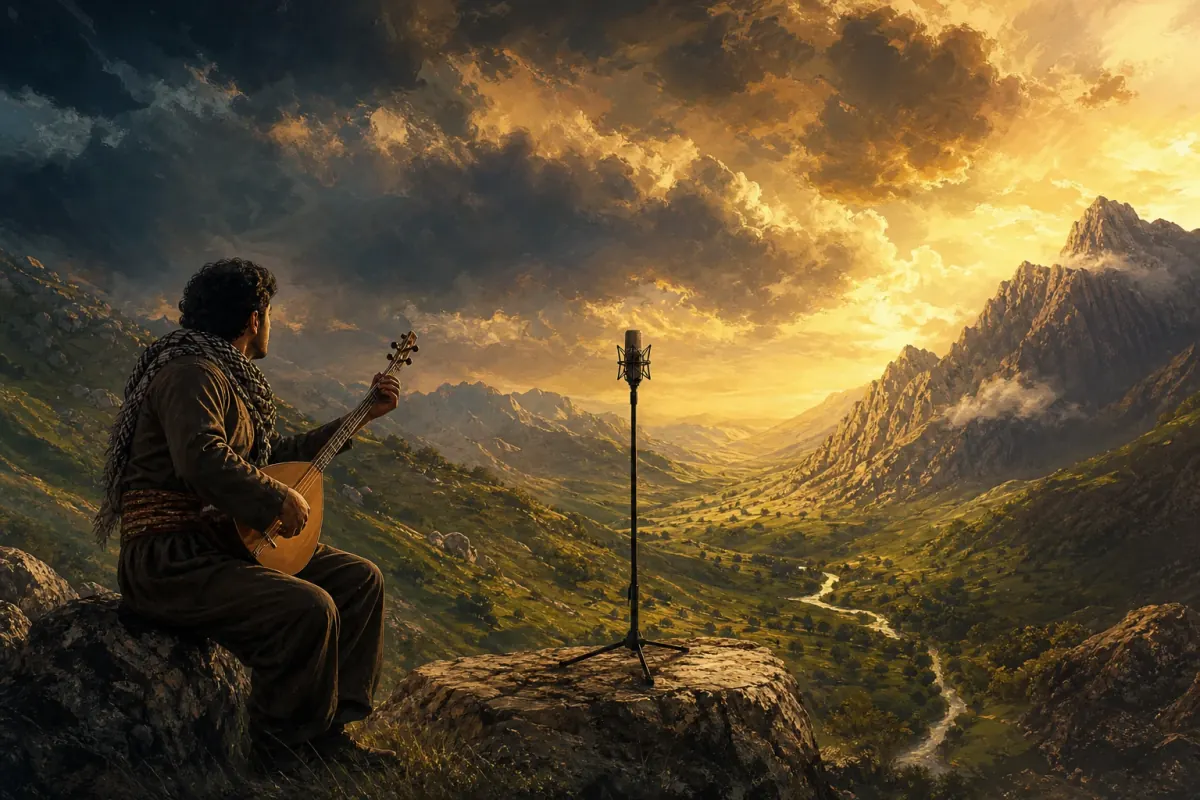
Few Kurdish singers have had a life as unusual as Homer Dizayee's. He grew up in a village on the Erbil plain, recorded his first song in Baghdad, and then spent more than half a century abroad: as a student and musician in Vienna, as a broadcaster for Voice of America, and later as an adviser to an Iraqi president. Along the way he wrote songs that sounded like nothing else in Sorani music. They were frank about love and desire and open about their debts to Western melody. Yet almost nothing has been written about him in English. This article covers his life, his style, his best songs and where to start listening.
Quick facts
- Name: Homer Dizayee (Sorani: هۆمەر دزەیی); birth name Omar Osman Dizayee (عومەر عوسمان دزەیی)
- Origin: Village of Dugirdakan, Erbil plain, Kurdistan Region of Iraq
- Born: Birth year uncertain (see below)
- Lived in: Vienna and the United States for more than 50 years
- Genre: Sorani song with strong Western influences
- Also: Broadcaster, author, political adviser
- Known for: Xwaye Ebê Êsta, Dwênê Şew, Çendî Gerram le Şaran, Baxçey Paşa, Qijkalî Lêw Alî
A note on his birth year
Wikidata, Sorani Wikipedia and Persian Wikipedia all give 1936, and many Kurdish news sites have copied it. When we traced the claim, the Persian article cites only the Sorani one, and the Sorani article gives no source for the year. We found no independent record, such as an interview or official biography, that confirms it, and the KurdNote team has reason to doubt it. So we leave his exact age out. The safe statement is that he was active as a singer by the mid-1950s. As far as we know he is living: he was still publishing opinion pieces in Rudaw in 2023.
Early life: from the Erbil plain to Baghdad
His surname is that of the Dizayee tribe of the Erbil plain. Voice of America's Kurdish service, in a 2016 profile, notes that he spent his childhood and part of his youth in the village of Dugirdakan (دووگردکان). According to Sorani Wikipedia, he started school in Erbil and then continued his studies in Kirkuk and Baghdad.
His family did not welcome his love of singing, and Sorani Wikipedia says they put obstacles in his way. He kept going anyway, and recorded his first song in Baghdad in 1955.
That detail says a lot about the era. In the 1950s, Baghdad was the centre of Kurdish broadcasting and recording in Iraq. The Kurdish section of Baghdad Radio was where most Sorani singers of the period were first heard, and a young singer from the Erbil plain had very few other ways to reach an audience. Recording in the capital put him in the same world as the established radio voices of the day, even though his own path would soon lead far away from it.
Career
Ankara, then Vienna
In 1956 he went to Ankara to study but did not finish. After about a year he moved to Vienna. That move shaped everything that followed. In Vienna he met musicians and singers from outside Kurdistan, heard European music up close, and earned a degree in political science. He would spend most of the next five decades outside Kurdistan.
The 1960s songs
In 1966, according to Sorani Wikipedia, he released two of his best-known songs as filmed clips: Baxçey Paşa ("The Pasha's Garden") and Qijkalî Lêw Alî ("Fair-Haired, Red-Lipped"). Both are still widely played. VOA's profile points out that some of his songs are more than forty years old and still sound contemporary. That is a fair description of these two.
Voice of America
According to Sorani Wikipedia, in 1988 he moved to the United States and worked for the Kurdish service of Voice of America, the US government broadcaster whose Kurdish programmes reached listeners across the region. Persian Wikipedia goes further and credits him with founding and leading the service, but that claim is marked as unsourced there, so we note it only as a claim.
Politics
In 2006 he became an adviser to the President of Iraq, Jalal Talabani. Several Kurdish outlets repeat this, and it is the reason Sorani sources often describe him as both a singer and a politician. He has also written opinion pieces for Rudaw on Kurdish and Iraqi politics.
Author
In 2015 the Endêşe foundation in Sulaymaniyah published his book Çîrokî Muzîkî Klasîk ("The Story of Classical Music"), a Kurdish-language introduction to Western classical music. VOA singled out his writing on music history and theory as a major part of his work. If that interests you, our own library has several Kurdish books on world music history, such as A Short History of World Music and Famous Names of World Music.
His style: daring words, borrowed melodies
Two things set Homer Dizayee apart from almost every Sorani singer of his generation.
The lyrics. His songs describe love and the body far more openly than traditional Kurdish song does. The Sorani writer Twana Hama, in an essay for Xelk.org, argued that this makes him a pioneer of sensual, even erotic, imagery in Kurdish song. Others have criticised him for it. In 2020 Zamen Press ran a video in which he answered those critics. VOA's profile called him perhaps the most liberal of Kurdish musicians, and noted that he revives old Kurdish words and coins new word combinations to keep the language in step with the modern world.
The melodies. Many of his tunes are adapted from Western or other foreign songs, and he has been open about this. In interviews he has named the sources of his melodies. In a tradition where originality is often assumed, that frankness is unusual. It also explains why his songs can sound so different from the maqam-based music of his contemporaries.
His voice sits somewhere between a crooner and a traditional Kurdish singer: warm, expressive and conversational rather than ornamental. VOA describes it as a voice full of feeling.
Best songs
These are the titles Sorani listeners type most often next to his name, plus the two 1960s classics:
- Xwaye Ebê Êsta (خوایە ئەبێ ئێستا): a reflective song of longing and memory.
- Dwênê Şew (دوێنێ شەو), "Last Night": broadcast by Kurdsat and one of his most shared songs.
- Çendî Gerram le Şaran (چەندی گەڕام لە شاران), "How Long I Searched the Cities".
- Narîn (نارین): one of the most searched titles with his name.
- Xozge (خۆزگە), "If Only".
- Baxçey Paşa (باخچەی پاشا), "The Pasha's Garden": a 1966 classic.
- Qijkalî Lêw Alî (قژکاڵی لێو ئاڵی): also from 1966.
- Xewn le Xewda (خەون لە خەودا), "A Dream in Sleep".
- Kurdistan (کوردستان): his song for the homeland, frequently searched.
The one album Sorani Wikipedia lists for him is Gella Weriwekan (گەڵا وەریوەکان, "The Fallen Leaves").
KurdNote doesn't yet have notation for these songs. For Sorani melodies you can play today, browse our Sorani sheet music. His songs of distance and memory sit well beside our longing and exile playlist.
Legacy
Homer Dizayee's influence is harder to measure than a singer with a large catalogue, but it is real.
- He widened what a Kurdish love song could say. Later Kurdish pop has become far franker, and he was one of the first to go there.
- He was a bridge to Western music. Through his adaptations, his years in Vienna and his book on classical music, he brought European musical ideas into Kurdish culture at a time when few others could.
- He shows the diaspora's long reach. Like many Kurdish artists, he did most of his work far from home, and his songs still reached home. Our article on Kurdish diaspora music follows that wider story.
He is also part of a strong Erbil tradition of singers. For a very different Erbil voice from a later generation, read our biography of Zakaria Abdulla.
Homer Dizayee and his generation of Kurdish singers
Homer Dizayee's career runs in parallel with the great Iraqi-Kurdish radio singers such as Tahir Tofiq and Ali Mardan, who were building the Sorani repertoire in Baghdad in the same years he was recording there. Our overview of famous Kurdish singers introduces that generation. And if his love of European classical music makes you curious, our biographies of Chopin and Beethoven are a good next step.
Listening guide: where to start
- First listen: Xwaye Ebê Êsta, then Dwênê Şew.
- The classics: Baxçey Paşa and Qijkalî Lêw Alî from 1966.
- An album: Gella Weriwekan (The Fallen Leaves).
- To hear him speak: VOA Kurdish's 2016 "Life in Culture" interview, about 26 minutes long, is the best spoken introduction to his thinking about music.
Sources
- ھۆمەر دزەیی, Sorani Wikipedia
- ژیان لە فەرهەنگدا: هۆمەر دزەیی, Voice of America Kurdish (2016)
- چەند کورتە سەرنجێک لەسەر ئاواتە مەخمەلییەکانی ھۆمەر دزەیی, Xelk.org (archived)
- ھۆمەر دزەیی وەڵامی ئەو ڕەخنانە دەداتەوە, Zamen Press (archived)
- ھۆمەر دزەیی لە ئەندێشە کتێبە نوێکەی خۆی بڵاوکردەوە, Sulyon (archived)
- هۆمەر دزەیی, Rudaw author page
Curious about the classical music Homer Dizayee loved? Download A Short History of World Music for free, visit Homer Dizayee's artist page, or play Kurdish melodies from our Sorani notation library.